



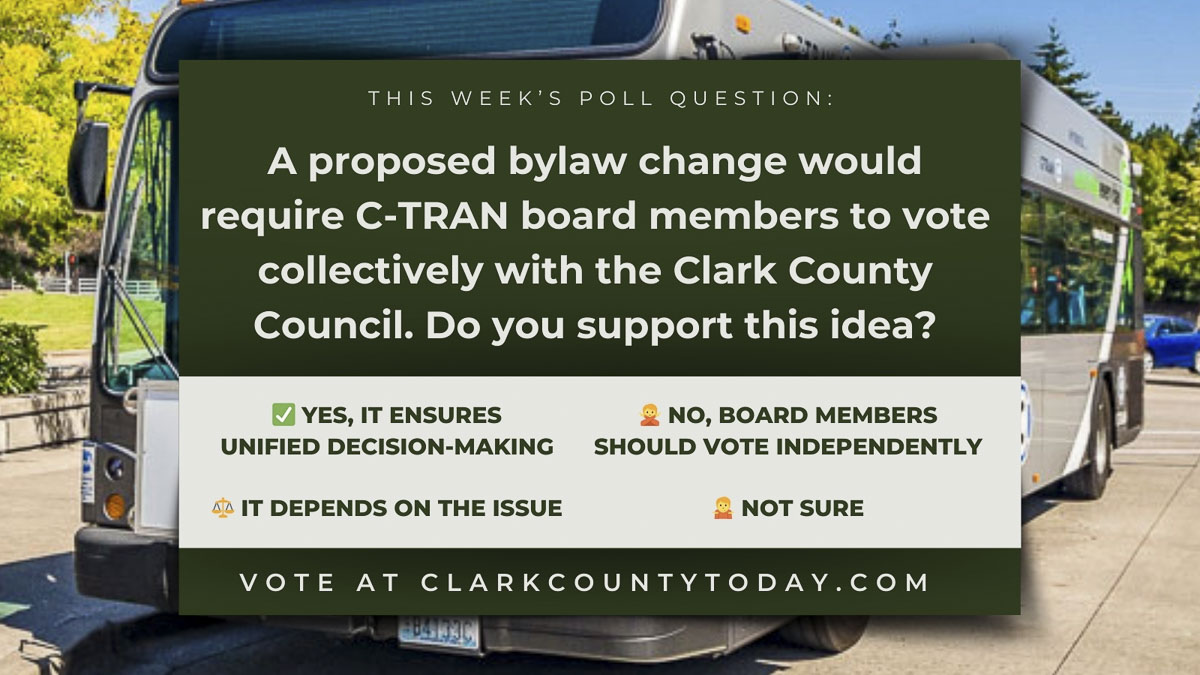
This week’s poll dives into a major debate surrounding the C-TRAN Board of Directors. Clark County Council recently removed Michelle Belkot from the board after she refused to align with the council’s stance on light rail funding. Now, a proposed bylaw change could require board members to vote collectively with the council, potentially limiting independent decision-making. Supporters argue that a unified vote ensures consistency and accountability, while critics say it strips board members of the ability to represent their constituents. What do you think? Should C-TRAN board members be required to vote as a bloc, or should they maintain their independence? Cast your vote and let us know your thoughts!
More info:
Michelle Belkot speaks out after Clark County Council kicks her off C-TRAN board

Clark County Council removed Michelle Belkot from the C-TRAN Board of Directors after she opposed funding light rail operations and maintenance.
Read more

Also read:
- POLL: With updated estimates reaching as high as $17.7 billion, what should happen to the I-5 Bridge replacement project?
 A new poll asks readers how the I-5 Bridge replacement project should proceed amid higher cost estimates and questions about transparency within the Interstate Bridge Replacement Program.
 - Letter: ‘Walz’s tough talk is a blatant attempt to deflect his complicity in the massive fraud in his state’
 Camas resident Anna Miller argues that a governor has no legal authority to deploy the National Guard to interfere with federal law enforcement and criticizes Minnesota Gov. Tim Walz’s public statements.
 - Opinion: Not a Good choice
 Lars Larson argues that personal choices led to a deadly confrontation with law enforcement during an ICE operation in Minneapolis.
 - Opinion: ‘The IBR team has been lying to us and thanks to a veteran Oregon journalist, we have the smoking gun’
 Ken Vance argues newly obtained documents show Interstate Bridge Replacement staff withheld updated cost estimates from lawmakers and the public.
 - Opinion: State CO2 report shows 86% of Washington’s claimed climate benefits are probably fake
 Todd Myers argues a state climate report significantly overstates emissions reductions and raises concerns about data accuracy and accountability in Washington’s climate spending.
 wpDiscuz
