



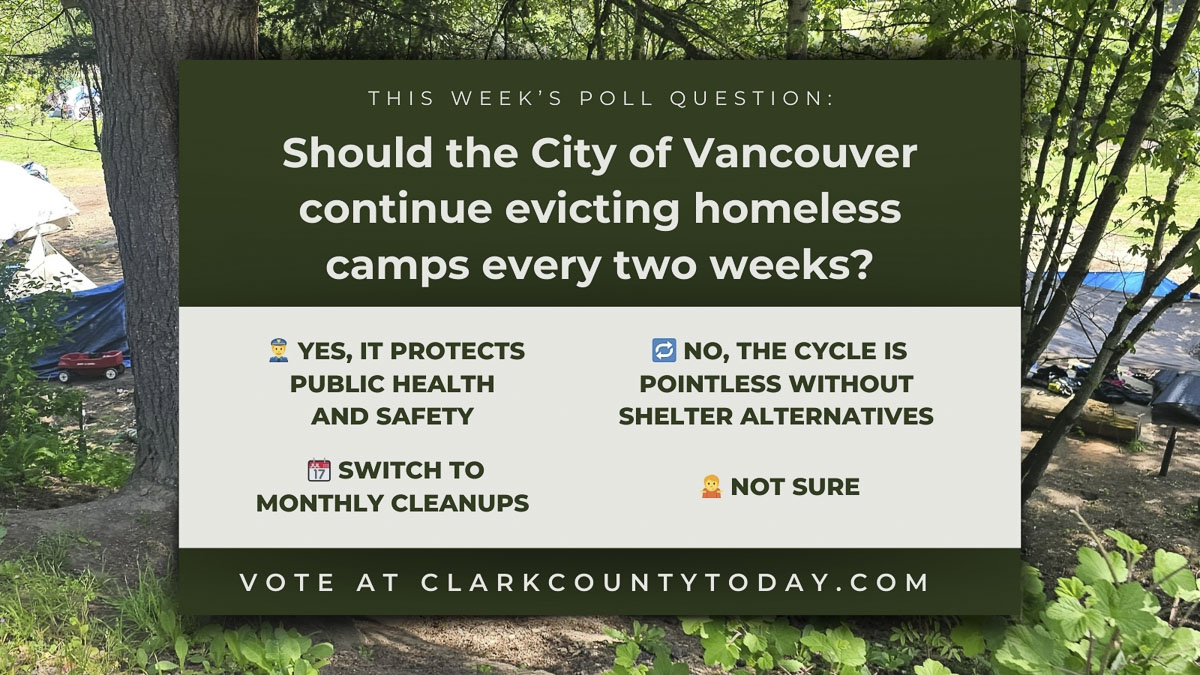
For years, the City of Vancouver has followed a routine of clearing homeless camps along the Burnt Bridge Creek Trail every two weeks, only to see them reappear just across NE Andresen Road. Officials say the repeated cleanups are essential for health and safety, citing biohazards and fire risks, while also distributing expectations for where camping can and cannot occur. But with limited shelter space and few legal places to go, many campers simply rotate between the same two sites. Critics argue the practice is ineffective without long-term housing solutions, and even some campers say the constant disruption makes life harder. This week’s Clark County Today poll asks: Should the city continue these biweekly evictions?
Read more:
A cycle of uncertainty: Homeless camps moved every two weeks from one side of the road to the other

Homeless camps along NE Andresen Road in Vancouver are being cleared by the city every two weeks, with residents simply moving from one side of Burnt Bridge Creek Trail t...
Read more

Also read:
- Opinion: The legislature has committed $2.4 billion to recurring pension increases since 2018
 Six legislative COLAs have raised public employer costs by $2.38 billion since 2018, driving up unfunded pension liabilities and increasing burdens on county and city budgets.
 - Opinion: ‘Just because they got away with it doesn’t mean they weren’t wrong’
 A Skamania County deputy’s report found violations of county rules and the Open Public Meetings Act, but no prosecutor acted on the findings.
 - Opinion: Small things grow great by concord
 Washington’s initiative process gives citizens direct power to challenge lawmakers. Failed restrictions and new measures on girls’ sports, parental rights, and citizenship prove the influence of grassroots action.
 - Opinion: California’s $20 fast food minimum wage creates less jobs and lower income
 Study data show California fast food workers now face fewer shifts, higher menu prices, and widespread automation after the $20 wage hike.
 - Opinion: State is rightly emphasizing experience and skills, not degrees
 Elizabeth New explains how a new state policy removes unnecessary advanced degree requirements, supporting skills-based employment and broadening opportunities for capable workers.
 wpDiscuz
