



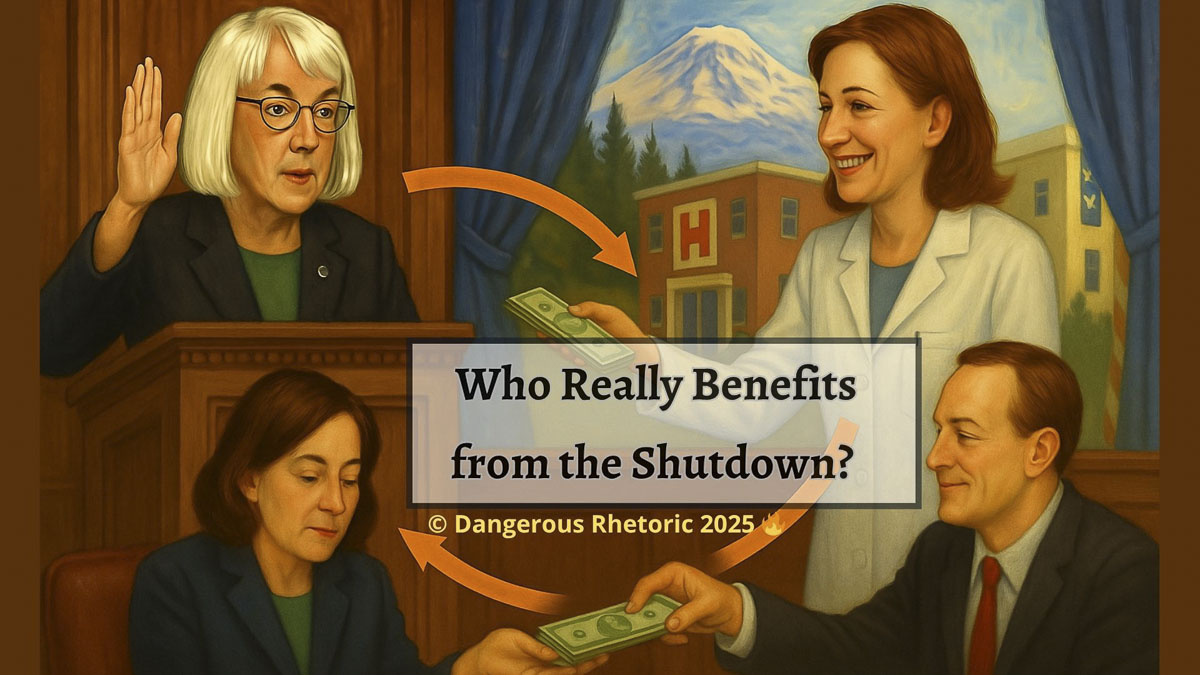
Nancy Churchill continues her ongoing series on incentives in public life
Nancy Churchill
Dangerous Rhetoric
This column continues our ongoing series on incentives in public life. In part one, we looked at how fear is used to influence public perception and behavior. In part two, we examined how political actors frame electoral outcomes to claim or deny legitimacy.

Today, we turn to a different kind of incentive — one measured not in emotion or status, but in cold, hard cash. Specifically, we look at the incentive structures built into the federal health care system and how they are driving the recent government shutdown.
Follow the money
When most Americans hear “government shutdown,” they picture dysfunction: lawmakers locked in partisan gridlock or bickering over federal spending priorities. But the current shutdown isn’t primarily about ideology or compassion. It’s about cash. Billions of taxpayer dollars flow through the Affordable Care Act and end up in the pockets of massive insurance companies.
Since its inception, the ACA has operated not just as a health care program, but as a subsidy pipeline. Federal payments go straight to insurance companies, not to patients. According to recent reporting, the amount is staggering: up to $40 billion annually in taxpayer-funded subsidies to insurers and hospitals, many of whom use these funds to pad profits and insulate themselves from real market competition.
In a telling breakdown, a viral analysis described the ACA as a “cash machine,” where subsidies are captured in the form of higher premiums and profits by insurance corporations. This isn’t about helping families afford health care. It’s about keeping the insurance industry flush with government money.
Shutdown as leverage
So why would Democrats risk a full-blown shutdown of the federal government over this issue? Because those subsidies are scheduled to expire. And Democrats, led by Senator Chuck Schumer, are refusing to pass a clean funding bill unless the ACA subsidies are extended for another year.
Rep. Dan Newhouse of Washington made it clear this isn’t about protecting working families, it’s about preserving entrenched interests. As he put it, “This is not about good governance. This is about politics.”
The shutdown is being used as a bargaining chip to force continued funding for a system that prioritizes corporate profits over public health. In communities across the country the fallout is real: farmers unable to access operating loans, veterans facing service delays and military families preparing for missed paychecks. And yet, the response from Senate Democrats is a demand for more ACA subsidies.
Insurance profits, political payouts
It’s no secret where these subsidies eventually end up. As President Trump recently pointed out, “NO MORE MONEY, HUNDREDS OF BILLIONS OF DOLLARS, TO THE DEMOCRAT SUPPORTED INSURANCE COMPANIES FOR REALLY BAD OBAMACARE.” Trump’s call is clear: the money should go directly to the people, not to bloated bureaucracies and politically connected insurers.
The ACA isn’t just bad health policy! It’s also a political funding mechanism!
A new analysis found 68% of health insurance company political donations go to Democrats. These corporations are making investments. When subsidies roll in, profits rise. And when profits rise, campaign donations follow. In that cycle, it’s easy to see why Democrats like Schumer are willing to hold the government hostage to keep that stream flowing another year.
Which raises a very real question: Are they fighting so hard because they’re running out of money? With midterms approaching, a sudden halt in donations could cripple their ground game. Every month that ACA subsidies continue is another month of campaign funding kept alive. That’s not healthcare; that’s political insurance.
Who pays?
The irony is thick. While Democrats claim to be defending “access to healthcare,” the ones footing the bill are working-class Americans and their employers. Small businesses and even local governments face rising health care costs that out pace their ability to keep up. Premiums keep rising. Deductibles keep climbing. And tax dollars are being routed to insurance executives who, in turn, write checks to keep one party in power.
Meanwhile, President Trump and a growing chorus of conservative leaders are calling for a radical redirection: Cut out the middlemen and let Americans buy their own plans. As Trump said, doing so would let people “save an absolute fortune” while finally taking “the fat cat insurance companies out of the corrupt system.” He’s not backing down — and the American people shouldn’t either.
This isn’t a health care debate. It’s a funding war.
The incentive is funding, not compassion
Let’s not pretend this is about compassion. If the system actually cared about public health, we’d see investments in things like preventative care, nutrition, and locally based services. Instead, we see a structure that rewards illness, not recovery. Chronic disease is profitable. Independent, healthy people are not.
The ACA was sold as a moral good. But what we’re watching now is not a battle for health access, it’s the system defending itself. The insurance companies need the subsidies. The Democrats need the donations. And the shutdown once again, shows who this government is really working for.
A chance to end the ACA campaign finance funnel
The Senate may be moving to end the shutdown this week, but the fight over ACA subsidies is far from over. Democrats are already planning to renew their push in December, just weeks before the ACA tax credits expire. That means this issue is coming back, and soon.
The shutdown was never about protecting health care. It has always been about protecting a broken system. Billions in ACA subsidies go directly to insurance companies. Those same companies send millions back into political campaigns, mostly to Democrats. That is not compassionate policy. That is a taxpayer-funded campaign finance funnel.
You can influence the national conversation. Contact your Senators and also make sure Senate Republicans hear you loud and clear. Your voice matters! Tell them to stop allowing government funding to be used for corporate giveaways. Urge them to reject any extension of the ACA subsidies when the fight returns in December.
Americans deserve real health care reform, not another round of backroom deals. The federal government should serve the people, not insurance companies or hospital lobbyists. It is time to end the incentives that funnel taxpayer dollars into campaign coffers and keep corrupt politicians in power.
Coming next: When dependency becomes a way of life
This essay reveals how corporations and government reinforce one another through financial incentives. In our next essay, we’ll examine how government programs can shape the choices of individuals and communities. When assistance becomes normalized, and dependency becomes generational, the incentive is not just economic, it becomes cultural and psychological.
Nancy Churchill is a writer and educator in rural eastern Washington state, and the chair of the Ferry County Republican Party. She may be reached at DangerousRhetoric@pm.me. The opinions expressed in Dangerous Rhetoric are her own. Dangerous Rhetoric is available on Substack, X, and Rumble.

Also read:
- 49th Legislative District Democrats share their reasons for backing state income tax at Town Hall
 Three Democrat legislators defended the new income tax affecting only those earning over $1 million annually.
 - Letter: Freeze the scope and build the bridge
 Vancouver resident calls for project discipline after 22 years of planning and nearly half a billion in costs.
 - Opinion: Public workers’ First Amendment rights are getting attention – in Idaho, not Washington
 Idaho moves to stop public schools from collecting union dues through government payroll while Washington continues favoring unions over worker choice.
 - Opinion: Lawsuit filed against the unconstitutional income tax in Washington state
 Former Attorney General Rob McKenna and Supreme Court Justice Phil Talmadge challenge the 9.9% income tax in Klickitat Superior Court.
 - Letter: ‘Oregon and Washington aren’t refusing to clean their rolls — they’re contesting federal jurisdiction and timing’
 Camas resident challenges Lars Larson’s fraud claims, explaining legal disputes over federal jurisdiction.
 wpDiscuz
