



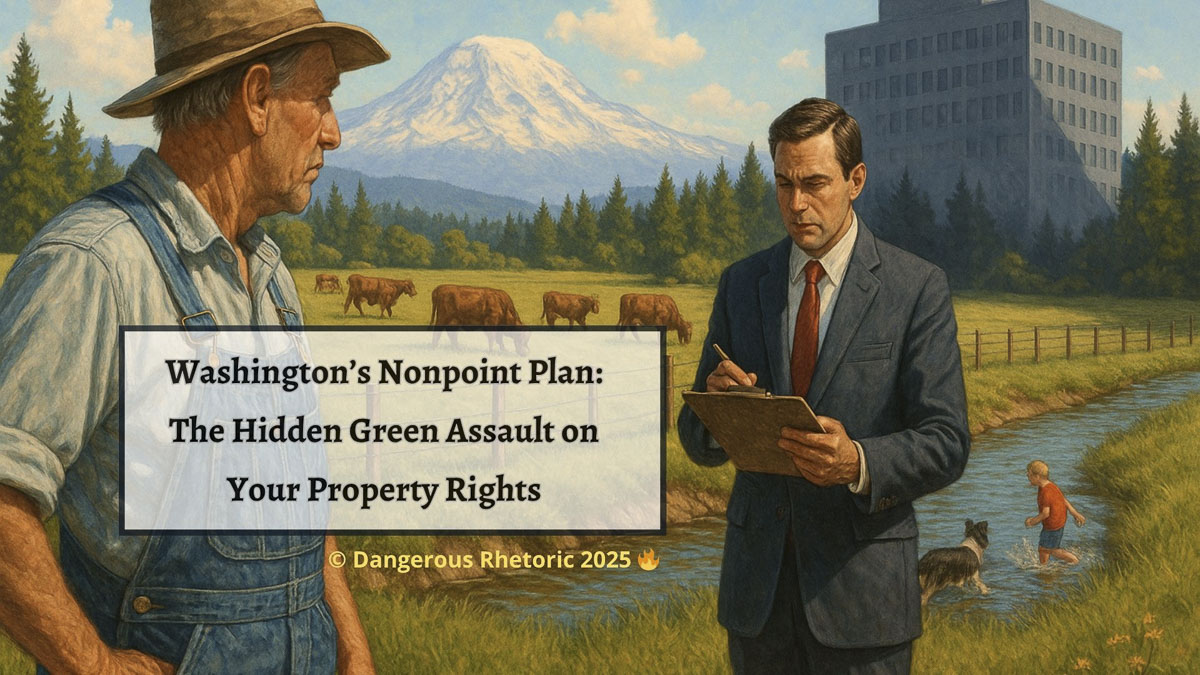
Nancy Churchill says that when ‘voluntary’ turns mandatory, property rights disappear
Nancy Churchill
Dangerous Rhetoric
The Washington Department of Ecology is getting ready to pull a fast one on the public. Cloaked in bureaucratic language, the agency has quietly opened public comment on its updated “Plan to Control Nonpoint Sources of Pollution.”

On the surface, it’s just another “water quality” plan. In reality, it’s a power grab that turns so-called “voluntary” guidelines into enforceable mandates — giving Olympia sweeping control over how you use your land, whether you’ve done anything wrong or not.
And make no mistake — while nonpoint pollution comes from many sources, this update zeroes in on one target: rural agriculture. Cities get a pass. Suburbs get a pass. But if you have livestock, open pasture, or even a garden near a creek, you’re in the crosshairs.
Redefining “pollution” for power
According to Ecology, nonpoint pollution is contamination that comes from dispersed sources — like rain washing pollutants off the land into waterways or, unbelievably, a “lack of shade-providing plants next to streams” contributing to warmer water.
Let’s pause here. “Lack of shade” is not pollution. It’s a natural condition. Not every stream was meant to be covered by a tree canopy. But under this definition, bare banks or even weeds become regulatory violations and rural landowners become easy targets. In the hands of regulators, this subjective definition becomes a weapon — a pretext for declaring your land out of compliance even when no actual contamination exists.
The Clean Water Act didn’t do this — Olympia did
Under the Clean Water Act, the EPA delegates most nonpoint pollution control to the states and at the federal level it’s largely voluntary. There’s a reason for that: Nonpoint pollution — from fertilizer runoff to oil from roads — is hard to trace, hard to measure, and impossible to regulate fairly with a one-size-fits-all mandate.
But Washington’s Department of Ecology has decided “voluntary” isn’t good enough. Ecology has been steadily erasing cooperation and replacing it with coercion. One quiet trick: the federal standard targets intentional discharges, but Washington’s version removes the word “intentional.” That single change means almost anything could be called pollution — a muddy patch in a pasture, a septic tank, livestock, irrigation, even your dog playing in a creek.
It’s regulation by entrapment — and the rules keep getting more stringent even though the Clean Water Act itself hasn’t changed.
The takings they don’t want to call takings
Courts have ruled that a “taking” isn’t just when the government seizes your land. It’s also when regulations strip away all reasonable use of your property. The Constitution protects against that kind of overreach through substantive due process — your right to be free from arbitrary deprivation of property rights.
If Ecology imposes a buffer zone that swallows half your land, and you can’t graze animals or plant crops there, they’ve taken that portion of your property. They just avoid calling it eminent domain — and conveniently avoid paying you for it. That’s how they hope to sidestep the Constitution.
The proper standard for regulation
Before the state takes away your ability to use your own property, it should be forced to meet a clear test:
Identify the harm: A real, specific harm to other people.
Prove its real harm: Using real data, not speculative or imagined harm based on cherry-picked studies that predict theoretical harm.
Prevention is fair: But only if the harm is a credible, demonstrable risk to other people.
Proportionality: The regulation must match the scale of the threat.
This standard protects both clean water and property rights. Without it, regulators can — and will — impose sweeping restrictions without ever proving you, personally, are causing any harm to other people.
Rulemaking in the shadows
Lawmaking happens in the open, where elected officials answer to voters. Rulemaking happens in agency offices, where unelected bureaucrats draft regulations with the force of law, but without transparency or political consequences.
That’s exactly what’s happening with the Nonpoint Plan. Most property owners who will be hit by these rules don’t even know they’re coming, let alone have a seat at the table. The plan’s own slide deck quietly admits Ecology has been working with tribes and select government agencies since 2023 — two years of closed-door negotiations shaping policies that will affect every rural landowner.

This isn’t a public process; it’s a strategy to lock in the outcome before the public ever hears about it. And when the goal is total water control, the last thing they want is an open debate. If Washington’s rural landowners don’t speak up now, they’ll wake up to find their rights are already gone.
Regulating the unmeasurable
If the Clean Water Act doesn’t regulate nonpoint pollution this way, why is Washington attempting to regulate something it can’t reliably identify, measure, or prove harmful? Because once you redefine “pollution” to mean almost anything, you can regulate almost anything.
These rules would let the state restrict land use without testing the water on your property, without showing that your land use caused contamination and without proving anyone was harmed. All they need is the possibility of harm, and suddenly, your rights are gone.
The Trojan Horse of “clean water”
Everyone wants clean water. That’s why it’s the perfect Trojan horse for expanding government control. By hiding behind the language of environmental protection, Ecology can take control of land use, bypass the legislature, and strip away property rights — all while claiming the moral high ground.
If they succeed here, the precedent is set: the state can regulate you into submission without proof, without compensation and without legislative debate. Your property rights become privileges, granted or revoked at the whim of an agency director.
Call to action
The public comment period for the Nonpoint Plan closes August 29, 2025, less than 100 days from when Ecology rolled it out. That’s unacceptable. The tribes, environmental groups, and agencies have had two years of closed-door input. The public deserves at least a year of collaborative, transparent stakeholder meetings before rules of this magnitude move forward.
We should also demand that any regulation be backed by real, site-specific data. That means water testing upstream and downstream of a property before imposing restrictions. No landowner should be punished without hard evidence they’ve caused harm.
For now, ask Ecology to extend the comment period, open the process to everyone and require testing before regulating. Next week, we’ll take a closer look at other problems hidden in these rule updates.
Submit your comment here → here.
Nancy Churchill is a writer and educator in rural eastern Washington State, and the chair of the Ferry County Republican Party. She may be reached at DangerousRhetoric@pm.me. The opinions expressed in Dangerous Rhetoric are her own. Dangerous Rhetoric is available on Substack, X, and Rumble

Also read:
- Opinion: Tax day is painful enough without Washington adding its own
 Washington’s new 9.9% income tax mirrors federal pattern: start narrow, expand to hit everyone within years.
 - POLL: What do you believe is the biggest reason school districts are facing budget shortfalls?
 Districts across Washington warn of budget gaps as debate grows over rising costs versus inadequate state funding.
 - Opinion: The high cost of hiding – Why IBR’s delayed revenue study is a $15 billion warning sign
 IBR delays critical toll revenue analysis until June 2027, hiding financial details until after project approval.
 - Opinion: The high cost of hiding – Why IBR’s delayed revenue study is a $15 billion warning sign
 IBR delays critical toll revenue analysis until June 2027, hiding financial details until after project approval.
 - Opinion: Washington fails the test for affordability
 Mountain States Policy Center analysis reveals Washington ranks 5th most expensive state as residents migrate to Idaho and Texas.
 wpDiscuz
