



Jason Mercier of the Washington Policy Center believes we didn’t need a national study to tell us that Washington’s emergency powers statute is badly lacking checks and balances and meaningful legislative oversight
Jason Mercier
Washington Policy Center
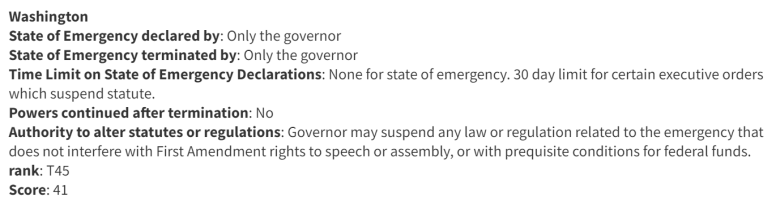
The results of a new national study comparing state emergency powers will not be a surprise for Washingtonians. Our state tied for 45th worst when evaluating the level of legislative oversight built into the grant of emergency powers provided to the executive branch.

According to the new study (Scoring Emergency Executive Power in All 50 States):
“As described in the first edition of this 50-State Emergency Powers Scorecard, states were not graded on how their governor exercised emergency powers during the COVID-19 pandemic. Rather, this scorecard judges the legal environment under which a governor may exercise executive power during a state of emergency. While some governors’ actions (and resulting legislative or judicial action) during the pandemic helped determine a more exact interpretation of various state laws, the purpose of this scorecard was, and continues to be, to provide context and a point of comparison related to the extent of legislative oversight of the executive branch in times of emergency.
To develop each state’s score, Maine Policy examined each state’s emergency powers statutes to determine the extent of legislative oversight, powers delegated to the chief executive, and the process for initiating or terminating a state of emergency declaration.”
Here are the details for Washington’s ranking.
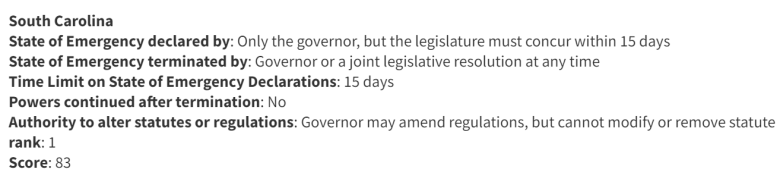
South Carolina scored the top spot providing the most legislative oversight.
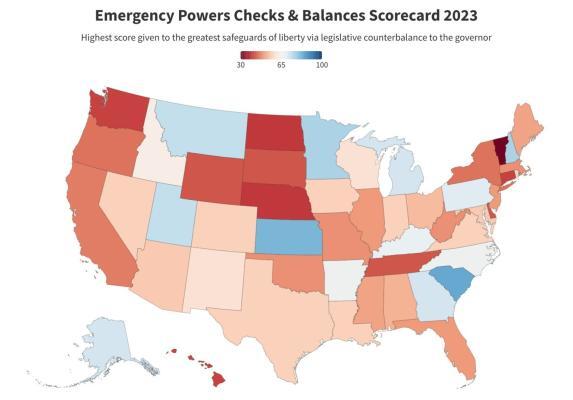
Idaho came in 14th place while California ranked 38th.
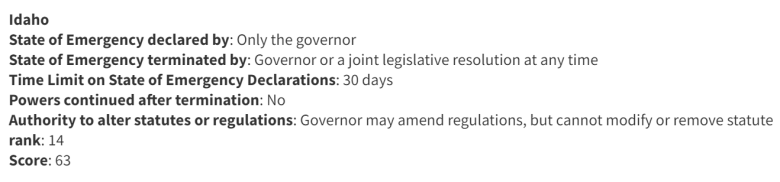
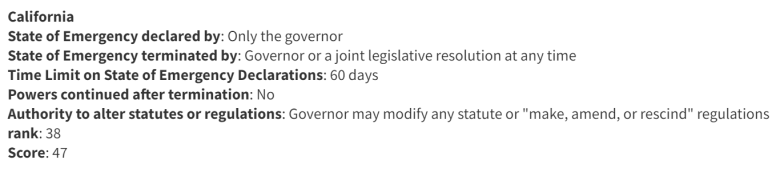
There was hope in Washington this year that with the Governor’s nearly 1,000-day governance by emergency orders finally expired, the legislature would give a fresh look at the statutory imbalance concerning checks and balances present in our emergency powers statute. Unfortunately, efforts to reform the state’s emergency powers died yet again this year without even the courtesy of public hearings.
No one disputes that in an emergency, governors need broad powers to act fast. Legislative bodies inevitably take longer to assemble and act than a single executive, so they temporarily delegate their power to the executive in emergencies. But these powers are supposed to be transferred for a limited period of time.
The Governor should not fear being required to make the case to lawmakers why a particular emergency restriction is appropriate to continue, and the legislature should not hide from its constitutional responsibility to debate and adopt policy. At some point, the executive branch should be required to receive permission from the legislative branch to continue making far-reaching policies under an emergency order.
We didn’t need a national study to tell us that Washington’s emergency powers statute is badly lacking checks and balances and meaningful legislative oversight. That said, this new report provides a good comparison of how each state treats emergency powers authority and how little accountability is built into our state’s current statute.
Jason Mercier is the director of the Center for Government Reform at the Washington Policy Center.

Also read:
- Opinion: Tax day is painful enough without Washington adding its own
 Washington’s new 9.9% income tax mirrors federal pattern: start narrow, expand to hit everyone within years.
 - POLL: What do you believe is the biggest reason school districts are facing budget shortfalls?
 Districts across Washington warn of budget gaps as debate grows over rising costs versus inadequate state funding.
 - Opinion: The high cost of hiding – Why IBR’s delayed revenue study is a $15 billion warning sign
 IBR delays critical toll revenue analysis until June 2027, hiding financial details until after project approval.
 - Opinion: The high cost of hiding – Why IBR’s delayed revenue study is a $15 billion warning sign
 IBR delays critical toll revenue analysis until June 2027, hiding financial details until after project approval.
 - Opinion: Washington fails the test for affordability
 Mountain States Policy Center analysis reveals Washington ranks 5th most expensive state as residents migrate to Idaho and Texas.
 wpDiscuz
