




Elizabeth New (Hovde) points out that many workers don’t benefit at all from the paid family and medical leave fund and are just going without wages they could be using for other life needs
Elizabeth New (Hovde)
Washington Policy Center
“The paid family and medical leave (PFML) premium rate will increase to 0.92% in 2025,” Emily Makings with the Washington Research Council reported Wednesday afternoon. “The Employment Security Department (ESD) made the announcement during today’s meeting of the PFML Advisory Committee.”

The 2025 rate is significantly higher than the rate that accompanied the program when it first began in 2019 at .40%. The fund is not paying its way as Washingtonians were sold.
In addition to a more than doubling of the tax rate, PFML has already received a general fund bailout of $200 million. Short-term deficits in the PFML account beginning early in 2025 and continuing intermittently through 2026 could require another bailout. Lawmakers have also questioned if they set the rate too low for this “if you build it they will come” taxpayer-financed benefit.
Employers and employees pay into this fund that allows workers taxpayer-paid time off with new babies or time off for people with medical needs of their own or others. Employers pay 28.57% of the total PFML tax and employees pay 71.43%. In 2025, employers will pay 28.48% of the premium and employees will pay 71.52%, writes Makings.
Many workers, of course, don’t benefit at all from this fund and are just going without wages they could be using for other life needs. My research has also shown that PFML is no safety net. Middle- and upper-income wage earners use the program more than those with lower incomes. In fact, people making $60 or more an hour used the fund about twice as much as the lowest wage-earners.
Elizabeth New (Hovde) is a policy analyst and the director of the Centers for Health Care and Worker Rights at the Washington Policy Center. She is a Clark County resident.

Also read:
- POLL: Do you agree with giving a state commission the power to remove an elected sheriff?
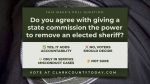 A new poll asks if a state commission—not voters—should have the power to remove an elected sheriff, following concerns raised by Clark County Sheriff John Horch.
 - Opinion: Defending Democracy by denying it?
 Washington voters are blocked from weighing in on new income taxes as state lawmakers and officials bypass public input, drawing criticism from Northwest voices.
 - Opinion: Stalin would be proud – Clark County Socialists gathered for ‘No Kings’
 Reform Clark County’s Rob Anderson criticizes local and national groups for organizing protests that featured Auditor Greg Kimsey as a keynote, raising concerns about public trust and political partisanship.
 - Letter: Vancouver Mayor Anne McEnerny-Ogle makes several serious and incorrect engineering statements
 Bob Ortblad critiques engineering claims by Vancouver Mayor Anne McEnerny-Ogle, highlighting cost and safety advantages of an immersed tunnel for the I-5 crossing.
 - Opinion: The beginning of the end of anchor babies
 Lars Larson argues the Constitution excludes children born to non-legal residents, as the Supreme Court debates birthright citizenship and public opinion data shows limited support.
