



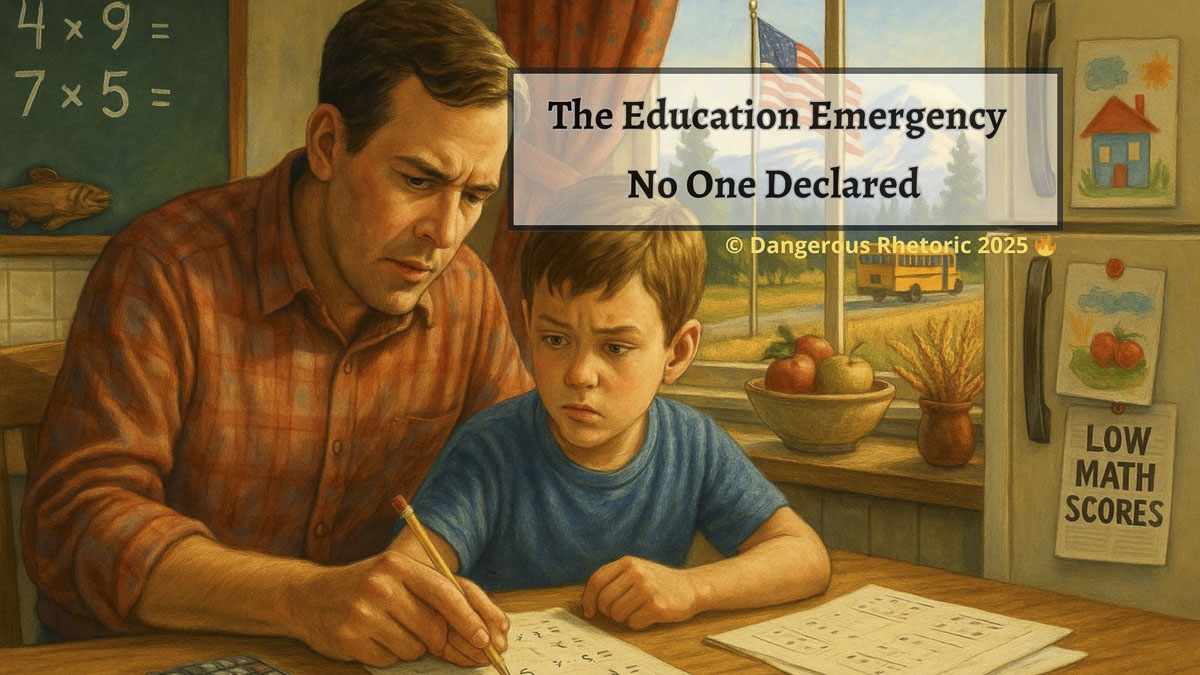
Nancy Churchill says Washington’s public schools are failing, and the crisis begins with math
Nancy Churchill
Dangerous Rhetoric
A decade of one-party control has left Washington’s students behind. The data are undeniable, and even the Seattle Times can no longer ignore it. After years of political spin, excuses, and ideological distractions, reality has finally caught up with the state’s education establishment: Washington’s public schools are failing, and the crisis begins with math.

When failure becomes the norm, it stops feeling like failure. That’s where we are now.
The Long Decline: It started with ‘new math’
The decline in math education didn’t start yesterday. When I was in elementary school in the 1970s, “new math” was introduced. I remember sitting in class, confused by charts, boxes, and “sets.” We were told not to memorize multiplication tables but to understand “concepts.” I never really mastered the times tables — and I wasn’t alone.
The idea behind “new math” was noble: to modernize education in the Space Race era by teaching logic and abstraction. But it turned elementary classrooms into experiments, and students into test subjects. As one historian of education noted:
“Since the 1960s, the reforms haven’t stopped. New math was just the opening act of what became known as ‘the math wars’ — an ongoing series of curricular reforms rooted in debate about how and why students should learn mathematics. There’s just a fundamental disagreement among educators about the right way to teach something. So one legacy of the new math is just a reminder that learning math is always political.”
That’s the story of American education in a nutshell — endless reform, no results. “New math” became “whole math,” then “common core.” Every decade brought a new silver bullet and a new generation that couldn’t multiply without a calculator. For half a century, politicians and bureaucrats have been changing the formula instead of teaching it.
The numbers don’t lie
We’re now seeing the long-term cost of that failure. Between 2013 and 2024, Washington’s national ranking in math collapsed. In fourth grade, our students fell from tenth place to twenty-seventh. By eighth grade, the drop was just as steep — from seventh to twenty-fifth.
Even reading scores dropped, but math is where the freefall is most severe. Once a top performer, Washington now trails states it used to outperform by wide margins.
This isn’t a post-pandemic dip. It’s the cumulative result of fifty years of “innovation” that systematically replaced mastery with method, and substance with slogans.
A system in denial
According to the Seattle Times Editorial Board, “Alarm bells have been ringing since students returned to in-person instruction after the pandemic.” Nearly a third of all Washington students can’t demonstrate a basic grasp of grade-level math skills. Among low-income students, it’s 45%. Half of all students in the state qualify as low-income — meaning that mediocrity has become the majority experience.
The Times finally admitted what parents have known for years: this is an emergency that should have been declared long ago. The editorial even calls out State Superintendent Chris Reykdal for recognizing the crisis “way too little, much too late.”
The truth is harsher. Under Reykdal’s nine years of leadership, the Office of Superintendent of Public Instruction (OSPI) became less about instruction and more about ideology. The focus drifted from arithmetic to activism, from multiplication to tolerance, from education to indoctrination.
The architect of decline
Chris Reykdal’s tenure is the product of one-party control and institutional arrogance. Traditionally, the superintendent’s job was administrative — to collect data and distribute dollars. Reykdal made it political, aligning with teacher unions and Olympia’s bureaucratic priorities rather than parents and local schools.
Even Future 42 noted the irony: “The Seattle Times Editorial Board is having buyer’s remorse after (stupidly) endorsing OSPI Chris Reykdal.”
It’s the same pattern we’ve seen for decades. The same establishment that builds the firehouse, starts the fire, and then demands applause for holding the hose. The education bureaucracy fails upward and no one is ever fired — least of all the superintendent presiding over the decline.
The real problem with Math education
Anyone who points out this failure is accused of “attacking public education.” Some even claim math success is “racism!” How ridiculous. The real problem is pretending that endless reform equals progress. The real problem is calling mediocrity “equity.”
Washington’s children aren’t behind because they’re incapable. They’re behind because the people in charge stopped caring about results. They traded math for politics, merit for slogans, and accountability for power.
Half a century ago, “new math” made classrooms political. Today, that same politicization has hollowed out the math competence of several generations of students. The numbers don’t just measure skill — they measure trust, and Washington’s education system has broken it.
Finding Math success
The education emergency has already happened. The real question now is whether anyone will focus on actually helping children learn math again.
Do you want your child to succeed at math? You’ll have to teach him or her yourself—or find a tutor who still believes in practice and mastery. Because the secret to success in math isn’t ideology. It’s repetition. It’s memorization. Who knew? When students do the work, it becomes easy to learn math.
If Olympia won’t fix the problem, Washington’s parents will have to. Real reform begins at the kitchen table — one worksheet, one problem, one child at a time. Real reform begins with believing that all students can succeed at learning math.
Nancy Churchill is a writer and educator in rural eastern Washington State, and the chair of the Ferry County Republican Party. She may be reached at DangerousRhetoric@pm.me. The opinions expressed in Dangerous Rhetoric are her own. Dangerous Rhetoric is available on Substack, X, and Rumble

Also read:
- Opinion: State is rightly emphasizing experience and skills, not degrees
 Elizabeth New explains how a new state policy removes unnecessary advanced degree requirements, supporting skills-based employment and broadening opportunities for capable workers.
 - Opinion: The wealth migration is real – which states are benefiting?
 IRS data shows Idaho, Montana, and Wyoming attracted significant wealth from new residents, while Washington state saw a loss of $500 million as its new capital gains tax took effect.
 - Opinion: Voting with the Democrat Party – Back to the future!
 Lars Larson connects the history of election rules to today’s debates, highlighting Supreme Court concerns over counting ballots after Election Day.
 - Opinion: ‘Stay close, stay informed, stay the course’
 Anna Miller calls on residents to join Clark County Republican Women’s dinner, urging perseverance and unity as local government faces turbulent times.
 - Opinion: Will the income tax cause a drop in charitable giving?
 High-income households leaving Washington after new tax may redirect donations, possibly shrinking local nonprofits’ funding despite the intended deduction benefit.
