



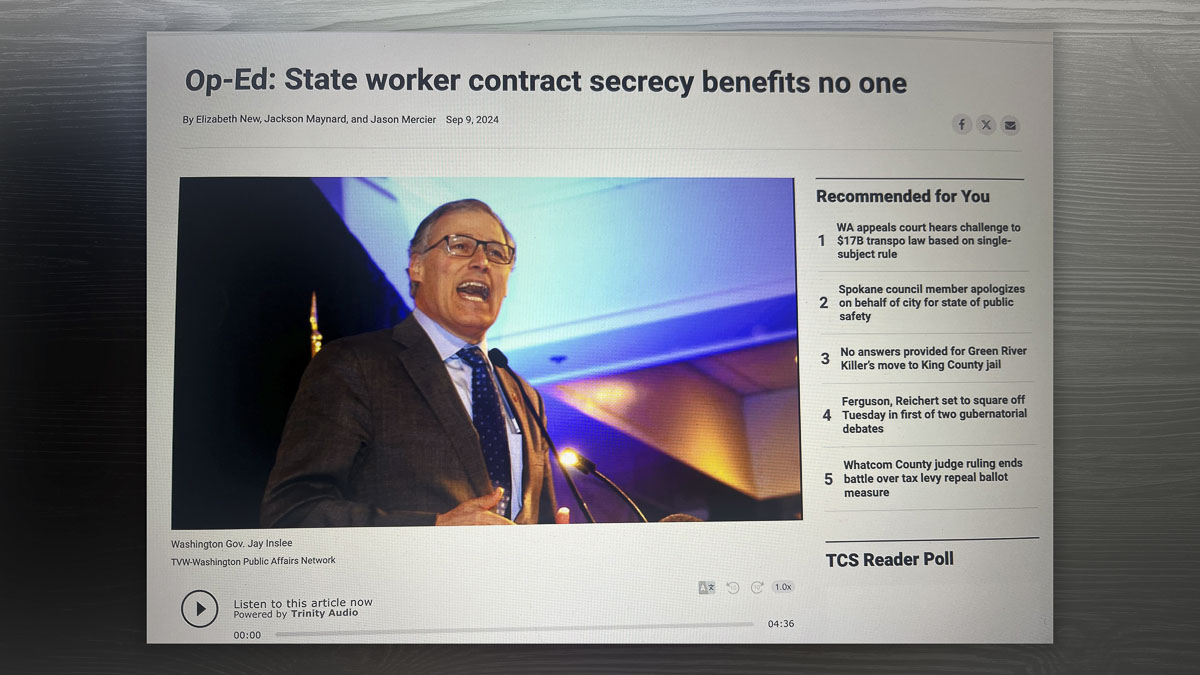
Elizabeth New (Hovde) shares an opinion column about private salary negotiations between the state and public employee unions
Elizabeth New (Hovde)
Washington Policy Center
Should salary negotiations between the state and public employee unions be private? No. They help no one. I wrote an opinion column about this with Jason Mercier, vice president at Mountain States Policy Center, and Jackson Maynard, executive director of the Citizen Action Defense Fund. It ran in a handful of publications this week. Find it here or here.
I’ll have another blog out soon about Tuesday’s “Walkout for Washington.” This public employee action was organized by the Washington Federation of State Employees to protest state salary offers. The crazy thing about the walkout is that union members involved in it don’t even know the details of the pay-increase proposals or the negotiating that is in play. Stay tuned.
Elizabeth New (Hovde) is a policy analyst and the director of the Centers for Health Care and Worker Rights at the Washington Policy Center. She is a Clark County resident.

Also read:
- Opinion: Sheriffs fight back
 Four county sheriffs are suing to block a new law giving a governor-appointed board power to decertify and remove sheriffs, bypassing voter oversight in Washington.
 - Opinion: The growing gap between public voice and political power
 Todd Myers describes how large-scale protest and sign-ins often fail to sway state leaders, and argues authentic influence is most likely found through local action.
 - Opinion: Who is winning the race for affordable power?
 Hydroelectric power keeps Washington competitive, but new laws and carbon pricing are driving up electricity costs for residents each year.
 - Opinion: Half the road, full stop – Understanding pedestrian right-of-way
 Doug Dahl explains how Washington’s law requires drivers to stop when a pedestrian is within one lane of their half of the road, not just when directly in front.
 - Opinion: The state’s RFK-proofing bill comes with a cost
 Mandates like HB 2242 can lead to higher premiums as insurance companies absorb costs for new preventive services, affecting affordability statewide.
