



Charles Prestrud of the Washington Policy Center believes the budget shows little progress on the reforms to planning and prioritization that are desperately needed
Charles Prestrud
Washington Policy Center
Last week (May 16) Gov. Jay Inslee signed the State Transportation budget for the 2023-2025 biennium. The budget bill, HB 1125, runs to two hundred sixty-three pages and includes hundreds of line items. Following are a few highlights and items of interest:

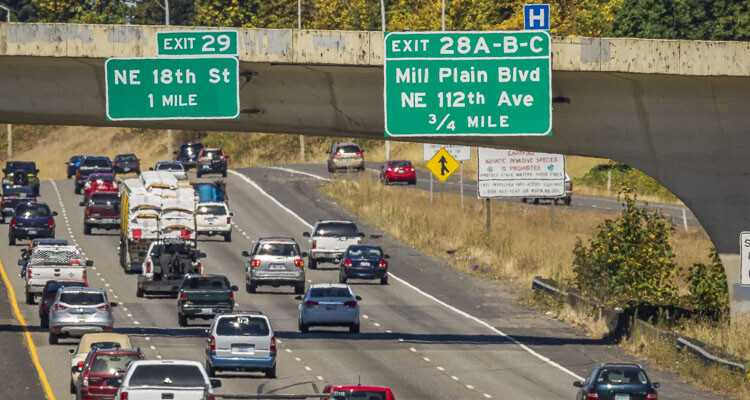
- The legislature funded most of the highway projects that had been pushed out of the Governor’s budget proposal. That is a positive step because the state population continues to grow, traffic volumes have rebounded after the pandemic, and additional highway capacity is needed. It’s also good because it re-affirmed the State’s commitment to projects that had been funded in the legislature’s previous transportation packages.
- The transportation budget does not include additional bonding. That was a prudent decision because in past budgets the legislature tended to bond heavily against future revenue from gas tax increases. The need to service that accumulated debt limits budget flexibility and makes it harder for WSDOT to find the funding needed for highway preservation and maintenance. More bonded debt would have made the future transportation budget situation even worse.
- The legislature increased funding for highway preservation and maintenance but not enough for WSDOT to get caught up on their backlog. Eventually we will pay a price for deferring projects (highway condition will deteriorate and the needed repairs won’t get cheaper).
- The legislature was far too generous with transit and non-core transportation programs. Hundreds of millions of dollars will be doled out to transit agencies and cities without adequate oversight or performance monitoring. The state auditor does routine checks to verify funds are spent and financial controls are followed, but what they won’t do is look at whether the projects made any sense or whether they actually produce the desired benefits. For example, many projects funded in recent years by the State’s Regional Mobility Grant program would have a hard time passing a benefit/cost test.
- There is considerable doubt WSDOT will be able to complete all the highway projects funded in the transportation budget on the desired timeline. The combination of staff vacancies and an increasingly bureaucratic planning process will make it difficult for WSDOT to move all the projects through to completion on schedule. Cost-overruns due to an unfavorable bid climate and inflation can also be expected.
- The failure of the mileage tax/road user fee bill (HB 1832) was a good thing, as was Governor Inslee’s veto of the bill that would have established a process for reporting how many miles individuals drive (HB 1736, the odometer bill). But the underlying issues have not gone away and an array of interest groups can be expected to push for a mileage tax in future sessions.
- HB 1846, which directs WSF to proceed with procurement of new ferries, is a step in the right direction. However, the bill still requires hybrid-electric propulsion, which will make the new ferries more expensive and may lengthen the timeline for completion. Further delay in acquiring new ferries would make it even more difficult for WSF to fully restore service to pre-COVID levels. For instance, service to Sidney B.C. may not resume until 2030. The bill takes the positive step of opening the process to out-of-state shipyards, but the bill was amended to give a 13% price preference to in-state shipyards, which means the playing field still isn’t quite level.
So, a few bright spots, but the big picture shows little progress on the reforms to planning and prioritization that are desperately needed, nor much attention to system capacity needs or agency accountability. So, despite the large increases in transportation spending the legislature has passed in recent sessions, serious issues remain for future legislature’s to resolve.
Charles Prestrud is the director of the Coles Center for Transportation at the Washington Policy Center.

Also read:
- Letter: ‘This is the worst thing that ever happened to the region’
 A Hayden Island resident Sam Churchill is criticized in a letter calling the $14 billion Interstate Bridge Replacement project a “boondoggle” that destroys local businesses.
 - Opinion: Sheriffs fight back
 Four county sheriffs are suing to block a new law giving a governor-appointed board power to decertify and remove sheriffs, bypassing voter oversight in Washington.
 - Opinion: The growing gap between public voice and political power
 Todd Myers describes how large-scale protest and sign-ins often fail to sway state leaders, and argues authentic influence is most likely found through local action.
 - Opinion: Who is winning the race for affordable power?
 Hydroelectric power keeps Washington competitive, but new laws and carbon pricing are driving up electricity costs for residents each year.
 - Opinion: Half the road, full stop – Understanding pedestrian right-of-way
 Doug Dahl explains how Washington’s law requires drivers to stop when a pedestrian is within one lane of their half of the road, not just when directly in front.
