




Liv Finne of the Washington Policy Center believes that it’s important for the public to be informed about how much school leaders are paid and how effective the system is at educating children
Liv Finne
Washington Policy Center
Earlier this week, using public records, I posted the salaries of the highest-paid school employees in Washington state for the 2021-22 school year. As a tax-funded monopoly system, it’s important for the public to be informed about how much school leaders are paid and how effective the system is at educating children. After further research, I found there is more to report about this topic.

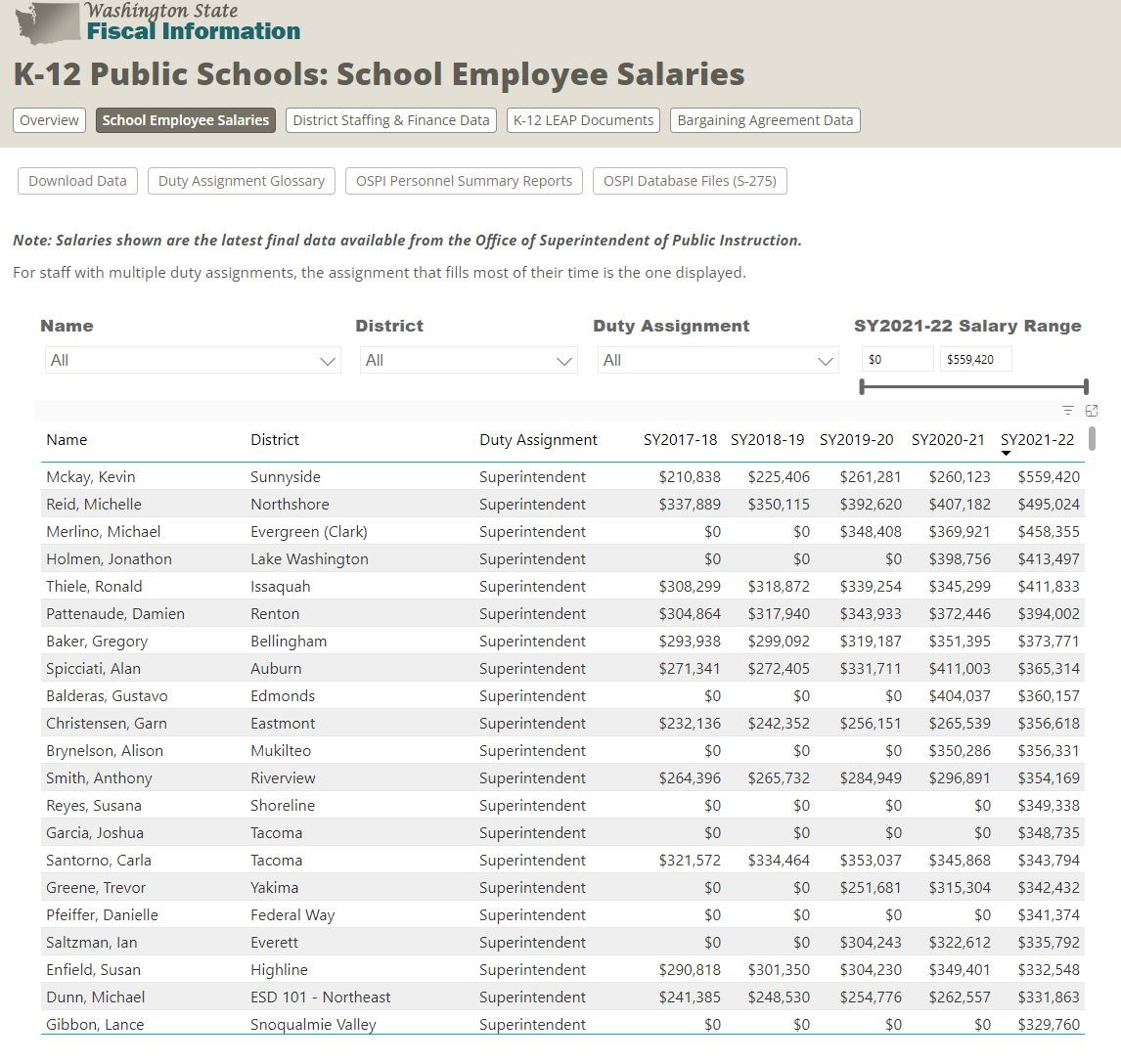
Below is a table on K-12 School Employee Salaries as reported by the Washington State Fiscal Information, www.fiscal.wa.gov.
Here are some of the most notable findings. The Sunnyside school district superintendent received a $559,000 salary, nine times the average family wage in that area. The Tacoma School board paid out for two superintendents. Normally districts have only one superintendent, aided by one or more deputy superintendents. Carla Santorno, who retired in 2021 as superintendent, received a salary of $343,000. Her successor, Josh Garcia, received a salary of $348,000. Unless these amounts were pro-rated, it means that in 2021-22, the Tacoma School District paid nearly $700,000 in superintendent salary.
These public-dollar sums do not include employee benefits , which amount to about $50,000 per person.
Under the current system school administrators have almost no incentive to be careful stewards of public money – their pay is unrelated to student learning levels. In fact, administrators have every incentive to get more pay, and are often able to convince willing school board directors to approve these large pay increases. Public schools have plenty of money, so there is no lack of funding for this purpose.
Since a centralized monopoly has little accountability to the public, the best solution is to allow parents to have school choice. Only when school superintendents face the possibility of losing parent-directed funding to homeschooling, charter public schools or private schools will they start making spending decisions consistent with the public interest, and for the benefit of teachers and students.
In the meantime, more people recognize that public schools have become a lucrative jobs program for administrators. In many Washington communities, running the school district is the best job in town.

Also read:
- Opinion: The legislature has committed $2.4 billion to recurring pension increases since 2018
 Six legislative COLAs have raised public employer costs by $2.38 billion since 2018, driving up unfunded pension liabilities and increasing burdens on county and city budgets.
 - Opinion: ‘Just because they got away with it doesn’t mean they weren’t wrong’
 A Skamania County deputy’s report found violations of county rules and the Open Public Meetings Act, but no prosecutor acted on the findings.
 - Opinion: Small things grow great by concord
 Washington’s initiative process gives citizens direct power to challenge lawmakers. Failed restrictions and new measures on girls’ sports, parental rights, and citizenship prove the influence of grassroots action.
 - Opinion: California’s $20 fast food minimum wage creates less jobs and lower income
 Study data show California fast food workers now face fewer shifts, higher menu prices, and widespread automation after the $20 wage hike.
 - Opinion: State is rightly emphasizing experience and skills, not degrees
 Elizabeth New explains how a new state policy removes unnecessary advanced degree requirements, supporting skills-based employment and broadening opportunities for capable workers.
