




Todd Myers of the Washington Policy Center believes legislators should strengthen House Bill 1009 so that the promise of reducing barriers to access into the workforce is realized
Todd Myers
WND News Center
In each of the last two legislative sessions, there has been bipartisan support to reduce state barriers to work. Last year, legislators eased restrictions on people with a criminal conviction who have served their time, giving them an opportunity to find a new career.
A new study shows there is much more work to be done.
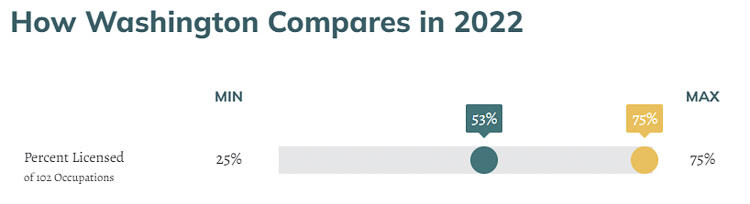
Research from the Institute for Justice found that Washington state requires government licenses to work in a larger number of job categories than any other state. Although the number of days lost in Washington is less than average, Washington’s total burden of occupational licensing ranks 8th worst in the nation.

As we’ve noted in the past, research from the Obama Administration and others make it clear that occupational licenses have a disproportionate impact on low-income workers, immigrants, and minorities, but do little to actually improve safety.
Fortunately, there is some good news on this front in the upcoming legislative session.
House Speaker Laurie Jinkins says workforce development is a top priority for the session, and specifically mentioned reducing the burden of occupational licenses. Speaking with TVW host Mike McClanahan, the Speaker noted that, “frequently our licensing requirements over time grow into a place where they are actually protecting people from entrants, from competitors coming into an industry. We don’t want to do that.” She noted that we need to focus on “competency, not about protecting people from entry and competitors into practice.”
Representatives Mari Leavitt and Andrew Barkis have co-sponsored HB 1009 that would take a step in that direction, helping military spouses who have qualified for occupational licenses in other states to find work in Washington state. The bill notes that “The length of time to credential after a move is a significant employment barrier, with one study finding 20 percent of military spouses waited at least 10 months for a license after moving to a new state.”
The legislation encourages (but doesn’t require) licensing authorities to “Conduct a review of the authority’s licensing application process for military spouses and identify barriers to military spouse employment,” as well as to “Review licensing fees and related expenses and identify possible ways to reduce costs for military spouses.” It also expands assistance to military spouses to navigate Washington’s occupational licensing system.
This is a nice step, but it doesn’t go far enough to link licensing to competence, as Speaker Jinkins mentioned. State agencies have been extremely reluctant to remove licensing barriers and simply encouraging them to do so is unlikely to yield meaningful results.
Legislators should strengthen the bill so that the promise of reducing barriers to access into the workforce is realized. That would be a truly meaningful step to improve the quality of our workforce and provide historically disadvantaged communities with new opportunities.
Todd Myers is the director of the Center for the Environment at the Washington Policy Center.

Also read:
- Opinion: Half the road, full stop – Understanding pedestrian right-of-way
 Doug Dahl explains how Washington’s law requires drivers to stop when a pedestrian is within one lane of their half of the road, not just when directly in front.
 - Opinion: The state’s RFK-proofing bill comes with a cost
 Mandates like HB 2242 can lead to higher premiums as insurance companies absorb costs for new preventive services, affecting affordability statewide.
 - Opinion: What is the cost of a bridge?
 John Ley argues the I-5 Bridge replacement’s soaring cost stems from costly extras like light rail, noting other states deliver larger, toll-free bridges for much less.
 - POLL: Do you agree with giving a state commission the power to remove an elected sheriff?
 A new poll asks if a state commission—not voters—should have the power to remove an elected sheriff, following concerns raised by Clark County Sheriff John Horch.
 - Opinion: Defending Democracy by denying it?
 Washington voters are blocked from weighing in on new income taxes as state lawmakers and officials bypass public input, drawing criticism from Northwest voices.
