



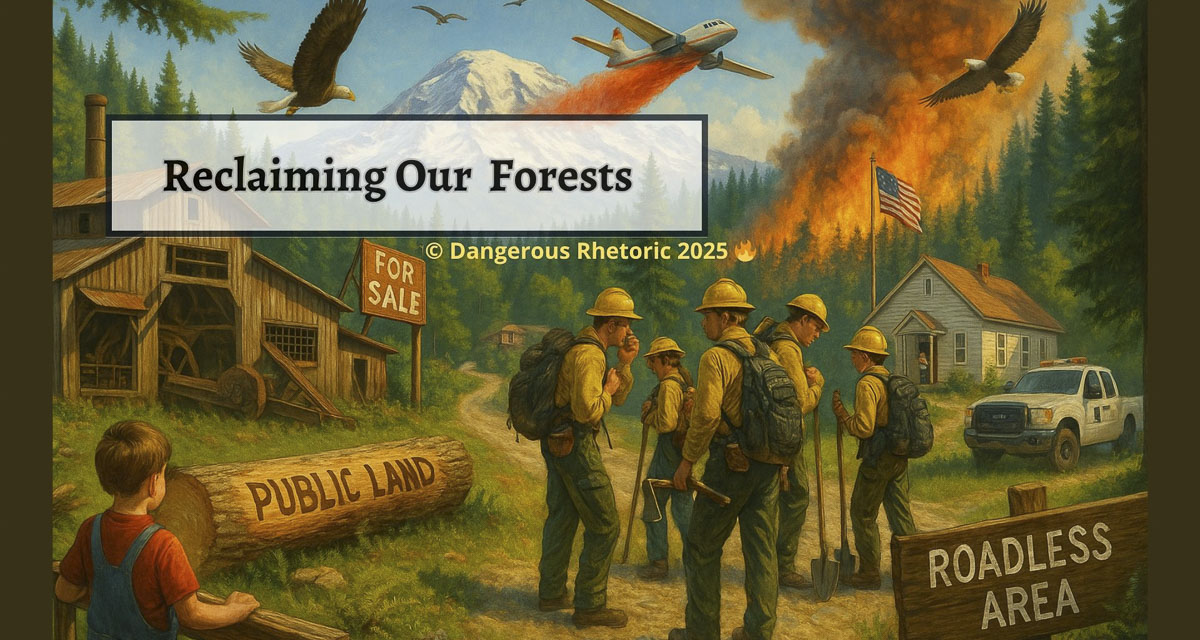
Nancy Churchill discusses why reversing The Roadless Rule is a win for Washington and America
Nancy Churchill
Dangerous Rhetoric
In January 2001, the Clinton administration enacted the Roadless Area Conservation Rule, putting 58.5 million acres of National Forest land — including 2.1 million right here in Washington — off-limits to road building and timber harvesting.

The rule was sold as a way to protect untouched wilderness, but in practice, it’s had a negative impact on the environment as well as hurting working families and rural communities. One-third of all U.S. Forest Service lands were effectively locked up, gutting industries like logging and mining. While Alaska was able to win exemptions for the Tongass National Forest in 2020, Washington is still stuck under this federal overreach, paying the price in jobs lost and forests mismanaged.
How it’s hurt Washington’s logging communities
Washington’s logging industry, once an economic powerhouse, has been devastated by the Roadless Rule. National Forests like the Colville and Okanogan-Wenatchee contain huge swaths of roadless land. The Colville alone has over 220,000 acres labeled as “wilderness quality,” according to Conservation Northwest.
The rule’s restrictions have slashed harvests in some forests, gutting rural economies. In 1990, over 62,000 people in Washington worked in timber. By 2022, that number dropped to around 18,000. Places like Ferry County have lost mills, lost jobs, and lost the tax base they depend on.
Environmentalists like to point out that public lands belong to “the public.” This is correct. It’s just that “public” doesn’t only include out-of-town environmentalists. “The public” includes the people who actually live and work on or near the lands. Public lands were always supposed to be managed so that the communities that agreed to set them aside would benefit from resource sales. These sales would support public services like law enforcement, hospitals, and schools.
Without timber sales and without local jobs — the tax base shrinks, and schools and local services suffer. The “public” no longer receives any benefit from the public lands that should be supporting each community.
Unfortunately, the rule doesn’t just impact jobs. The rule makes it harder to manage forests properly, like thinning dense stands to prevent wildfires. The result? Fire suppression costs in Washington are skyrocketing — at least $22 million for major fires in 2020 alone, according to state data. From 2015 to 2019, the average annual wildfire bill for the nation hit $83 million.
Why it’s time for a change
Since it was imposed, the Roadless Rule has done real damage in Washington and across the West, as Agriculture Secretary Brooke Rollins has pointed out. By blocking basic forest management tools — like creating roads or removing fuel — the rule has left millions of acres vulnerable. Over eight million acres have burned in wildfires since the rule went into effect. Those fires not only destroy homes and habitat, but they choke the air with smoke and stretch firefighting crews thin. The public health impacts and budget burdens only grow.
With logging restricted, the timber supply has become unreliable, forcing us to rely on more expensive foreign lumber when we’ve got more than enough. That’s bad news for U.S. consumers, and bad news for mill towns and blue-collar jobs. And it’s not just state budgets that take a hit — local governments get fewer federal Payments in Lieu of Taxes (PILT), which are meant to offset the cost of federally owned lands that can’t be taxed.
Why repealing the rule makes sense
Rolling back the Roadless Rule is a common-sense move that benefits everyone—especially here in Washington. As Rollins explained, it would allow for responsible thinning and restoration work to help reduce fire danger. It would also open up new opportunities for jobs in logging, mining, and hauling — industries that have deep roots in our state.
Better road access would mean faster, safer responses when wildfires break out. And instead of forcing one-size-fits-all rules from D.C., the repeal would give local leaders and communities the freedom to manage their forests under NEPA. That means real, on-the-ground, local decision-making — not faceless bureaucracy or judicial fiat. It’s a win for economic growth, public safety, and local control.
Do roads really cause fires—or help stop them?
Some critics claim roads make forests more vulnerable to fire by increasing human-caused ignitions. A 2012 study did show that fires in the Cascades often start near roads, especially in high-density (not wilderness) areas. But that’s only part of the story!
The truth is, roads help fight fires more than they start them. A more recent scientific study from 2019 found roads can act as fire breaks and give crews the access they need to stop fires before they explode. The 2017 Norse Peak Fire proved the point — it broke out in a roadless wilderness area and spread fast because firefighters couldn’t get to it. With modern road design and reasonable access controls, ignition risks can be managed. What we can’t manage is fire with no roads and no tools.
It’s time to act
Washingtonians have a stake in this, and we need to speak up. This is a federal issue, so reach out to your U.S. House representative and two senators using Congress.gov and urge them to support reversing the Roadless Rule.
Just as important, tell them to oppose HR 3930, the Roadless Area Conservation Act of 2025. That bill (and its Senate companion) would lock the old 2001 rule in place, ignoring the economic pain and increased wildfire risk it causes our state and communities around the nation. The public health hazards caused by smoke from out-of-control wildfire is impacting people far from the roadless areas. That alone is reason to fight for common-sense forest management rules.
Send a clear message — call, email, or post on X:
“As a Washington voter, I support reversing the Roadless Rule to create jobs and reduce wildfires. Please also oppose HR 3930 and restore local control.”
This isn’t just about trees — it’s about jobs, safety, public health and giving Washington communities the tools to thrive and prosper. Don’t wait. Speak up now and help take our forests back.
Nancy Churchill is a writer and educator in rural eastern Washington State, and the chair of the Ferry County Republican Party. She may be reached at DangerousRhetoric@pm.me. The opinions expressed in Dangerous Rhetoric are her own. Dangerous Rhetoric is available on Substack, X, and Rumble

Also read:
- POLL: What do you believe is the biggest reason school districts are facing budget shortfalls?
 Districts across Washington warn of budget gaps as debate grows over rising costs versus inadequate state funding.
 - Opinion: The high cost of hiding – Why IBR’s delayed revenue study is a $15 billion warning sign
 IBR delays critical toll revenue analysis until June 2027, hiding financial details until after project approval.
 - Opinion: The high cost of hiding – Why IBR’s delayed revenue study is a $15 billion warning sign
 IBR delays critical toll revenue analysis until June 2027, hiding financial details until after project approval.
 - Opinion: Washington fails the test for affordability
 Mountain States Policy Center analysis reveals Washington ranks 5th most expensive state as residents migrate to Idaho and Texas.
 - Opinion: Washington fails the test for affordability
 Mountain States Policy Center analysis reveals Washington ranks 5th most expensive state as residents migrate to Idaho and Texas.
