



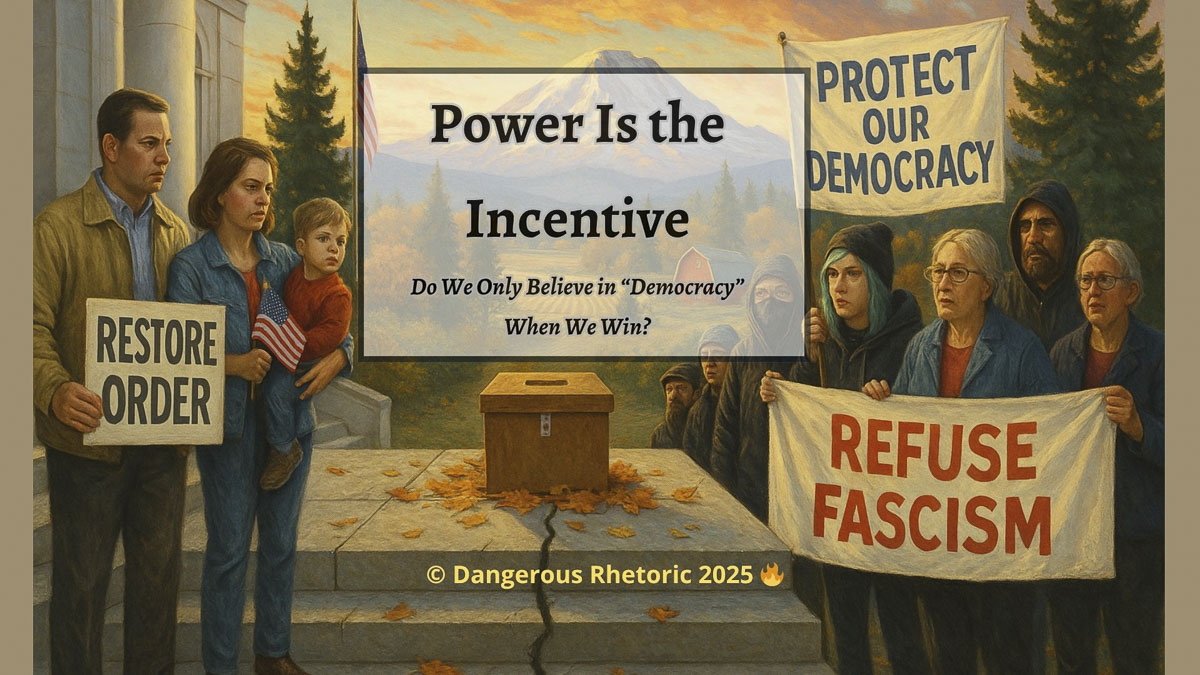
Do we only believe in ‘Democracy’ when we win?
Nancy Churchill
Dangerous Rhetoric
This piece is part of an ongoing series on incentives in American public life. In Part One, we examined how fear is used as a political and media strategy: how a fearful public becomes easier to influence, divide, and direct. Fear shapes perception. But once perception has been reshaped, the next step is to redefine legitimacy itself. In this essay, we look at the phrase “our democracy” and how it has come to mean something very different than it once did.
Elections and consequences
For many years, Americans were told that “elections have consequences.” The phrase carried a tone of civic maturity: sometimes your preferred candidate wins, sometimes they lose, but the system continues and the work of persuasion goes on. It was a reminder that democracy requires accepting outcomes we dislike.

That principle appeared widely understood, until the most recent election, when voters chose a Republican president and Republican majorities in Congress and state governments. Instead of acknowledging that the public had rendered a decision, many commentators responded with alarm.
They did not simply disagree with the policy direction; they questioned the legitimacy of the outcome itself. Demonstrations erupted. Media outlets declared democracy under threat. Officials warned of authoritarianism. The election result was treated less as a civic moment than as a national emergency.
“Our Democracy”
This response raises an essential question: Do we only believe in democracy when our preferred side wins?
Over the past decade, the phrase “our democracy” has shifted in meaning. Increasingly, it is used not to describe the American constitutional system, but to describe the continuation of political power by one particular coalition.
When that coalition holds office, democracy is described as stable. When it loses power, democracy is described as endangered. The implication is unmistakable: political legitimacy belongs only to one side, not because of election results, but by assumed moral correctness.
This shift was reflected openly in the aftermath of the election. Rather than debate policies or priorities, some public voices claimed the result itself was invalid. They argued Republican leadership was inherently dangerous and therefore unfit to govern — even after winning under the same rules everyone agreed to beforehand.
Historian Victor Davis Hanson has observed that the political movement now warning of authoritarianism is the same movement that previously expanded executive power, bypassed legislative authority, and normalized rule by administrative decree. He notes that the loss of power did not create fear of tyranny; it created fear of accountability. Those who once exercised dominance now find themselves outside the center of decision-making, and their response is not accommodation but anger.
Power is the incentive
This is not simply partisan disappointment. It reflects an underlying incentive structure: if a group can convince the public that its opponents are dangerous, it can claim exclusive legitimacy. If the opposition is rebranded not as political rivals but as threats to democracy itself, then extraordinary measures — censorship, institutional pressure, federal intervention — begin to appear justified.
Fear and legitimacy reinforce each other. Fear says: Your opponents want to harm you. Delegitimization says: Therefore, they do not deserve power. Together, they imply: Only we should rule.
This dynamic does not strengthen democracy. It replaces it.
Jeffrey Mead recently commented on this incentive openly: Certain political actors are not rewarded when their communities improve, stabilize, or become less dependent. Their influence depends on maintaining grievances and crises rather than resolving them.
We can see this dynamic clearly in the homelessness systems of Seattle and Spokane, where entire industries have developed around the management — rather than the reduction — of human suffering. Programs and nonprofits receive funding in proportion to the scale of the crisis, not to their success in solving it. The result is a cycle in which bureaucracies expand while neighborhoods deteriorate.
The people living on the streets, many struggling with addiction or untreated mental illness, are not treated as human beings to be restored but as statistics that justify another grant or policy initiative. These are our children, our parents, our neighbors. Those they harm or endanger are loved by someone too. A decent society should not tolerate a system that profits from perpetual misery.
Civic self-correction
Meanwhile, ordinary Americans expressed something far more grounded in the election. They signaled frustration with rising costs, failing schools, lawlessness, border insecurity, unequal justice, and cultural hostility toward traditional institutions. They did not vote for upheaval. They voted for restoration — of boundaries, accountability, order, and the basic stability of daily life.
This is not radicalism. It is civic self-correction.
A functioning republic depends on this ability to course-correct peacefully and predictably. If, instead, losing an election becomes grounds for declaring that the system is broken, then the principle of representative self-government collapses. The country becomes not a republic of equals, but a contest for permanent power.
Refuse fascism or accept election results?
“Our democracy” is not just about casting a vote. It requires the ability to accept outcomes. Unfortunately, there are now voices on the radical left claiming, “We cannot wait for an election cycle.” This is a statement from a group that has publicly organized for insurrection under the banner of “Refuse Fascism.”
Such declarations reveal the final stage of the incentive pattern. Once fear and delegitimization take root, the next step is to justify action outside lawful means.
Ironically, this is not democracy at all. It is the opposite of it. The goal is not civic participation or representative government; it is permanent ideological control, achieved by undermining confidence in the very system that makes peaceful change possible.
Americans who recognize this pattern — who see the same words, the same alarms, and the same self-serving moral language repeated — are not cynics. They are realists. They understand that the survival of our constitutional republic depends on a citizenry willing to see through emotional manipulation and insist on lawful order, even when it is unpopular to do so.
Our constitutional republic requires discipline. It requires trust, humility, and restraint. The true test is not how we behave when we win — but how we behave when we lose.
Looking ahead to financial incentives
If this essay is about power and legitimacy, the next essay is about leverage. Even when voters choose change, powerful institutions may resist it — especially when financial incentives are at stake. Next, we will examine how shutdowns and federal funding streams reveal who actually benefits from the current health-care system and why those beneficiaries are willing to let the government grind to a halt to protect those institutions.
Nancy Churchill is a writer and educator in rural eastern Washington State, and the chair of the Ferry County Republican Party. She may be reached at DangerousRhetoric@pm.me. The opinions expressed in Dangerous Rhetoric are her own. Dangerous Rhetoric is available on Substack, X, and Rumble DangerousRhetoric@pm.me. The opinions expressed in Dangerous Rhetoric are her own.

Also read:
- Video: Can accelerated home construction replace need for WA income tax?
 A new report suggests boosting housing production by 20,000 units yearly could bring in over $600 million in revenue, offsetting a portion of proposed income tax revenue.
 - WA Gov. Ferguson to meet with NBA commissioner as hopes rise for Sonics’ return
 The meeting this week comes before a vote that could clear the way for the league’s expansion to Seattle Jake Goldstein-StreetWashington State Standard Washington Gov. Bob Ferguson on Thursday previewed an upcoming meeting with NBA Commissioner Adam Silver ahead of a planned vote on league expansion that could bring men’s professional basketball back to Seattle. …
 - 18th District lawmakers to host town hall meeting on Saturday, March 28, in Battle Ground
 Stephanie McClintock and John Ley will meet with Battle Ground constituents to answer questions, review the new income tax, and discuss the effects of the $80 billion budget.
 - POLL: After hearing state leaders describe the I-5 Bridge as vulnerable in an earthquake, what is your reaction?
 State and local leaders describe the I-5 Bridge as structurally at risk but recommend drivers continue crossing it while complex replacement plans unfold.
 - Opinion: Historical state income tax and another massive operating budget highlight the end of the 2026 legislative session
 Rep. John Ley details the passage of a state income tax, an expanding $80 billion budget, and new Clark County infrastructure funding following the 2026 legislative session.
