



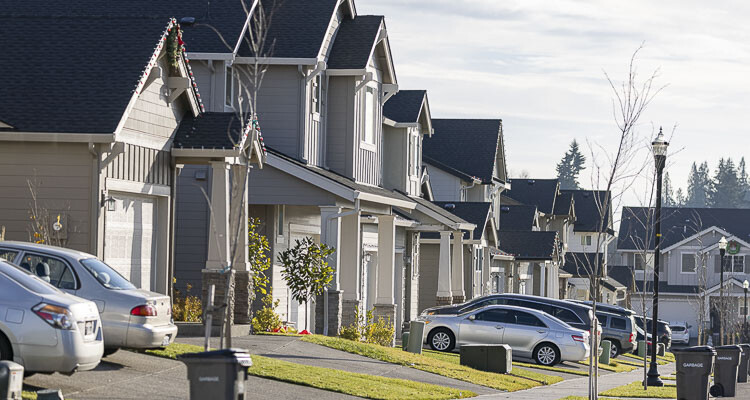
Mark Harmsworth says the Growth Management Act has laudable goals but it’s obvious now, 30 years later, that state lawmakers over-reacted and it went too far
Mark Harmsworth
Washington Policy Center
Increasing housing density in existing neighborhoods was one solution offered by the legislature this year to improve housing affordability. The passage of House Bill 1110, referred to as the ‘Middle Housing Bill’, passed, with concerns, due to state preemption (overruling local zoning ordinances) and the potential impacts to existing, established neighborhoods.

According to the state Office of Financial Management, the median home price since 1995 has quadrupled with Washington. We now have the sixth highest median home price in the United States.
The reason? We have lots of people and not enough housing.
A new survey released by Zillow, shows increased support for higher density housing, but only if the housing is built withing walking distance of transit, parks and recreation. The “Not In My Back Yard” effect became more apparent when Seattleites were asked about larger densities in more traditional single family home neighborhoods, dropping support from 84% to 41%.
Accessory Dwelling Units (ADUs) garnered the greatest support at 89% of residents supporting them in their neighborhoods.
Back in 1990, Washington lawmakers thought “urban sprawl” that was afflicting the larger cities, such as Los Angeles, was our biggest problem. They decided to restrict buildable land to prevent the building of new neighborhoods in most rural areas.
Initially, as the GMA took effect, housing prices increased only modestly, but as the normal demand for more housing grew after 2012, the restrictions imposed in the early 1990s started to have a significant effect on pricing and availability. The GMA requires population targets for cities, strictly enforced by the Puget Sound Regional Council (PSRC), that continue to promote increasing densities through the removal of single-family homes and multi-family housing. These growth targets require cities to adsorb more population, through new construction or annexation of the surrounding areas. For cities that are already built out, such as Edmonds, Mukilteo or Shoreline, this is a significant problem. Nearby all buildable land remains off limits.
Middle housing is one option, but ultimately the GMA needs to be changed to allow more homes to be built.
Simple adjustments to the Growth Management Act, like modifying the arbitrary growth boundaries and reducing the population density goals set by the Puget Sound Regional Council, would increase available land and the ability for more housing to be built. Pairing this improvement with the streamlining of the permitting process would increase housing availability in short order.
The Growth Management Act has laudable goals but it’s obvious now, 30 years later, that state lawmakers over-reacted and it went too far. If we want to see more affordable housing return to Washington, the GMA has to be updated to meet modern conditions.
Mark Harmsworth is the director of the Small Business Center at the Washington Policy Center.

Also read:
- Opinion: Half the road, full stop – Understanding pedestrian right-of-way
 Doug Dahl explains how Washington’s law requires drivers to stop when a pedestrian is within one lane of their half of the road, not just when directly in front.
 - Opinion: The state’s RFK-proofing bill comes with a cost
 Mandates like HB 2242 can lead to higher premiums as insurance companies absorb costs for new preventive services, affecting affordability statewide.
 - Opinion: What is the cost of a bridge?
 John Ley argues the I-5 Bridge replacement’s soaring cost stems from costly extras like light rail, noting other states deliver larger, toll-free bridges for much less.
 - POLL: Do you agree with giving a state commission the power to remove an elected sheriff?
 A new poll asks if a state commission—not voters—should have the power to remove an elected sheriff, following concerns raised by Clark County Sheriff John Horch.
 - Opinion: Defending Democracy by denying it?
 Washington voters are blocked from weighing in on new income taxes as state lawmakers and officials bypass public input, drawing criticism from Northwest voices.
