



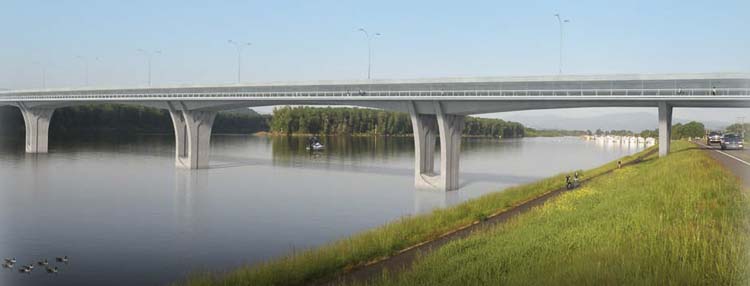
Clark County Today Editor Ken Vance says our neighbors need to do a better job meeting us halfway on transportation solutions and Washington’s lawmakers and leaders need to start playing a little hardball with their Oregon counterparts
Ken Vance, editor
Clark County Today
In my most recent in a series of columns that I will devote to possible solutions for our region’s transportation issues, I reintroduced the idea of an East County Bridge that would provide Southwest Washington drivers with a much-needed third crossing over the Columbia River.

That column generated a number of responses, including one reader describing it as one of the dumbest ideas I’ve ever had. While I do not agree with that assessment, I acknowledge he had an interesting point in explaining why he thought my idea was less than appealing – Oregon couldn’t care less about a third bridge.
But before addressing his reasoning, first a review:
The vision for this bridge was embraced by Clark County citizens in two separate advisory votes, one that voters approved in the November 2013 General Election that asked voters county-wide if the Board of County Commissioners (now Clark County Council) should work to get a real proposal that would include an actual design, a maximum price less than $900 million, flexible financial terms, and an achievable time frame. The majority of voters said yes and directed their Clark County Commissioners to lead that charge. If successful, the plan was that those specifics would be proposed to the voters for their approval in 2014. A proposal was successfully completed. Bridge builder Figg Engineering stepped up and provided a real design, quoted a price guaranteed to be less than the preferred maximum, offered pre-approved multi-year financing, and guaranteed that everything would be completed – including all design, permits, and construction – within five years of receiving the green light. The builder also promised to cover against any cost overruns.
Those specifics were presented to Clark County voters in the November 2014 General Election. Voters again said yes and directed their county commissioners to provide the local leadership, champion the project, share the vision, and build the support to succeed. However, even though the majority of citizens throughout Clark County and in the city of Vancouver supported the proposal, the Vancouver City Council opposed it, preferring the Columbia River Crossing (CRC) project instead, including light rail and tolling. The interchange at SR-14 and 192nd Avenue, where the proposed East County Bridge would connect, lies within Vancouver city limits, so that connection was effectively dead.
My ‘dumbest idea’
In the days since I reintroduced the proposed East County Bridge, reaction has been mixed, which is exactly what I anticipated (even though 85 percent of those who responded to our current poll question approved the proposal). In my opinion, the best of the comments in opposition to the proposal came from a contributor who identified himself as Mike Spence. A portion of his comment I provide here:
“… that’s the dumbest idea CCT’s editor has had in several months,’’ Spence wrote. “Ya’ see, on the other side of said bridge (actually halfway across the river) is … wait for it … Oregon. Oregon has expressed no desire to have a third bridge, no wish to tear down a thriving manufacturing area, no yearning to tear up marinas, no longing to build new infrastructure over wetlands, no craving to spend multi-millions of dollars all in order to connect with Clark County.’’
Spence went on to accurately state other obstacles to the idea, but the above portion is what I want to discuss today. He is 100 percent correct. Oregon lawmakers and transportation officials showed no interest in the proposal when it was first introduced more than a decade ago and there is nothing to suggest to me that it’s any different today. But, I want to clarify that Oregon’s leadership has never shown any interest in any solution to our region’s transportation issues unless it serves their desire to extend TriMet’s light rail into Washington while folding in bailout funding for that near-bankrupt transit agency and the state’s own underfunded transportation projects. The bottom line is this, when it comes to transportation issues, Washington residents deserve a better and more reliable partner than Oregon.
A little history lesson

Chuck Green retired from his position as Ridgefield’s Public Works director effective June 30. The news release from the city of Ridgefield said “he is looking forward to traveling with his wife and continuing to be involved in the local community.” Green served as Public Works director in Ridgefield since January 2023 after several months on contract as interim city engineer and commercial projects review manager. Before joining the city of Ridgefield, he contributed to Ridgefield projects as a consultant, including being construction manager for the Ridgefield Outdoor Recreation Complex and various transportation plans throughout the 2000s. His extensive public project work history includes the Hood River Bridge Replacement, Clark County Public Works Transportation Group, C-TRAN Vine Bus Rapid Transit, and public service on the Clark County Charter Review Commission and Commission on Aging. All told, Green worked for 43 years in public service over his career.
Green is one of the more experienced persons in Clark County regarding transportation projects and the history of discussions between Washington and Oregon. In 2021, he shared the following on social media.
“The I-205 Bridge was opened almost 40 years ago. Since that time:
Clark County’s population has grown 261 percent
Cross-Columbia River vehicle traffic has grown 239 percent
Cross-River Transportation Capacity has grown 0 percent
“I went back into my database to look at all of the ‘good ideas’ for new transportation capacity between Oregon and Washington since the 1950s, in the sense of ‘a new (bridge, tunnel, tram, train, boat) between Oregon and Washington would be a really good idea, don’t you think?’
“Since the 1950’s, there have been over 20 ‘good ideas’ about some new cross-river, bi-state connection. Other than the second I-5 bridge span and the I-205 bridge, both of which were planned and funded by the federal government, how many of these ‘good ideas’ have been implemented?
“Zero.
“Other than the Frog Ferry, which is a recent proposal by a Portland group, how many of these good ideas were proposed by Oregonians?
“Zero.
“Other than the I-5 bridge replacement/Columbia River Crossing project, how many of these “good ideas” are on any adopted transportation plan?
“Zero.
“So, I present to you, the ‘road to good ideas’ proposed over the years here in Clark County.’’
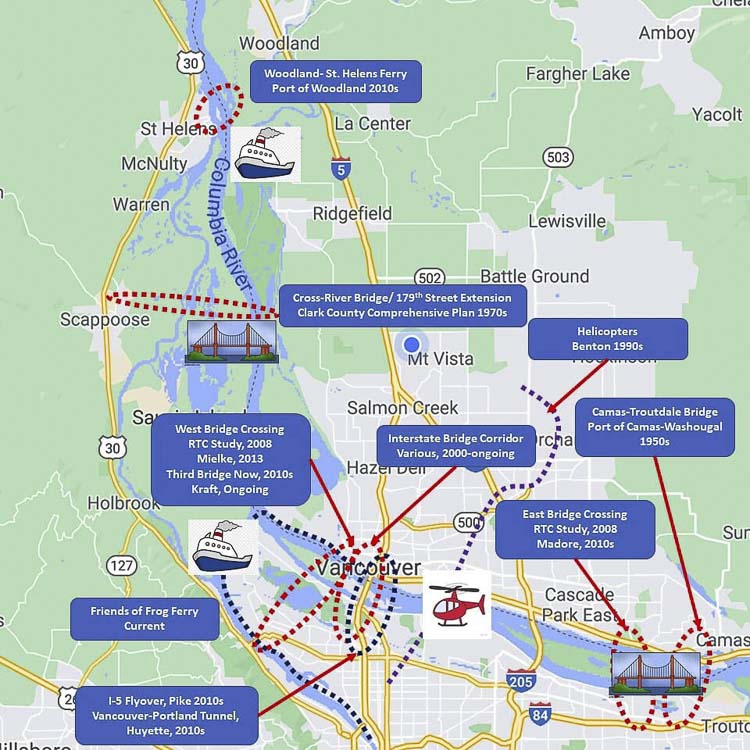
Rep. John Ley shared Green’s thoughts in a previous Clark County Today report. In that report, Ley did provide a couple of ideas that Oregon leaders actually did propose. Despite that, I certainly share the perspective and context of Green’s original information. And, I believe strongly that it helps to illustrate the fact that Oregon has not been a good partner to Washington in addressing the transportation issues shared by the two states. It also shows that ideas for future solutions should not be vetted through the lens of what Oregon leaders will or will not approve. Washington sends about 75,000 of its residents into Oregon for employment and those workers pay state income taxes in Oregon. So, our neighbors need to do a better job meeting us halfway on transportation solutions and Washington’s lawmakers and leaders need to start playing a little hardball with their Oregon counterparts.
Also read:
- Drivers may experience traffic delays and closures during summer road preservation work in Clark County
 Multiple preservation methods including slurry seal, chip seal and hot mix asphalt will impact county roadways.
 - Vancouver Fire Department responds to emergency aircraft landing on SR-14
 A Cessna aircraft made an emergency landing on State Route 14 near milepost 2 after experiencing mechanical issues.
 - Final Supplemental Environmental Impact Statement published for Interstate Bridge Replacement Program
 Federal agencies published the final environmental impact statement for the Interstate Bridge replacement project.
 - Speed cameras designed to bring added safety to work zones
 WSP issued 65,000 infractions in first year, with 59,000 being penalty-free first offenses as program expands statewide.
 - Marie Gluesenkamp Perez seeks federal assistance in combating sea lion predation of salmon & steelhead fishing stock
 Congresswoman pushes for expanded lethal removal authority as sea lions devour Columbia River fish stocks.
 wpDiscuz
