



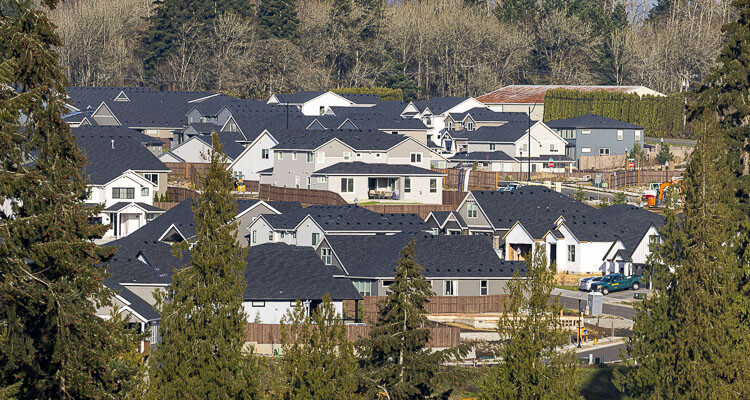
Mark Harmsworth of the Washington Policy Center says the bill will, in the long term, only continue to increase the cost of affordable housing
Mark Harmsworth
Washington Policy Center
House Bill 1389 (HB 1389), otherwise known as rent control and similar to House Bill 1124 (HB 1124), will have a devastating effect on the affordability of rental housing and will increase rents.

There have been numerous studies that have shown the effects of rent control in other states. All point to a short-term positive impact, but long term, rent control has caused a decrease in affordability, lower quality rental properties and an increase in rents. The Brookings Institute published a report in 2018, which is still relevant today, that clearly shows that over time, rent control has the opposite effect to the original intention, which is to keep rents as low as possible.
Similar legislation has previously been passed in other states and now, given enough time has passed, the real impact is becoming apparent.
And it’s not good news for renters.
San Francisco, which enacted rent control in 2019 has seen a 15% reduction in rental housing availability with condo conversions falling 25%. Similar results have been seen in other cities where rent control has been implemented, such as Cambridge, Brookline, Boston and Minneapolis/St. Paul.
St. Paul saw developers pull out of development projects since they were no longer profitable. With permit applications down 80%, the St. Paul City Council, in response, realizing the dire situation rent control was creating, quickly voted in September 2022 to change the rental cap limits and create exemptions for developers to try to salvage the situation.
National Public Radio, in a 2019 interview with Rebecca Diamond, an economist from Stanford University, called out the long term, detrimental effect of rent control. Diamond explained property owners moved money out of the rental market, decreasing housing availability by 25% which drove up the costs of rent. The fix, according to Diamond, is to increase the amount of available housing stock.
In Washington, the passage of the Growth Management Act (GMA) in 1990, restricted buildable lands which has reduced the number of new homes that have been built. The housing crisis in Washington was partially created by public policy and now it’s time to update and reform the GMA. Simple changes to the GMA by modifying the arbitrary growth boundaries and population density goals set by the Puget Sound Regional Council (PSRC), will increase available land and the ability for more affordable housing to be built.
House Bill 1389 and rent control will not solve housing affordability in either the ownership, rental or commercial real estate markets. It will, in the long term, only continue to increase the cost of affordable housing.
Mark Harmsworth is the director of the Small Business Center at the Washington Policy Center.

Also read:
- Opinion: Sheriffs fight back
 Four county sheriffs are suing to block a new law giving a governor-appointed board power to decertify and remove sheriffs, bypassing voter oversight in Washington.
 - Opinion: The growing gap between public voice and political power
 Todd Myers describes how large-scale protest and sign-ins often fail to sway state leaders, and argues authentic influence is most likely found through local action.
 - Opinion: Who is winning the race for affordable power?
 Hydroelectric power keeps Washington competitive, but new laws and carbon pricing are driving up electricity costs for residents each year.
 - Opinion: Half the road, full stop – Understanding pedestrian right-of-way
 Doug Dahl explains how Washington’s law requires drivers to stop when a pedestrian is within one lane of their half of the road, not just when directly in front.
 - Opinion: The state’s RFK-proofing bill comes with a cost
 Mandates like HB 2242 can lead to higher premiums as insurance companies absorb costs for new preventive services, affecting affordability statewide.
