




Todd Myers of the Washington Policy Center says that we can expect Washington’s elected officials to continue to prioritize politics over the planet
Todd Myers
Washington Policy Center
Governor Inslee wants to buy 8,767 people a $1,125 latte. Metaphorically, at least.
Governor Inslee’s new program to subsidize the purchase of electric vehicles is so wasteful at reducing CO2 emissions, it is the equivalent of paying that absurd amount for a 16-ounce latte.

On Earth Day, Governor Inslee announced a $45 million program to subsidize the purchase or lease of electric vehicles. The program is targeted at those making 300% of the federal poverty level or less, which amounts to $93,600 per year for a family of four.
The program pays up to $9,000 for a lease of three years or more, and $5,000 for a purchase or two-year lease.
The state estimates the subsidy could reduce up to 24,000 metric tons of CO2 over the life of the program. They estimate that about 8,767 people would receive rebates and that each vehicle purchase would reduce 3.65 metric tons of CO2.
What does that mean for the planet? Virtually nothing. Even worse, it is a massive waste of money that could go to projects that do yield environmental benefits.
Using the state’s own estimates, the program pays $1,875 to reduce each metric ton of CO2. By way of comparison, the state’s CO2 price is only $25.76, or just over one percent the amount paid by the subsidy.
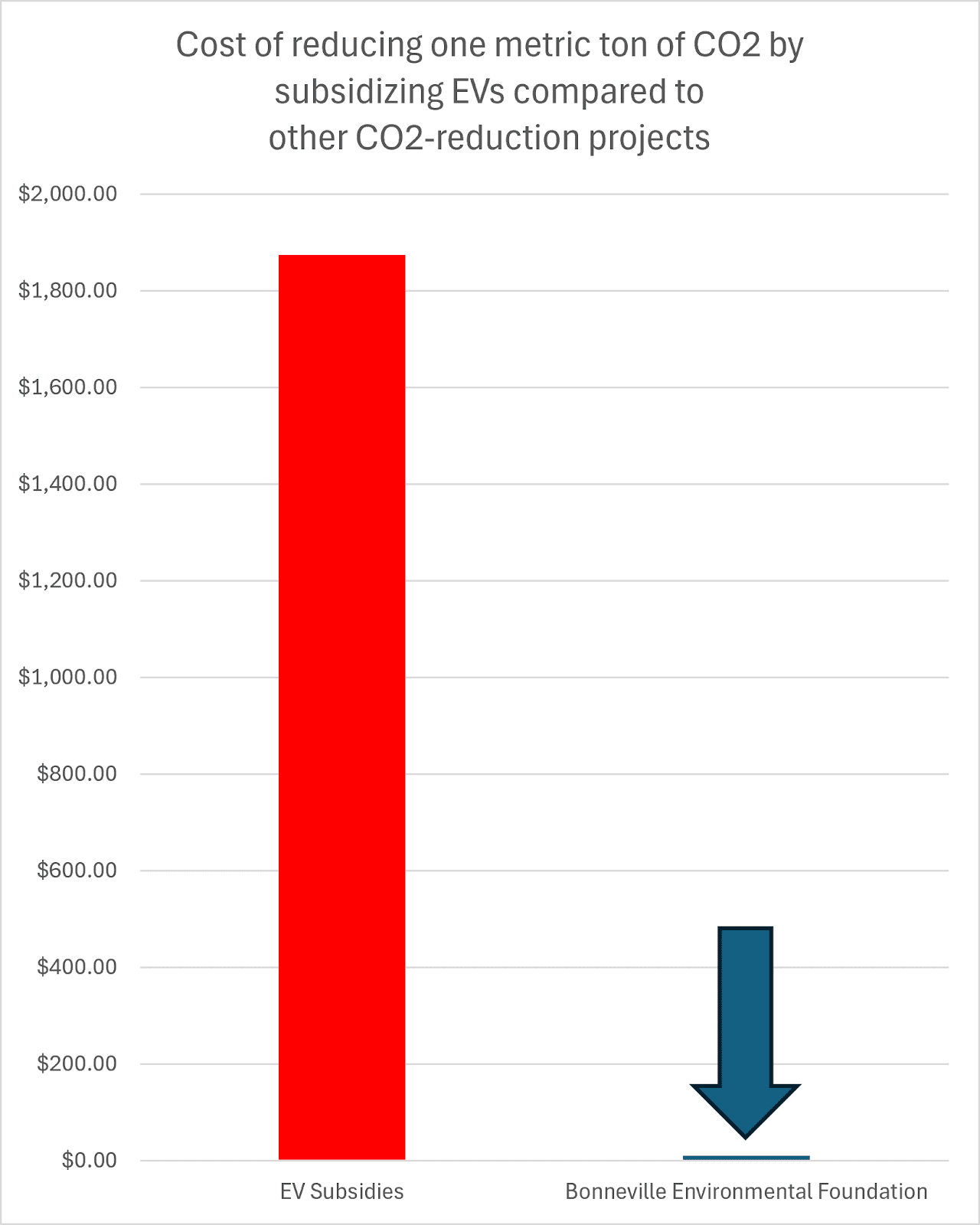
It is even worse than that. Anyone can invest in projects that reduce CO2 emissions for $10 per metric ton. At that rate, the state’s new EV subsidy spends about 187 times as much as publicly available alternatives to cut CO2 emissions. That’s like paying $1,125 and getting a $6 latte.
The press release says the program is important because “Transportation is the biggest contributor to greenhouse gas emissions.” Even if the program is successful and yields the maximum CO2 reductions they predict, it would reduce total state transportation-related CO2 emissions by about 0.03%.
It spends $45 million to reduce transportation-related CO2 emissions by about three one-hundredths of a percent. By way of comparison, for the same amount, the state could have doubled the two-year budget for salmon recovery projects funded by the Washington State Salmon Recovery Funding Board.
It is even worse than that.
Washington state already has a cap on CO2 emissions, so any reductions in one area mean the state can emit more elsewhere up to the cap. In effect, this program does nothing to reduce CO2 emissions because the tiny amount of reduction will be made up elsewhere, as allowed by the state’s CO2 law.
This is one more example of how wasteful and ineffective Washington’s climate policy is. It also reveals the disingenuousness of claiming that climate change is an “existential crisis” while wasting tens of millions of dollars on projects that do nothing to address that crisis.
As long as the media coverage is uncritical and special interest groups continue to praise government waste, we can expect Washington’s elected officials to continue to prioritize politics over the planet.
Todd Myers is the director of the Center for the Environment at the Washington Policy Center.

Also read:
- POLL: Do you support extending light rail beyond the waterfront to connect with C-TRAN at Library Square?
 Readers can weigh in on Anne McEnerny-Ogle’s proposal to extend light rail beyond the waterfront to Library Square for improved C-TRAN connections.
 - Opinion: Passing a cyclist – Law, myth and a little patience
 Most drivers can’t legally pass cyclists in-lane due to vehicle width versus road measurements.
 - Opinion: The path to real tax reform requires a spending limit
 Washington Policy Center director argues constitutional spending caps would force real budget tradeoffs instead of endless tax increases.
 - Opinion: ‘Both states know they have seriously flawed voter registration’
 Lars Larson argues Oregon and Washington are suing DOJ to avoid cleaning up fraudulent voter rolls before elections.
 - Letter: Compassion without accountability is failing Clark County
 Sarah Mittelman calls for clear standards and measurable results in homelessness spending.
 wpDiscuz
