



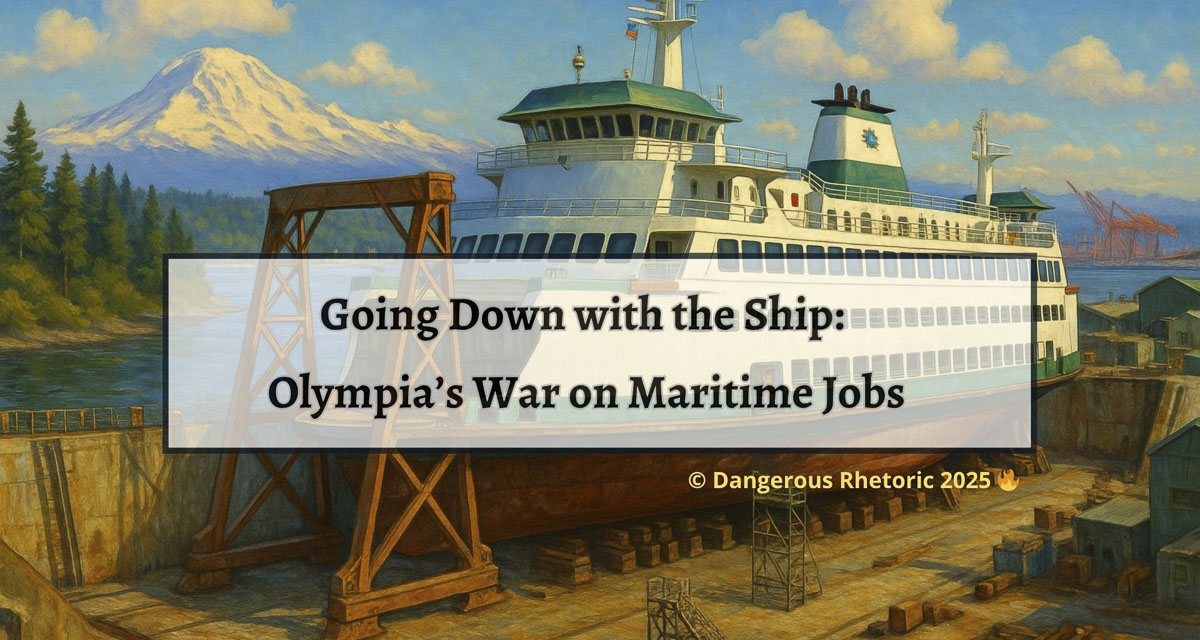
Nancy Churchill shares her views on Olympia’s war on maritime jobs
Nancy Churchill
Dangerous Rhetoric
Washington state has over 3,000 miles of shoreline, with nearly 30% used for ports and shipyards. We also have a legacy of naval shipyards dating back to World War II and one of the largest ferry systems in the world.

With all these natural advantages, you’d think we’d be a national leader in shipbuilding. But we’re not.
Instead of building ships for the future, Washington policymakers are driving the industry into drydock with high taxes, red tape, and political neglect.
This year, our state outsourced the construction of three new ferries to a Florida shipyard — passing over in-state companies that have built vessels here for generations. This isn’t just a missed opportunity. It’s a warning sign. If we don’t act, the last vestiges of our shipbuilding legacy may sink beneath the waves.
Washington should be a shipbuilding powerhouse. But we’ve let that potential rust.
A natural advantage, squandered
No other state on the West Coast has Washington’s geographic edge. Puget Sound offers deep-water ports, protected inlets, and a moderate climate ideal for year-round marine work. Our shipyards in Seattle, Everett, Bremerton, and Tacoma once turned out aircraft carriers, destroyers, and the nation’s first nuclear submarines. Today, public and private yards still handle Navy overhauls, ferry retrofits, and commercial conversions.
We have the infrastructure, the expertise, and the need. The world’s oceans are growing more contested. The U.S. Navy’s 30-year shipbuilding plan is the most ambitious since the Cold War. Demand for ferries, tugs, and patrol vessels is rising fast. And yet, instead of seizing this moment, Washington is watching shipbuilding jobs drift to other states.
Taxed to death
Washington’s tax structure actively punishes capital-intensive industries like shipbuilding. The state’s Business & Occupation tax hits businesses not on profits, but on gross receipts—no matter how thin the margins. Add to that a maze of environmental permitting delays and regulatory mandates, and expansion becomes nearly impossible.
While states like Florida and Mississippi offer tax credits and fast-track industrial approvals, Washington’s shipbuilders face paperwork and penalties. That’s why, when it came time to build three new hybrid-electric ferries, Governor Bob Ferguson bypassed local firms like Vigor Industrial and Nichols Brothers and awarded the contract to Eastern Shipbuilding in Panama City, Florida.
Florida got the work; we got the bill
In a recent op-ed, Bob Pishue noted: “Washington companies should be able to compete in their own backyard, just like they want to compete in other states.” Taxpayers achieved a win, because the state’s open competition saved taxpayers hundreds of millions of tax dollars by driving costs down 33%.
However, while taxpayers may have won the cost-control battle, we’re losing the war by failing to support local industry. Even with a local tax credit, Washington shipbuilders couldn’t secure the contract — proving just how uncompetitive the industry has become. Jobs slipped away, and a sector that should be thriving is now at risk of capsizing.
“This should signal an urgent S.O.S. to lawmakers that they need to right the state’s tax and regulatory ship,” Pishue continued.
Political neglect
Shipbuilding doesn’t fit the narrative in Olympia. While lawmakers trip over themselves to subsidize solar panels and climate consultants, they ignore the strategic value of a strong marine manufacturing base. Despite its past and potential economic impact, the maritime industry receives a fraction of the attention and support granted to sectors like aerospace, software, or green energy.
The ferry outsourcing decision this year didn’t just cost Washington jobs. It sent a message: Our leaders no longer believe in building things here. While other states nurture industrial capacity with pride, we seem embarrassed by ours: “Gov. Bob Ferguson made the final call to accept the low bid from Florida-based Eastern Shipbuilding Group to build three new hybrid electric ferries…”
Infrastructure and labor bottlenecks
It’s true that many WWII-era shipyards in Seattle and Tacoma have been decommissioned or repurposed. But the bones are still there — dry docks, piers, and cranes that could anchor a resurgence in modern shipbuilding. The challenge isn’t geography — it’s political will.
Meanwhile, the workforce is aging. According to the Government Accountability Office, many civilian workers are nearing retirement. And private firms report difficulty recruiting the next generation. Washington needs more investment in vocational education, high school trade pathways, and public-private apprenticeships. We need welders, fabricators, and pipefitters as badly as we need coders and consultants.
The GAO reports, “Over the next decade, the shipbuilding industrial base will require 174,000 new workers to keep pace with the service’s shipbuilding goals.”
With a commitment to our shipbuilding industry from politicians, Washington could also lead the way in developing the skills of the next generation of shipbuilders with our existing civilian apprenticeship program.
“Since 1901, the civilian apprenticeship program at Puget Sound Naval Shipyard & Intermediate Maintenance Facility in Bremerton, Washington, has trained civilians in more than two dozen shipyard trades, including welding, machine operations, electrical work, rigging, painting and shipfitting.”
Procurement and global pressure
U.S. shipbuilders already face steep competition from foreign yards that are lavishly subsidized by governments in China and South Korea. Without strategic support, they struggle to compete even in the domestic market. The Jones Act protects some U.S.-built ship requirements, but it doesn’t ensure those ships are built in Washington.
And yet, even when the state itself controls procurement — as in the recent ferry deal—it fails to support its own industrial base. If Washington won’t choose Washington when it can, why would anyone else?
Time to right the ship
Washington state has every natural and historical advantage to be a shipbuilding giant. But it won’t happen by accident. It requires action:
- Tax reform to reward capital investment and high-skilled industrial work.
- Procurement policies that prioritize in-state jobs and long-term capacity.
- Workforce development, especially in the trades and apprenticeships.
- And above all, political leadership that values industry as much as ideology.
We can build ships in Washington. We’ve done it before. We still do it now—in spite of the obstacles. But unless we reclaim our industrial backbone, the next generation won’t.
Let’s stop wasting the waterfront and kneecapping our industries. Let’s build.
Nancy Churchill is a writer and educator in rural eastern Washington State, and the chair of the Ferry County Republican Party. She may be reached at DangerousRhetoric@pm.me. The opinions expressed in Dangerous Rhetoric are her own. Dangerous Rhetoric is available on Substack, X, and Rumble

Also read:
- Opinion: Defend bail now or face more chaos on our streets
 A proposed Washington court rule would cap bail for most misdemeanors and allow defendants to bypass bondsmen, raising concerns about accountability and public safety.
 - Opinion: Someone explain the Democrat Party to me please
 Lars Larson criticizes Democrat politicians for shutdown threats, Homeland Security funding refusals, and positions on election laws, housing, and gun rights.
 - POLL: Do you agree with requiring board members to follow council direction?
 Disagreement among county councilors centers on whether C-TRAN board members should reflect the council’s collective wishes or act independently, highlighting ongoing concerns about public accountability.
 - Opinion: In plain sight – yielding to pedestrians
 Drivers often fail to see pedestrians due to inattentional blindness, which highlights the need for more focused awareness at intersections and stronger safety practices.
 - Opinion: The legislature has committed $2.4 billion to recurring pension increases since 2018
 Six legislative COLAs have raised public employer costs by $2.38 billion since 2018, driving up unfunded pension liabilities and increasing burdens on county and city budgets.
