



Unless elected officials and agency leaders in Washington recognize that government restrictions and regulation are hindering industry growth, Washington will continue to lag behind states where climate policy isn’t a priority
Todd Myers
Washington Policy Center
Climate policy is one of the most divisive political issues in the United States, but one thing people agree on is that innovation will be key to addressing the problem. Elected officials and agency staff in Washington Government the state is a leader in environmental innovation, but the evidence is growing that the biggest obstacle to that sector is the government itself.

Writing in The Seattle Times, environmental innovator Makoto Eyre highlighted the potential of carbon capture technology to remove CO2 from the atmosphere and turn it into valuable products. He wrote, “Recent findings from the United Nation’s Intergovernmental Panel on Climate Change demonstrate that we will need to build up the global capacity to remove 10 billion tons of greenhouse gas annually by 2050 to keep global temperatures from rising to dangerous levels — even if humanity substantially reduces emissions.”
To that end, Washington state taxpayers are chipping in with a $12 million grant program for climate tech.
Ironically, if Eyre’s company is successful, the state’s climate law puts severe restrictions on using it to meet Washington’s climate goals.
The technology would have to go through a rigorous assessment by the Department of Ecology to certify that it achieved verifiable CO2 reductions. But there is an even more severe barrier facing the company
Carbon capture is still relatively expensive, but if the technology Eyre’s company is developing could remove atmospheric CO2 for a low price, the state’s climate law would limit its use to only five percent of compliance with the state’s carbon goals for organizations covered by the law, like the University of Washington and BP. For the other 95 percent they would have to pay a tax to Washington state.
State taxpayers would subsidize an industry the Department of Ecology certifies is effective while state law would severely limit the market for that same industry. And yet, that is what Washington state is doing.
It is just one example of how rhetoric about growing the green economy is at odds with the state’s regulatory environment.
The Washington State Department of Commerce targets “clean technology” as one of its “key sectors” for economic growth. The agency’s website claims, “Washington State is leading the way in developing and adopting a clean, affordable and sustainable energy portfolio.”
Despite the rhetoric from the governor and state agencies about building a green economy in Washington state, most of the growth in production of wind, solar, and battery technology has been in the Southeast United States, where there are no aggressive climate laws but the business environment is better.
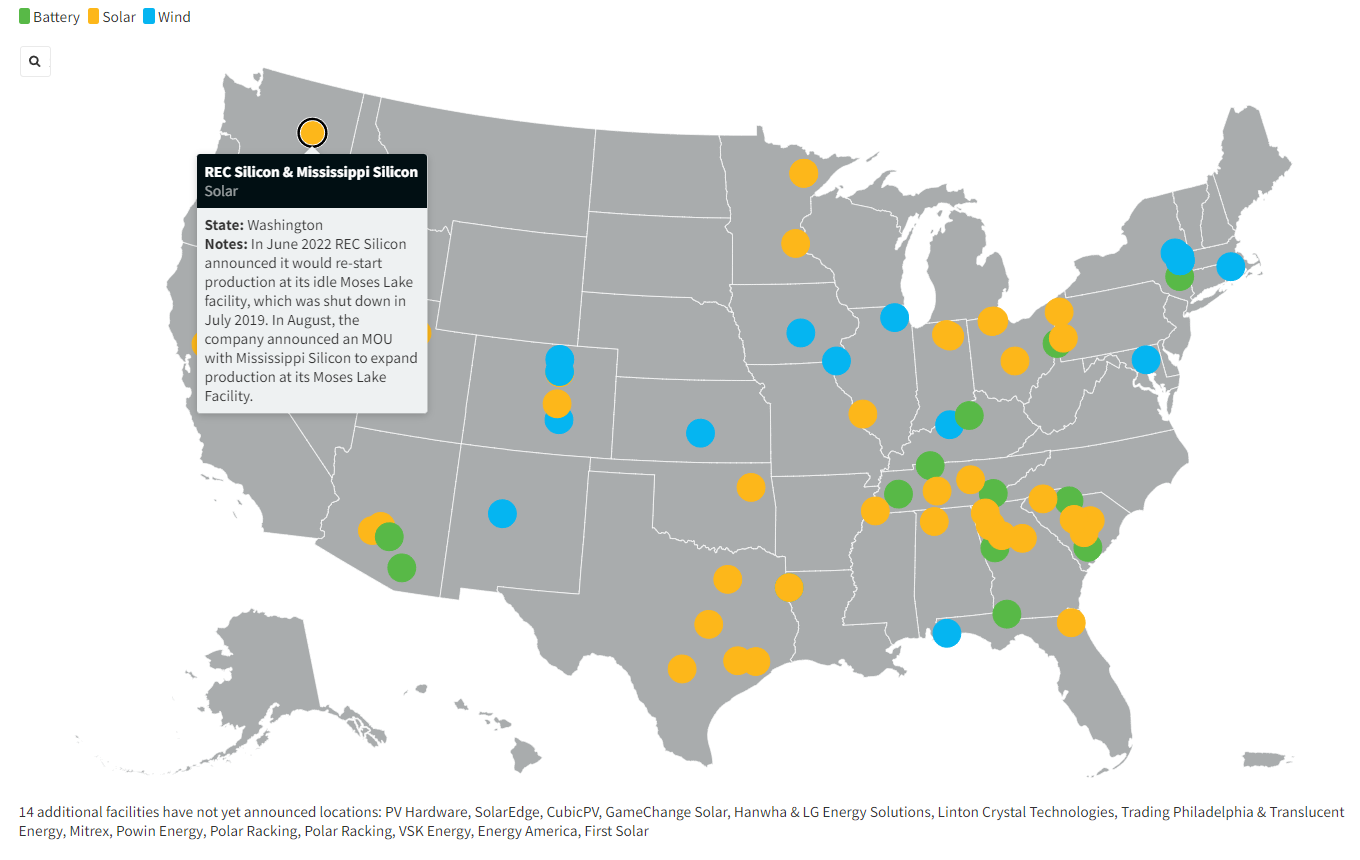
This map from American Clean Power tracks announced plans to build solar, wind, and battery plants in the year since the federal government announced massive new spending on those industries. Notably, the only plant in Washington is not new but one that is re-starting production. Meanwhile, South Carolina, Tennessee, and Georgia each have six new manufacturing plants. Companies are indicating where they think they can be successful, and it isn’t Washington state.
When Washington state utilities are required by law to buy batteries to keep the lights on, they will likely have been manufactured in the SE United States.
Some, like American Clean Power, argue that these announcements show that the huge spending proves the federal government can drive the green economy. I don’t doubt that if the federal government spent $1 trillion on the pet rock industry, there would be a dramatic increase in the production of geologic companions. The issue is whether this spending is productive and what these announcements indicate about what is important to businesses. Even in the so-called “clean power” sector, a favorable business climate is more important than state politicians’ commitment to fighting climate change.
Fundamentally, having politicians target particular industries for growth is unlikely to be successful. When Booth Gardner was governor in the 1980s, he didn’t plan to make Washington the world leader in online book sales, software, and coffee. And yet, 15 years later, Washington state was the leader in all of those areas.
The fact that the industries that Governor Inslee covets are locating far from Washington is more evidence that business climate matters more than environmental happy talk and government planning.
Unless elected officials and agency leaders in Washington recognize that government restrictions and regulation are hindering industry growth, Washington will continue to lag behind states where climate policy isn’t a priority.
Todd Myers is the director of the Center for the Environment at the Washington Policy Center.

Also read:
- Opinion: Sheriffs fight back
 Four county sheriffs are suing to block a new law giving a governor-appointed board power to decertify and remove sheriffs, bypassing voter oversight in Washington.
 - Opinion: The growing gap between public voice and political power
 Todd Myers describes how large-scale protest and sign-ins often fail to sway state leaders, and argues authentic influence is most likely found through local action.
 - Opinion: Who is winning the race for affordable power?
 Hydroelectric power keeps Washington competitive, but new laws and carbon pricing are driving up electricity costs for residents each year.
 - Opinion: Half the road, full stop – Understanding pedestrian right-of-way
 Doug Dahl explains how Washington’s law requires drivers to stop when a pedestrian is within one lane of their half of the road, not just when directly in front.
 - Opinion: The state’s RFK-proofing bill comes with a cost
 Mandates like HB 2242 can lead to higher premiums as insurance companies absorb costs for new preventive services, affecting affordability statewide.
 wpDiscuz
