



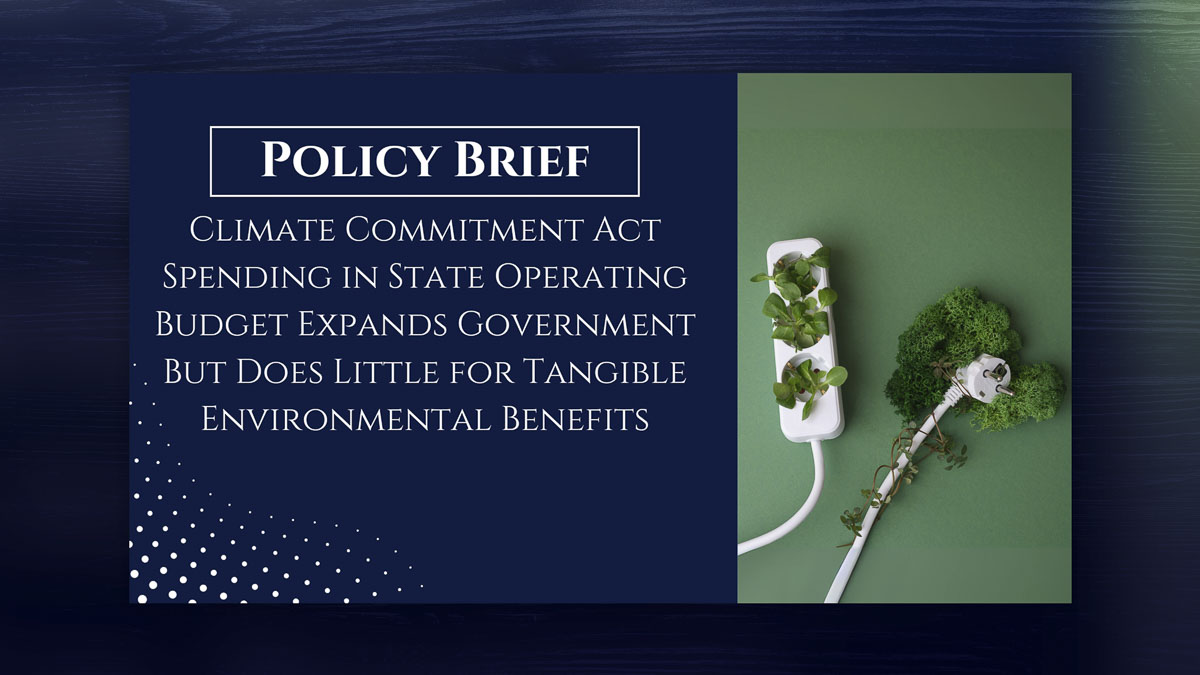
The state of Washington has collected nearly $4 billion in CO2 taxes since the beginning of 2023 to fund a range of government programs including public transit, electric ferries, CO2-reduction projects, climate mitigation, and environmental restoration
Todd Myers
Washington Policy Center
Key Findings
- The 2025-27 state operating budget spends about $174 million from CO2 taxes on various projects purportedly related to climate change.
- More than 70% of that spending goes to projects that increase the size of government or pay for government planning.
- Much of the spending that claims to mitigate climate impacts is actually used to hire more government employees or pay for studies.
- High-profile projects account for little of the total spending. For example, a project to reduce childhood asthma accounts for less than 0.2 percent of total spending.
- Facing a new budget shortfall, the governor should immediately suspend spending on projects that do not yield tangible environmental benefits.
Introduction
The state of Washington has collected nearly $4 billion in CO2 taxes since the beginning of 2023 to fund a range of government programs including public transit, electric ferries, CO2-reduction projects, climate mitigation, and environmental restoration. Supporters of the CO2 tax, known as the Climate Commitment Act (CCA), highlight the benefits of the tax, claiming that it is going to reduce childhood asthma, help disadvantaged communities, and reduce greenhouse gas emissions.
A close look at how the tax revenue is being spent in the new 2025-27 operating budget shows that, contrary to the rhetoric, much of the money ends up in state agencies to hire more government employees, pay for studies, and fund planning bureaucracy.
For example, more money is spent to pay for staff to “lead cross agency coordination for wildfire and extreme heat emergency management” – $382,000 – than to reduce childhood asthma.
More than 70 percent of CO2 tax revenue in the operating budget is going to expand government or fund planning bureaucracy rather than projects that yield tangible environmental benefits. For example, the second largest expenditure from CCA money in the 2025-27 operating budget is $22.5 million to fund local government planning for climate change.
About 18 percent of CCA tax revenue goes to government services including funding to reduce the impact of the CO2 taxes on energy bills by providing utility bill assistance or workforce training. Just nine percent of CCA tax revenue in the operating budget goes to actual environmental projects, including projects to promote forest health.
In total, about $174 million of the funding from the CO2 tax is included in the operating budget for the 2025-27 biennium in two accounts tied to the CCA – the Climate Commitment Account and the Natural Climate Solutions Account. About $90 million of that goes to government bureaucracy, another $30 million for planning, $35 million for services and just $15.8 million for actual projects.
There is also a significant amount of money from the CO2 tax included in the capital budget. Those expenditures are more likely to include actual projects. We will do a more detailed analysis of those projects and how effective they are at a later date. The spending in the operating budget accounts for about one-quarter of CO2 tax spending outside the transportation budget.
Supporters of these expenditures will argue that government overhead is necessary to manage programs that help achieve Washington’s climate goals. However, that has been the approach for two decades and the state has consistently failed not only to meet its CO2 targets but even to reduce emissions. The state has spent billions of dollars on government programs and bureaucracy, always with the promise that results will follow at some point in the future.
Rather than looking for a new approach, the 2025-27 Operating Budget continues the trend of hoping these programs will finally turn the corner.
Todd Myers is the vice president for research at the Washington Policy Center.
Also read:
- Vancouver Police arrest barricaded man
 Terry Meyers, 58, faces multiple assault charges after pointing firearm at neighbor and barricading himself.
 - 49th Legislative District Democrats share their reasons for backing state income tax at Town Hall
 Three Democrat legislators defended the new income tax affecting only those earning over $1 million annually.
 - Letter: Freeze the scope and build the bridge
 Vancouver resident calls for project discipline after 22 years of planning and nearly half a billion in costs.
 - Ekklesia Theatre presents ‘Every Brilliant Thing’
 Interactive theatre production donates 50% of ticket sales to local counseling services.
 - Opinion: Public workers’ First Amendment rights are getting attention – in Idaho, not Washington
 Idaho moves to stop public schools from collecting union dues through government payroll while Washington continues favoring unions over worker choice.
 - Opinion: Lawsuit filed against the unconstitutional income tax in Washington state
 Former Attorney General Rob McKenna and Supreme Court Justice Phil Talmadge challenge the 9.9% income tax in Klickitat Superior Court.
 - Vancouver Police investigate domestic violence homicide
 Vancouver Police Major Crimes Unit investigating after woman found dead with knife wounds on NE Oakbrook Circle.
