




Liv Finne states that forward-looking lawmakers across the country have responded to the learning needs of children by giving them access to expanded school choice funding
Liv Finne
Washington Policy Center
An exciting opportunity has emerged from the damage inflicted on students from the extended COVID public school shutdowns and school curriculum controversies. Forward-looking lawmakers across the country have responded to the learning needs of children by giving them access to expanded school choice funding.

The popularity of school choice is growing fastest in the South and Southeast. These laws give families public aid to customize the education program for their children, in a homeschool or in a private school, whichever is the best fit for the students.
School choice laws fulfill the vision of the conservative economist Milton Friedman and of left-leaning academics like Theodore Sizer and Phillip Whitten. Both sides agree choice produces the best learning results for children.
Liberal cities like Washington, D.C. and Baltimore already offer their families access, with low-income minority parents sending their children to private religious schools with this assistance.
School choice programs provide families from $4,000 – $8,000 per child to cover education expenses, including private school tuition.
Several states are now implementing exciting new School Choice programs. Here’s a current tally.
In the last three years eleven states have passed school choice programs open to all or 98 percent of families. These are:
- West Virginia (March 2021): This school year 6,300 students received Hope Scholarships of $4,500 average value each.
- Arizona (July 2022): 77,249 students received an ESA (spell out) each providing about $7,000 per student.
- Iowa (January 2023) 29,000 applications in 2023-24 for a Students First Education Account, with 17,481 approved. Average value for 2024-25 will be $7,800 per student.
- Utah (January 2023): 27,270 students have signed up to receive a Utah Fits All scholarship of $8,000 per student.
- Arkansas (March 2023) 5,600 students received an Education Freedom Account in 2023-24, average value $7,635 per student.
- Florida (March 2023) 407,000 students have received scholarships of $7,800 average value.
- Indiana (April 2023) 69,271 students were awarded School Choice Scholarships of average value $5,854.
- Oklahoma (May 2023) Nearly 30,000 families applied for the Oklahoma Parental Choice Tax Credit Act, which provides scholarships $5,000-$7,500 in value. The $150 million cap is expected to fund between 20,000 and 30,000 scholarships.
- Ohio (July, 2023) As of March 2024, 87,000 scholarships have been awarded of average value $6,165 for K-8 students and $8,407 for high school students.
- North Carolina (September 2023) 72,000 families have applied for an Opportunity Scholarship in 2024-25, with 13,511 funded in the first round.
- Alabama (March 2024) The CHOOSE Act is being implemented for 2024-25.
These initial results show how popular learning choice programs are with families.
In Washington state, despite the overwhelming opposition of the wealthy WEA union, there is a growing chorus of voices seeking access to better learning opportunities for children. These voices will grow louder every year as families hear about progress in other states in using public aid to give children access to the best education possible.
Liv Finne is the director of the Center for Education at the Washington Policy Center.

Also read:
- Opinion: Half the road, full stop – Understanding pedestrian right-of-way
 Doug Dahl explains how Washington’s law requires drivers to stop when a pedestrian is within one lane of their half of the road, not just when directly in front.
 - Opinion: The state’s RFK-proofing bill comes with a cost
 Mandates like HB 2242 can lead to higher premiums as insurance companies absorb costs for new preventive services, affecting affordability statewide.
 - Opinion: What is the cost of a bridge?
 John Ley argues the I-5 Bridge replacement’s soaring cost stems from costly extras like light rail, noting other states deliver larger, toll-free bridges for much less.
 - POLL: Do you agree with giving a state commission the power to remove an elected sheriff?
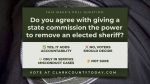 A new poll asks if a state commission—not voters—should have the power to remove an elected sheriff, following concerns raised by Clark County Sheriff John Horch.
 - Opinion: Defending Democracy by denying it?
 Washington voters are blocked from weighing in on new income taxes as state lawmakers and officials bypass public input, drawing criticism from Northwest voices.
