



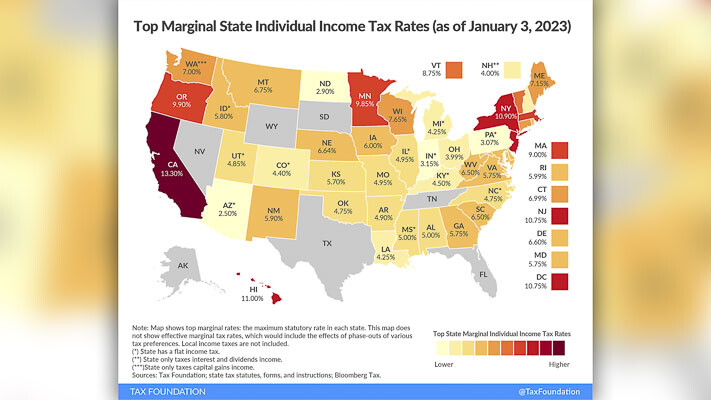
Taking effect for the first time this year, Washington is now the only state in the country to impose a standalone income tax on capital gains
Jason Mercier
Mountain States Policy Center
With property tax assessments increasing rapidly in Wyoming, some have begun to discuss whether there should be changes to the Cowboy State’s tax structure. It is important to first remember that assessed property values do not necessarily drive the actual property tax bill. Instead, that tax obligation is primarily set through the budget process by the amount to be spent (whether approved by government officials or voters through levies).

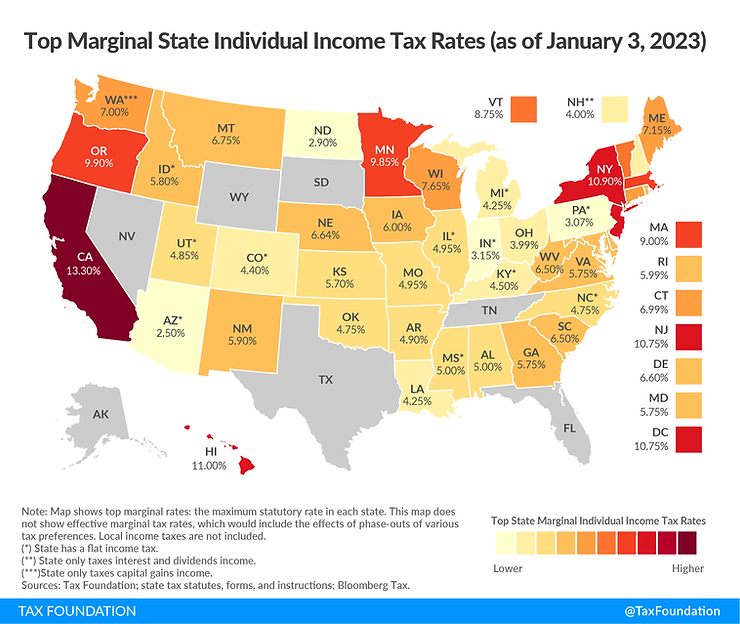
Concerning Wyoming’s current tax structure, as one of just a handful of states without a personal income tax, extreme caution should be taken to avoid losing this economic competitive advantage. This is especially true with any discussion of imposing a highly volatile and unpredictable income tax on capital gains.
Taking effect for the first time this year, Washington is now the only state in the country to impose a standalone income tax on capital gains (other income tax states tax it as ordinary income as part of their income tax codes). The policy choice has resulted in national tax rankings removing Washington’s prior standing of not having a personal income tax.
The federal Internal Revenue Service (IRS) has made it very clear that a capital gains tax is an income tax. Our friends at the Washington Policy Center posted this letter from the IRS clearly explaining this fact.
IRS: “This is in response to your inquiry regarding the tax treatment of capital gains. You ask whether tax on capital gains is considered an excise tax or an income tax? It is an income tax. More specifically, capital gains are treated as income under the tax code and taxed as such.”
Imposing taxes on capital gains income is not a recipe for predictable state revenue.
As explained by the California Legislative Analyst’s Office (LAO):
“California’s tax revenues have numerous volatile elements, but among the more significant sources of revenue volatility are the state’s tax levies on net capital gains through the personal income tax.”
“Capital gains depend heavily on movements in financial markets. As such, capital gains revenue is extremely volatile and difficult to predict. In any given year, there is significant risk that capital gains revenue could fall below budgetary expectations.”
If the goal of structural state tax reform is to improve budget stability and avoid boom-and-bust tax collections, an income tax on capital gains is the worst possible choice Wyoming policymakers can make.
Jason Mercier is the vice president and director of research at the Mountain States Policy Center.

Also read:
- Opinion: Washington passed an income tax to fund education, then the same majority cut education — and left $700+ million on the table
 State officials passed a new income tax to fund education, then approved over $1 billion in cuts—while forgoing $700 million in annual federal scholarships students could have received.
 - Letter: In defense of Joe Kent, a war hero
 Ozzie Gonzalez shares a firsthand account of his time working for Joe Kent, emphasizing Kent’s military background and principled stance on foreign policy controversies.
 - Opinion: ‘Washington’s majority party is panicking’
 Nancy Churchill argues that controversial state policies, including new taxes, law enforcement changes, and agency power grabs, are generating a wave of backlash in communities across Washington.
 - Letter: ‘Now we have Engineer Bob telling us the I-5 Bridge needs replacing because it is built on shifting sand with wooden structures’
 Amboy resident Thomas Schenk critiques Democrat leadership, tax policies, and the addition of light rail to the I-5 Bridge, while urging Republican voters to participate more in midterm elections.
 - Opinion: ‘This is not the best and most efficient use of the taxpayers’ funds’
 Ken Vance critiques the announced $14.4 billion I-5 Bridge replacement, questioning funding gaps, the insistence on light rail, unaddressed congestion, and transparency from state officials.
 wpDiscuz
