



Peter Bracchi says Vancouver’s records foreshadowed a fight for control of the Downtown Redevelopment Authority
Editor’s note: Opinions expressed in this letter to the editor are those of the author alone and may not reflect the editorial position of ClarkCountyToday.com
Weeks before the latest public showdown, the city of Vancouver’s own records pointed toward a push for tighter control over the Downtown Redevelopment Authority – and away from the board’s independent role.

The newest public reporting makes these records more important, not less. On March 17, The Columbian reported that Vancouver City Council advanced an ordinance that would move hiring power for the DRA executive director away from the DRA board. The public records obtained from the city show that this direction was visible weeks earlier.
That is why these documents deserve attention. They are not rumor, not campaign messaging, and not secondhand commentary. They are the city’s own records, obtained through a public records request, and they help explain how a personnel dispute turned into a broader struggle over governance, leverage, and control.
Key Issues
• Recent reporting says the Vancouver City Council advanced an ordinance to move DRA director hiring power away from the DRA board.
• A Feb. 13 city memo says Natasha Ramras’s DRA role did not automatically end when her city job ended.
• Emails between city and DRA lawyers show the dispute had already escalated into a direct power struggle.
• The DRA board voted 7-0 to keep Ramras temporarily and later praised her performance and continuity value.
This story matters beyond one employee or one board. The records suggest city leadership was dealing with two fights at once: a legal dispute after former CFO Natasha Ramras was fired, and a governance struggle over whether she would remain in her separately appointed DRA role. With the March 17 ordinance now moving in public, those earlier records look less like background and more like an early warning.
The first major document is a Feb. 13 memo from City Manager Lon Pluckhahn to the mayor and council. It says Ramras had retained counsel and filed a tort claim. Just as important, the memo acknowledges that her position as executive director of the DRA did not automatically end when her City employment ended because the DRA board had appointed her separately.
The second major set of records is the exchange between City Attorney Nena Cook and DRA counsel Dan Lloyd. Cook outlined the city’s legal powers over the DRA and said the city wanted to discuss its recommendation if the executive director position became vacant. Lloyd responded that the message ‘comes off as a threat’ and read it as ‘do what the City wants or else.’ That language, in the public records themselves, makes it difficult to describe this as a normal internal HR matter.
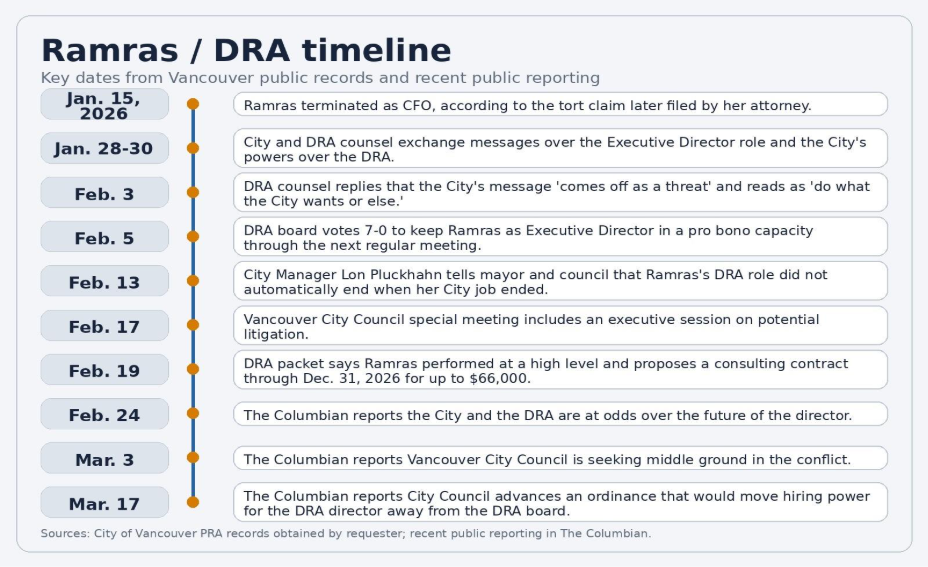
Timeline graphic: key dates from the records, plus the new March 17 public development.
The DRA’s own actions also matter. On Feb. 5, the board voted 7-0 to keep Ramras in a pro bono role until the next regular meeting. A Feb. 19 DRA packet then said she had performed at a high level, brought important institutional knowledge, and had continued providing services for continuity. That same packet proposed a consulting agreement through the end of 2026 for up to $66,000.
Important balance point: the retaliation and discrimination allegations remain allegations unless proved in court. The stronger public takeaway from these records is the documented struggle over the DRA role and the city’s influence over it – a struggle that now appears to be moving into formal city policy.
Why the records matter now
The public significance is now clearer than ever. The March 17 Columbian report says City Council has moved closer to taking hiring power for the DRA executive director away from the DRA board. That makes the earlier records easier to read: what appeared in February as pressure and leverage is now taking shape as formal policy.
Recent headlines described a conflict between the city of Vancouver and the DRA. These records explain why that conflict mattered. They show the dispute was connected to downtown governance, who would control a public authority, and how much leverage City Hall was prepared to use behind the scenes.
Whether Ramras ultimately wins or loses in court, the larger public question is no longer hypothetical. If a body described as independent can be pressured, restructured, or brought into line when conflict arises, residents deserve to know how and why. That is what makes these records worth reading.
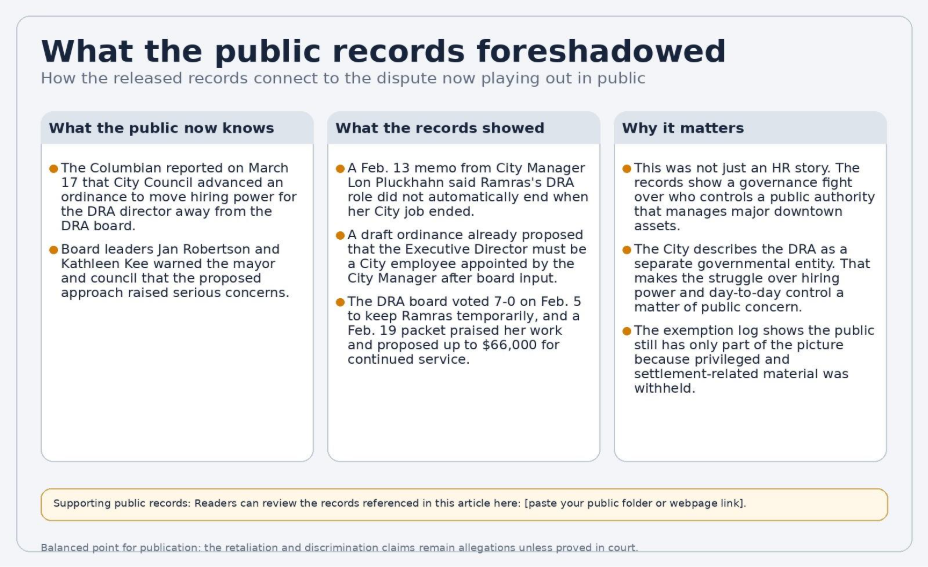
Summary graphic: how the released records anticipated the public fight now unfolding.
Supporting public records referenced in this article: https://drive.google.com/drive/folders/14UXdVVbS3IW87c6uBHxDnCHBeIaQ4A17?usp=sharing
Peter Bracchi
Vancouver

Also read:
- Opinion: Sheriffs fight back
 Four county sheriffs are suing to block a new law giving a governor-appointed board power to decertify and remove sheriffs, bypassing voter oversight in Washington.
 - Opinion: The growing gap between public voice and political power
 Todd Myers describes how large-scale protest and sign-ins often fail to sway state leaders, and argues authentic influence is most likely found through local action.
 - Opinion: Who is winning the race for affordable power?
 Hydroelectric power keeps Washington competitive, but new laws and carbon pricing are driving up electricity costs for residents each year.
 - Opinion: Half the road, full stop – Understanding pedestrian right-of-way
 Doug Dahl explains how Washington’s law requires drivers to stop when a pedestrian is within one lane of their half of the road, not just when directly in front.
 - Opinion: The state’s RFK-proofing bill comes with a cost
 Mandates like HB 2242 can lead to higher premiums as insurance companies absorb costs for new preventive services, affecting affordability statewide.
