



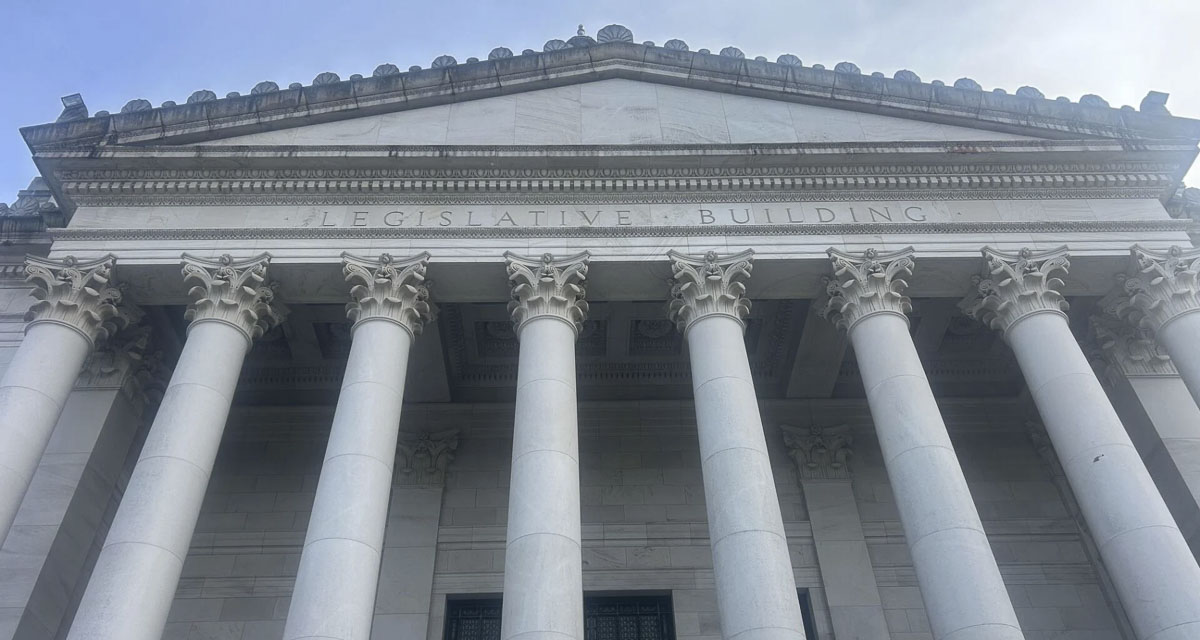
Democrats hold sizable majorities in both chambers of the Legislature. That often translates into Democratic lawmakers being able to pass bills regardless of Republican opposition
Carleen Johnson
The Center Square Washington
Three days after sine die, caucus leaders from both sides of the aisle in the Washington State Legislature are reflecting on wins and losses during this year’s 105-day session.
Democrats hold sizable majorities in both chambers of the Legislature. That often translates into Democratic lawmakers being able to pass bills regardless of Republican opposition.
“It didn’t need to be this way, and we could have done better than we did,” Sen. John Braun, R-Centralia, told The Center Square.
The Senate minority leader’s biggest regret is the massive tax increases pushed through by Democrats to balance what they argued was a $16 billion operating budget shortfall over the next four years.
Republicans contend the shortfall was less than half that size, but for the bill coming due on expanded programs and services promised in previous sessions, which they said could have been pushed out.
“We didn’t need to raise taxes,” Braun continued. “You saw the budget proposed by the Senate Republicans … that was thoughtful, showed restraint and lived within our means. We didn’t need to tax people, and the impact on affordability is going be enormous across the state on everything. Food, gas, housing, transportation, childcare, healthcare, all of that is in some way affected by these new taxes, and it’s going to make it more expensive, and it didn’t need to be.”
Rep. Joe Fitzgibbon, D-West Seattle, had a different perspective on the session.
“I’m relieved that we passed a balanced budget and that we passed it on time,” the House majority leader told The Center Square on Tuesday. “I don’t know that anybody is excited about this budget … you know, it was a budget full of difficult things, difficult choices, whether it’s difficult reductions or difficult revenue and not a single cut or a single tax increase is something that is easy or that doesn’t impact somebody or that we take lightly. I really think we did the best we could, given the hand that we were dealt.”
Braun expressed frustration at how Democrats ran some committee hearings, noting that time is limited for testimony and that committee members are often prevented from asking questions during the hearing.
“The way the Democrats have run hearings over the last few years has been more of a check box than a true desire to understand, to listen to what people are saying,” he said. “Especially on controversial things, you know, both sides, I think, are somewhat guilty on this. We’ve got to get lots of people to sign in and to testify, and it’s just the same thing over and over. Some chairs do a better job than others, but I don’t think we’re doing a good job right now.”
Braun and other minority leaders expressed frustration at being left out of budget negotiations in the final weeks of the session.
Fitzgibbon responded.
“You know, I understand their frustration,” he said. “You know, when the Republicans controlled the Senate, they undertook the exact same process and didn’t include the Senate Democrats in that process. I think we invited input from House Republicans … I don’t mean to suggest that they – you know, we’re more included than they were – but we just don’t get a lot from them when we do ask.”
Asked about wins, Braun mentioned several bills Republicans were able to stop.
“The bill that would have overregulated wood stoves, we stopped that,” he said. “We stopped the bill that would allow more prosecutor discretion for resentencing violent felons. Yeah, it goes on and on. So you know, health care mergers, we stopped that, and the $25 per hour minimum wage we stopped, and getting rid of elected sheriffs, we stopped. There’s a lot.”
The Center Square asked Fitzgibbon the same question about wins for Democrats.
“I mean something that I’m excited that we did get done that has been many years in progress is the recycling reform legislation, which will really expand access to recycling for Washingtonians and make sure that we have good recycling options and packaging that is more recyclable than we see today,” he said. “I think that’s a good step forward.”
He noted some disappointments, including passage of a final version of a bill to eventually close Rainier School for those with intellectual and developmental disabilities.
Republicans, however, counted the final Rainier School closure bill as a victory
“I really think that, you know, not just for budget reasons but also for moral reasons, that is not a successful place to care for people with disabilities,” Fitzgibbon explained. “There have been so many reports of, you know, not quality care being provided there. It’s a, it’s a very old rundown facility that is also very expensive for the taxpayer when we know that better care can be provided to people with developmental disabilities in other settings.”
He continued: “So I was really disappointed that that bill didn’t get across the finish line. We did pass a bill, a compromise bill that would stop new admissions to Rainier, and I think that is a step in the right direction.”
This report was first published by The Center Square Washington.

Also read:
- Former WA Supreme Court justice joins legal effort against income tax
 Phil Talmadge and Rob McKenna have joined forces with the Citizens Action Defense Fund to oppose Washington’s new tax on high-income earners, raising legal and constitutional questions.
 - Makeover in store for Congress with flood of lawmakers headed for the exits
 A wave of exits from Congress—over 65 lawmakers—will usher in unfamiliar faces and decrease veteran expertise, shifting the political landscape in Washington.
 - Opinion: Sheriffs fight back
 Four county sheriffs are suing to block a new law giving a governor-appointed board power to decertify and remove sheriffs, bypassing voter oversight in Washington.
 - Fiscal fallout: $375 million bond debt indirectly funding operating budget
 Shifting $375 million from a loan fund impacts local infrastructure as Washington state covers operating costs with bond debt, prompting concern among officials and advocacy groups.
 - Lawsuit aims to block new eligibility requirements for WA sheriffs
 Four sheriffs are suing over a state law that sets new eligibility rules, arguing it undermines voter authority by allowing removal for certification issues.
 wpDiscuz
