



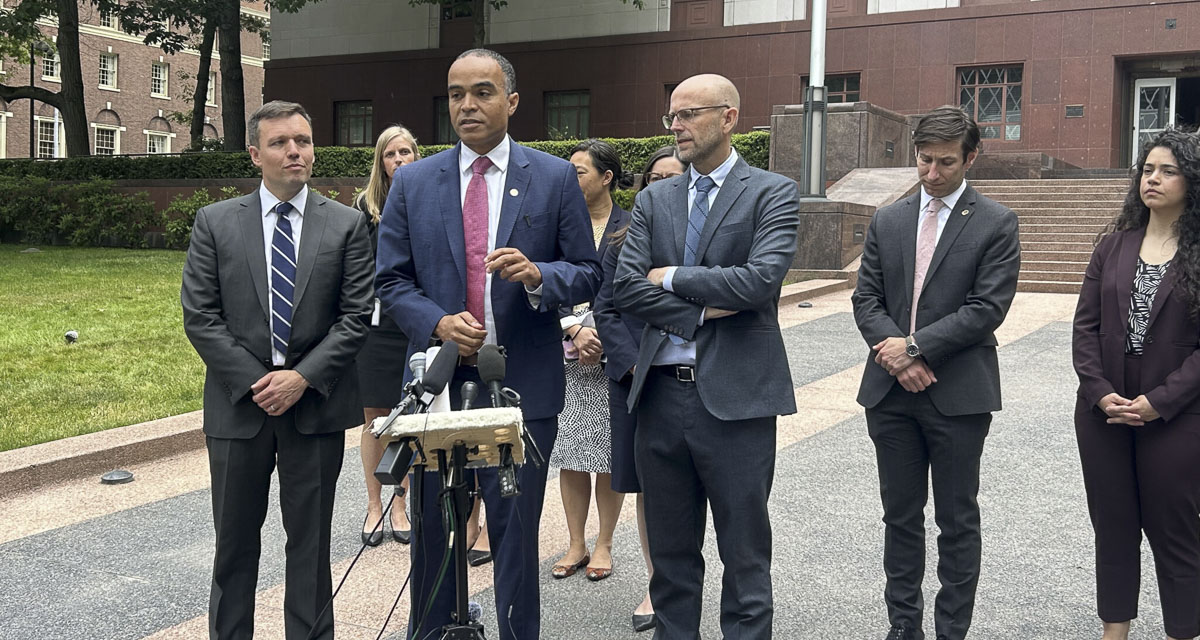
The state of Washington still intends to seek a nationwide block of the president’s order to restrict birthright citizenship
Jake Goldstein-Street
Washington State Standard
Despite a U.S. Supreme Court ruling in favor of the Trump administration on Friday, the state of Washington still intends to seek a nationwide block of the president’s order to restrict birthright citizenship.
“Washington still plans to seek relief for all its harms — that is what we argued for and won in the trial court,” attorney general’s office spokesperson Mike Faulk said in an email Friday.
Washington Attorney General Nick Brown, alongside attorneys general from Oregon, Arizona and Illinois, had argued nationwide relief was necessary while litigation plays out over the order.
But in a 6-3 ruling in the case on Friday, the Supreme Court imposed new limits on lower court judges issuing nationwide injunctions.
Under the ruling, President Donald Trump’s order could go into effect in 30 days in states that didn’t sue, raising the possibility that babies born to immigrant parents in Washington would be U.S. citizens, while those born in neighboring states like Idaho would not be.
The high court did not rule on the merits of Trump’s executive order. Further legal battles over the order, including with the lawsuit backed by Washington, still lie ahead.
Brown has argued previously that the state, instead of the federal government, would have to pay for social services for babies born in other states without birthright citizenship who later move to states like Washington.
In his Feb. 6 injunction, U.S. District Court Judge John Coughenour in Seattle agreed, ordering that anything less than nationwide relief is “ineffectual.” Coughenour’s order was one of three nationwide injunctions the Supreme Court considered.
Brown, in a statement, noted that the justices “confirmed that courts may issue broad injunctions when needed to provide complete relief to the parties.”
“We continue to believe that President Trump’s unconstitutional and cruel order must be stopped across the country to guarantee protection for Washington and its residents,” he continued.
Washington’s case currently sits at the 9th U.S. Circuit Court of Appeals after arguments in Seattle this month. Whether the Supreme Court’s ruling sends the case back to Coughenour is unclear. Faulk said the attorney general’s office expects more clarity on this question soon.
Trump’s executive action aims to end birthright citizenship for babies born to a mother and father who are not U.S. citizens or lawful permanent residents.
In 2022, about 4,000 babies were born in Washington to two parents without legal immigration status, according to the states’ lawsuit.
This report was first published by the Washington State Standard.
Also read:
- Opinion: Lawsuit filed against the unconstitutional income tax in Washington state
 Former Attorney General Rob McKenna and Supreme Court Justice Phil Talmadge challenge the 9.9% income tax in Klickitat Superior Court.
 - Vancouver Police investigate domestic violence homicide
 Vancouver Police Major Crimes Unit investigating after woman found dead with knife wounds on NE Oakbrook Circle.
 - Letter: ‘Oregon and Washington aren’t refusing to clean their rolls — they’re contesting federal jurisdiction and timing’
 Camas resident challenges Lars Larson’s fraud claims, explaining legal disputes over federal jurisdiction.
 - County Council to hold hearing on preferred land use alternative for comprehensive plan update
 Clark County Council will select preferred land use alternative from three options studied in environmental review.
 - Opinion: ‘When are we going to get the full and complete details of the Interstate Bridge Replacement Program’s I-5 Bridge replacement project?’
 IBR team buried key details about light rail ending at waterfront with massive elevator system required.
 - POLL: Do you support extending light rail beyond the waterfront to connect with C-TRAN at Library Square?
 Readers can weigh in on Anne McEnerny-Ogle’s proposal to extend light rail beyond the waterfront to Library Square for improved C-TRAN connections.
 - Opinion: Passing a cyclist – Law, myth and a little patience
 Most drivers can’t legally pass cyclists in-lane due to vehicle width versus road measurements.
