



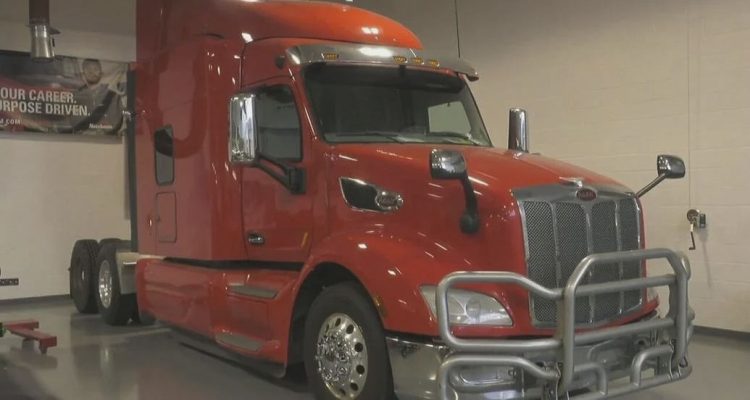
Under California’s Advanced Clean Trucks program, the trucking industry must progressively transition to zero emissions for medium and heavy-duty trucks
TJ Martinell
The Center Square Washington
The state trucking industry is calling on the Legislature and Gov. Jay Inslee to detach Washington state from a California-based electric vehicle program due to a variety of practical and logistical factors that they argue threaten the supply chain system.
Under California’s Advanced Clean Trucks program, the trucking industry must progressively transition to zero emissions for medium and heavy-duty trucks. Starting next year, zero emission vehicles must make up 7% of all Class 2b-3 truck and Class 7-8 tractor sales, while Class 4-8 truck sales must be 11% zero emission vehicles.
By 2030, the sales percentages will need to be 30% for Class 2b-3 trucks and Class 7-8 tractors, and 50% for Class 4-8 trucks.
Washington Trucking Associations President Sheri Call wrote in an Aug. 15 letter to Inslee expressing concerns about “vehicle costs, operational challenges, and low to non-existent vehicle adoption. We feel these issues will place constraints on the industry and reduce supply chain resiliency in Washington state – one of the most trade-dependent states in the nation.”
Noting that the buying cycle for trucks can be as long as two years, “owners are placing orders for model year 2025 and beyond today” and “prompting WTA members to evaluate their options given cost and infrastructure constraints.”
Citing a “lack of infrastructure, vehicle cost, availability, and operational limitations,” Call wrote that “members are left with only a couple options” in order to comply that ultimately could lead to trucking companies shifting their operations to states that are not required to comply with the Advanced Clean Trucks, or ACT, mandate.
According to Call, zero emission trucks are two and half times more expensive than clean diesel fuel trucks, while they have two and half tons less cargo capacity and only offer 150-200 mile distance per charge.
She wrote that holding Washington truckers to the same standards as California isn’t appropriate because “state officials there have been building support for decarbonization for decades, including funding robust incentive programs for clean commercial trucks.”
“Washington does not have the regulatory infrastructure in place to discourage outside dispatch of trucks that do not comply with any reduced carbon or zero emission standard,” Call wrote further. “ACT will drive up costs on every consumer good or service that relies on M/HD commercial trucks.”
The Center Square reached out to Inslee’s office for comment. In an email, Deputy Communication Director Mike Faulk wrote that “we are preparing a response to address the concerns they have raised, and are confident that between the public and private sectors’ collective efforts to electrify the transportation sector, the Advanced Clean Truck requirements are achievable.”
He added that “there are a variety of compliance options, including giving credit from previous years sales to meet the first target in 2025 and credit-sharing across weight classes allowing for manufacturers to ramp up availability.”
Faulk added that Washington is collaborating with California and Oregon to secure federal funding for an EV truck charging corridor along Interstate 5. Semi-trucks typically rely on a DC-fast charger.
This report was first published by The Center Square Washington.
Also read:
- Fiscal fallout: $375 million bond debt indirectly funding operating budget
 Shifting $375 million from a loan fund impacts local infrastructure as Washington state covers operating costs with bond debt, prompting concern among officials and advocacy groups.
 - Lawsuit aims to block new eligibility requirements for WA sheriffs
 Four sheriffs are suing over a state law that sets new eligibility rules, arguing it undermines voter authority by allowing removal for certification issues.
 - Opinion: The growing gap between public voice and political power
 Todd Myers describes how large-scale protest and sign-ins often fail to sway state leaders, and argues authentic influence is most likely found through local action.
 - City of Battle Ground seeks applicants for Salary Commission vacancy
 Battle Ground seeks a resident to join its independent Salary Commission, which reviews compensation and health benefits for local elected officials through 2027.
 - Opinion: Who is winning the race for affordable power?
 Hydroelectric power keeps Washington competitive, but new laws and carbon pricing are driving up electricity costs for residents each year.
 - Vancouver Fire Department assists with Columbia River Marina fire response
 Vancouver Fire Department joined Clark-Cowlitz and Scappoose crews to help fight a vessel and dock fire at Goble Marina, assisting in river operations where one boat sank and another was partially submerged.
 - White House govt. Funding request for 2027 cuts $73 billion
 President Trump’s budget seeks to boost defense funding while cutting $73 billion from agencies like the EPA, NASA, and Agriculture, prompting sharp criticism from Democratic leaders.
