



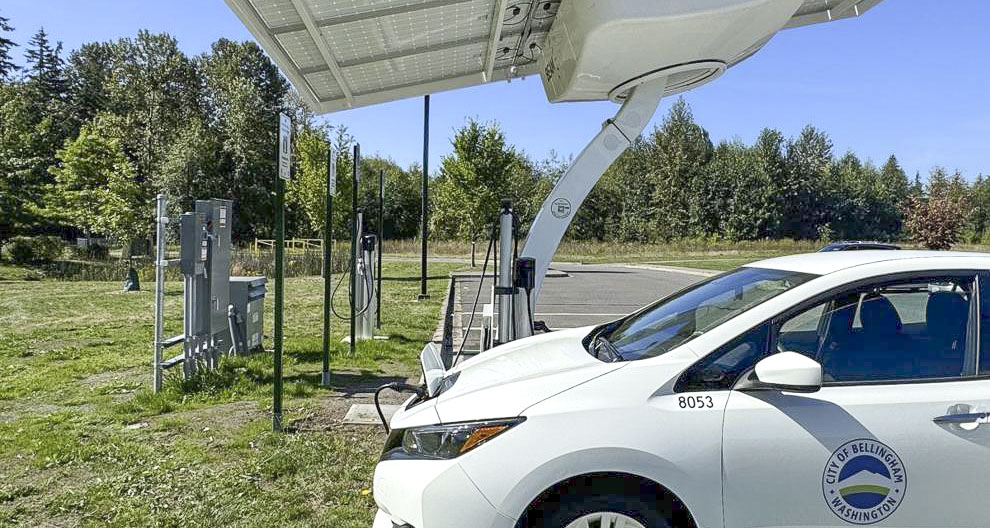
The state Electronic Vehicle Coordinating Council estimates the state will need a total of 3 million ports by 2035
TJ Martinell
The Center Square Washington
Although Initiative 2117 repealing the state’s cap-and-trade program was rejected by Washington voters earlier this month, state planners are still grappling with logistical and practical challenges around transitioning the transportation sector toward electric vehicles, an effort heavily funded by cap-and-trade revenue.
“EVs are going to be a story here and it’s going to be part of both Washington and nationally at different stages in different areas,” COIL, Inc. Founder Bobby Penn told the state Electric Vehicle Coordinating Council at its Nov. 6 meeting. “EVs are not going anywhere regardless of what’s happened with this election.”
However, the state will still need to figure out how to meet expected demand for EV charging ports of varying charging capacity. Although the state is meeting the forecast for L2 chargers, it remains behind on DC Fast Chargers. As a result of state funding, Washington is expected to have an additional 7,000 charging ports.
Yet, that’s a small amount compared to the total needed. According to UW Associate Professor of Civil and Environmental Engineering Don McKenzie, the state will need between 40,000 and 150,000 fast-charging ports alone to support 8 million vehicles, which he estimates could cost $30 billion.
The council estimates the state will need a total of 3 million ports by 2035.
McKenzie told the council that for right now “when I look at the numbers, it really doesn’t look like public charging is a very attractive business today as a standalone proposition. That can change when we get to scale. When you reach that scale, again, there’s a role that’s probably where the private sectors take you over, but what I haven’t really seen is a clear analysis of what that transition pathway might look like. At what point do those subsidies get ramp down and allow private markets to really take the lead and how much will the public sector need to spend in the meantime?”
“Until there is that sufficient demand, it will probably be necessary to offer subsidies or other policy inducements for public charging investment,” he added. “The problem that I see with that is that I’m not sure that government can run this all the way through.”
Consistency with that public funding will be crucial for private companies taking financial risks by investing in them, Electric Vehicle Charging Association Government Affairs Director Reed Addis noted.
“There is a commitment by many of you as policy makers to drive demand by consumers,” he said. “That demand in turn requires us to make sure we have facilities for them to charge with.”
He added that it’s important to “make sure there is adequate long term funding because that’s the only way we’re going to be able to truly make the consumers happy with the EV purchases and make sure that we’re delivering enough chargers in the right places. If we have boom and bust cycles either on the policy or the funding, that does wreak havoc and it is at least partially why you see some companies not able to sustain their ability to provide or locate infrastructure in your state.”
Penn noted that “the industry has to protect itself because if it goes beyond, if it goes to race for zero, then what will end up happening is that many companies will pull out and there won’t be a business incentive to stay in there.”
“We are dealing with the need for investment on the part of government,” he added. “Nobody is investing right now without there being some sort of incentive program. which is terrible because you know the market doesn’t indicate otherwise.”
This report was first published by The Center Square Washington.
Also read:
- Opinion: Half the road, full stop – Understanding pedestrian right-of-way
 Doug Dahl explains how Washington’s law requires drivers to stop when a pedestrian is within one lane of their half of the road, not just when directly in front.
 - Opinion: What is the cost of a bridge?
 John Ley argues the I-5 Bridge replacement’s soaring cost stems from costly extras like light rail, noting other states deliver larger, toll-free bridges for much less.
 - Letter: Vancouver Mayor Anne McEnerny-Ogle makes several serious and incorrect engineering statements
 Bob Ortblad critiques engineering claims by Vancouver Mayor Anne McEnerny-Ogle, highlighting cost and safety advantages of an immersed tunnel for the I-5 crossing.
 - Washington’s studded tire deadline is March 31
 Drivers must remove studded tires by March 31 or face a $137 fine, with WSDOT urging early action due to busy service centers and no planned deadline extension.
 - VIDEO: WA diesel hits record $6.53, crushing truckers and school budgets
 With diesel nearing $6.53 per gallon in Washington, trucking businesses and school districts now confront sharply higher fuel expenses affecting budgets and workers.
