



House Bill 2204 could provide a major boost to beverage producers during a disaster or state of emergency
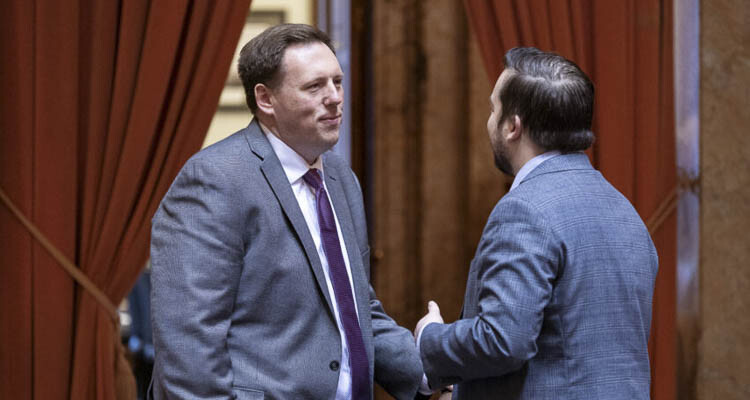
Three bipartisan bills from Rep. Kevin Waters are one step closer to becoming law after receiving approval from the Washington State Senate this week, including one that could provide a major boost to beverage producers during a disaster or state of emergency.
House Bill 2204, which passed unanimously, would allow beverage producers a temporary emergency permit – with no fees – to move their place of business to another beverage producing company in the event a natural disaster forces them to close.
“It’s great to see these policies move forward and I’m excited to see the positive effects they will have if signed by the governor,” said Waters, R-Stevenson. “Particularly, House Bill 2204 will have a big impact if it becomes law. Last summer’s Tunnel 5 Fire in my district caused significant damage and affected many homes and businesses, including several beverage producers. Those beverage producers need this legislation.”
The fire forced several wineries to shut down production and sales. The remaining wineries offered to open their facilities to five other companies. However, current law does not allow that to happen.
“These producers took a big hit because of the fire and because there is no policy in place, there wasn’t anything we could do to help them,” said Waters. “That needs to change, so I’m very happy to see this policy reach the governor.”
The Senate also passed House Bill 1982, 48-1. It would codify the Community Economic Revitalization Board (CERB) Rural Broadband program. Since 2018, CERB has operated a Rural Broadband Program with funding from the capital budget, which provides grants and loans to local governments and federally recognized tribes.
The program finances the cost to build infrastructure to provide high-speed, open-access broadband service to rural and underserved communities for the purposes of economic or community development.
“I’m a member of CERB and I have seen the great work this board has done over the last five years with this loan and grant program, including infusing $38 million into broadband through other revenues,” said Waters. “They are a trusted partner for economic development within rural communities and have proven their commitment to these communities throughout Washington.”
Lastly, the Senate unanimously passed House Bill 2260, which would align the penalties for selling alcohol to a minor in Washington by authorizing the Liquor and Cannabis Board (LCB) to impose civil penalties on store clerks for unintentionally selling alcohol to minors.
Under current law, if a restaurant worker or bartender unintentionally serves alcohol to a minor, they are given a fine instead of being charged with a criminal penalty. However, when a store clerk unintentionally sells liquor to a minor, the only penalty available is a criminal one – a gross misdemeanor.
Waters explained why he sponsored the bill, saying, “Not only would this bipartisan legislation bring equity to the penalty structure for selling to a minor for servers, bartenders, and store clerks, but it would also address another overlooked issue: enforcement.
“In many cases, with rising crime rates statewide and despite the severity of the offense, officers and prosecutors don’t always have the time to enforce and prosecute these cases. Additionally, disparate caseloads across Washington results in current laws not being implemented uniformly throughout the state. Allowing for administrative penalties for a store clerk selling to a minor would give the LCB greater flexibility and better enforcement options.”
“We need to do what we can to bring balance to this issue, but more importantly, we need to enforce the law by holding offenders accountable,” said Waters.
The bills now head to the governor’s desk for his signature.
Information provided by Washington State House Republicans, houserepublicans.wa.gov
Also read:
- POLL: What do you believe is the biggest reason school districts are facing budget shortfalls?
 Districts across Washington warn of budget gaps as debate grows over rising costs versus inadequate state funding.
 - Lt. Governor shares his ideas on fixing housing shortage to members of BIA of Clark County
 Lt. Gov. Denny Heck told Clark County builders the state needs one million additional homes in 20 years.
 - Opinion: The high cost of hiding – Why IBR’s delayed revenue study is a $15 billion warning sign
 IBR delays critical toll revenue analysis until June 2027, hiding financial details until after project approval.
 - Opinion: The high cost of hiding – Why IBR’s delayed revenue study is a $15 billion warning sign
 IBR delays critical toll revenue analysis until June 2027, hiding financial details until after project approval.
 - Opinion: Washington fails the test for affordability
 Mountain States Policy Center analysis reveals Washington ranks 5th most expensive state as residents migrate to Idaho and Texas.
 - Opinion: Washington fails the test for affordability
 Mountain States Policy Center analysis reveals Washington ranks 5th most expensive state as residents migrate to Idaho and Texas.
 - Opinion: How should teachers adapt to AI?
 Washington Policy Center’s Donald Kimball explores balancing AI benefits with preserving critical thinking in classrooms.
