



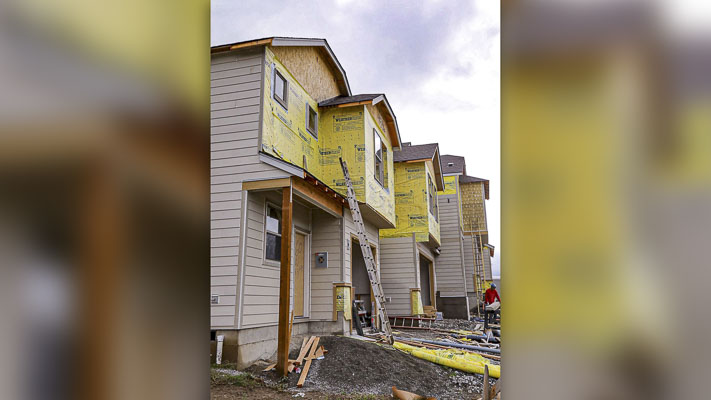
Economic and Revenue Forecast Council executive director points to a down trend in residential construction activity in expressing concerns
Brett Davis
The Center Square
Washington state’s revenue collections since the September forecast are $126 million, or 6.3%, above expectations. But that good news at Friday morning’s Economic and Revenue Forecast Council’s virtual meeting was tempered by concerns about the heightened risk of a recession.
In the parlance of ERFC Executive Director Stephen Lerch, Washington had “a positive variance of $126 million.”
Despite the uptick in revenue, Lerch pointed to monthly data through September from the U.S. Census Bureau showing residential construction activity in Washington and the U.S. has trended down since July, a possible indicator of a slowing economy.
“What you can see is really since about the middle of summer, the trend is certainly downward,” he told the council. “So we are starting to see, really, a slowdown in construction activity for both single- and multi-family homes.”
Mirroring a national trend, Seattle home prices declined in June, July, and August, according to information Lerch presented from the Case-Shiller Home Price Indices.
“Again, on a year-over-year basis, they’re still growing,” Lerch said. “They’re still higher.”
He provided some context regarding home prices.
“In August of this year, prices were certainly still on the order of 11% above where they were in August of 2021,” Lerch explained. “But as the sidebar notes, we’ve now seen a couple of months where prices have actually come down. So they’re still above their year-ago levels, but we’re seeing a couple of months where home prices are starting to come down a bit.”
Concerns about a possible recession permeated Lerch’s presentation to the council.
He pointed to several factors stoking fears that an economy already beset by record-breaking inflation and high gas prices could get worse, including the rise in interest rates, several polls of economists that indicate they think a recession is coming, and a leading indicator hinting at a downturn in the business cycle.
“We’re expecting that ultimately, the federal funds rate will get to a range of four-and-half to four-and-three-quarters of a percent by March of 2023, so that is pretty consistent with what the Federal Reserve said,” Lerch stated.
On Wednesday, the Federal Reserve approved a fourth-straight rate hike of three-quarters of a percentage point as part of its plan to bring down inflation.
Lerch pointed to a canvassing last month of a number of economists – including a Blue Chip Survey, a Wall Street Journal Forecasting Survey, and a Bloomberg Economist Survey – that show a majority of respondents anticipate a recession in the next year.
“And you can see these are rather pessimistic views,” Lerch noted.
Also suggesting a recession is on the way: the Organization for Economic Cooperation and Development’s composite leading indicator for the U.S., which includes housing starts, new orders for durable goods, stock prices, interest rates, consumer confidence, and weekly hours worked in manufacturing.
“It’s supposed to give a sense when the business cycle is turning,” Lerch explained. “In other words, some sort of advanced warning of recessions. And you can see, the last three recessions, it certainly has turned down prior to the recession, and we see that it is turning down now.”
That doesn’t assure a recession is on the way, he said.
“But we can also see some periods where it has turned down and a recession did not happen imminently,” Lerch said. “This does not guarantee a recession, but it would certainly be one indicator that a recession may be coming.”
Despite signs the economy is slowing and the threat of a recession, it wasn’t all bad news.
“On the upside, we could see some improvements in labor productivity, which would among other things, help with lowering inflation and would keep the economy going at a bit stronger pace,” Lerch said.
The next monthly revenue collection report will be out on Nov. 14. The final revenue forecast of the year is set for Nov. 18.
This story was first published by The Center Square Washington.
Also read:
- NBA vote clears way for expansion to Seattle
 The NBA Board of Governors has voted to explore adding teams in Seattle and Las Vegas, moving Seattle closer than ever to hosting pro basketball again.
 - Opinion: The legislature has committed $2.4 billion to recurring pension increases since 2018
 Six legislative COLAs have raised public employer costs by $2.38 billion since 2018, driving up unfunded pension liabilities and increasing burdens on county and city budgets.
 - Opinion: ‘Just because they got away with it doesn’t mean they weren’t wrong’
 A Skamania County deputy’s report found violations of county rules and the Open Public Meetings Act, but no prosecutor acted on the findings.
 - More drama at Clark County Council in regard to its representatives on the C-TRAN Board
 Councilors debated whether C-TRAN board representatives must follow group mandates, with Michelle Belkot refusing to commit to new voting rules and Glen Yung opposing her nomination.
 - Opinion: Small things grow great by concord
 Washington’s initiative process gives citizens direct power to challenge lawmakers. Failed restrictions and new measures on girls’ sports, parental rights, and citizenship prove the influence of grassroots action.
 - Opinion: California’s $20 fast food minimum wage creates less jobs and lower income
 Study data show California fast food workers now face fewer shifts, higher menu prices, and widespread automation after the $20 wage hike.
 - Gov. Ferguson signs law to undo WA estate tax increase enacted last year
 Washington rolls back its estate tax hike, restoring previous rates and prompting uncertainty around $340 million in expected revenue for education.
