



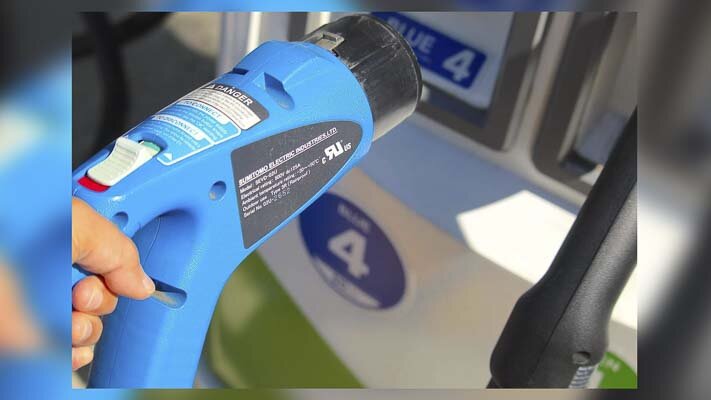
To meet the 3 million mark, Washington state will need to install 250,000 ports every single year starting this year – in 2021, just 460 were built
TJ Martinell
The Center Square Washington
The state of Washington has a goal of ending the sale of new gasoline vehicles by 2035. It also has created a Transportation Electrification Strategy, or TES, to ensure “that electric vehicle incentives and infrastructure are accessible and available to all Washingtonians.”
However, it’s going to need a lot more charging ports.
According to the Electric Vehicle Council, the state will need 3 million by 2035. It’s not yet known whether this includes both private and public charging ports.
Either way, the state has a long way to go.
Currently, there are roughly 4,500 public EV chargers in the state, mostly level 2 charging ports and just under 1,000 direct current fast charging ports.
Charging infrastructure is one of the critical aspects of making EV use en masse practical. Recently US Secretary of Energy Jennifer Granholm went on a road trip across the country to promote EV use, but the fleet hit a snag when there weren’t enough chargers for them all to use.
To meet the 3 million mark, Washington state will need to install 250,000 ports every single year starting this year – in 2021, just 460 were built.
Then there’s the cost, a topic that was raised at the state Electric Vehicle Coordinating Council’s most recent meeting on Wednesday. The council is preparing a draft update to the TES, which will include more details about the EV charger requirements.
Regarding the goal of 3 million charging ports, EV Council Co-Chair Tonia Buell said “my biggest question is how are going to do that?” She also told meeting participants that she did not know of any funding sources at this time that might cover the costs.
Those costs will vary depending on the type of charger installed. The average cost of installation is $300 to $1,500 cost for single EV port level 1, $6,000 for single EV port level 2, and $10,000-$40,000 for DC fast charging port.
However, in an email to The Center Square, Buell wrote that this just represents the equipment side of installation costs, which can be three times higher. According to the Oregon Department of Transportation, the total installation cost for a 350kW DC fast charging port can be as high as $172,000.
While a level 1 charger cost is estimated to be far less, it’s not considered practical for EVs used daily. A 30-minute charge on a level 1 port will only get a vehicle five miles, whereas a DC fast charger can provide enough energy for an EV to go 200 miles or more.
Even if the state only needed to install level 1 charging ports, the estimated price tag would still be $3 billion, and $18 billion if only level 2 charging ports were installed.
The TES draft update will include a forecast of what types of charging ports will need to be built.
Right now, there are 104,000 all-electric vehicles registered in Washington, placing it fourth in the nation in terms of total EVs. Another challenge for the coordinating council is how to get more drivers into EVs, which can cost more than what many households earn annually.
The TES draft update will be available for comment next month. The state Department of Commerce will submit the final draft to the state Legislature by the end of the year.
This report was first published by The Center Square Washington.
Also read:
- ‘An upward trajectory’: Petroleum expert on Iran conflict’s impact on gas prices
 Drivers in Washington are facing steeper costs at the pump due to supply disruptions, increased taxes, and a closed oil shipping route, which together raise expenses for businesses and consumers.
 - Opinion: Legislature agrees to increased spending in Supplemental Budget
 Washington lawmakers approved an $80.2 billion supplemental budget, banking on an income tax that is uncertain to withstand legal and electoral tests despite increasing spending beyond revenue projections.
 - Letter: ‘Only Florida has a more regressive tax structure than Washington’
 Washington households earning the least pay 13.8% in taxes, while the wealthiest 1% pay only 4.1%, according to Camas resident Anthony Teso’s letter.
 - Battle Ground Citizen of the Year for 2025 announced & celebration planned
 Johanna Hyatt has helped lead fundraising events, library initiatives, and aid for multiple local nonprofits during over a decade of community service in Battle Ground.
 - Clark College State of the College Address highlights achievements, challenges and regional impact
 Clark College’s annual address showcased student achievements, rising enrollment, robust scholarships, and workforce-driven academic programs influencing the regional economy in Southwest Washington.
 - Opinion: ‘I-5 Bridge replacement plan does not accomplish the needs of the project’
 Transportation architect Kevin Peterson outlines why the current I-5 Bridge proposal falls short on mobility, urban design, and transit, and offers alternative solutions including BRT and urban integration improvements.
 - Vancouver Police investigate convenience store robbery
 Police are investigating after two males reportedly robbed a convenience store on E Mill Plain Blvd at gunpoint, taking cash and merchandise but leaving the clerk unharmed.
 wpDiscuz
