



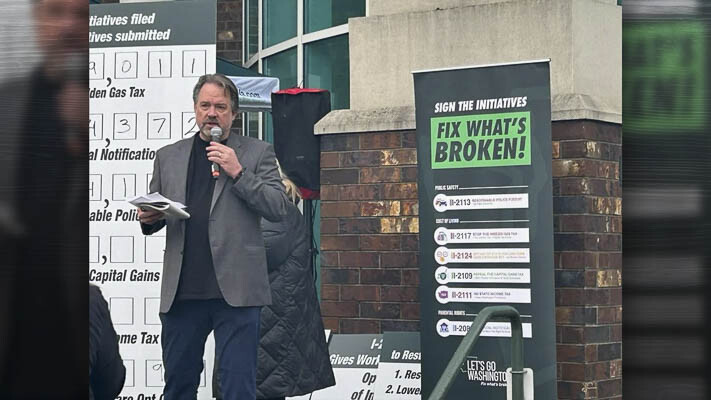
Initiative 2117, which has been certified for the ballot by the Secretary of State’s Office, would repeal the CCA’s cap and trade carbon auctions
TJ Martinell
The Center Square Washington
An initiative on the November ballot could eliminate almost all of the revenue currently diverted by the state toward electrifying the public and private transportation sector.
According to a Wednesday presentation by the Electric Vehicle Coordinating Council, 84 percent of all funding for zero emission vehicle investments comes from revenue generated by the 2021 Climate Commitment Act.
Initiative 2117, which has been certified for the ballot by the Secretary of State’s Office, would repeal the CCA’s cap and trade carbon auctions that have already generated billions in new revenue. Of that, $671 million has been dedicated to ZEV investments. Critics refer to the carbon auction as a “hidden gas tax,” arguing that it has led to increased gas prices in Washington compared to other states.
If approved by voters, it will represent one more hurdle for state efforts to electrify the transportation sector. Although the council approved a transportation electrification strategy last year, it has already acknowledged that it won’t meet its 2030 emission goals. On top of that, the state will need three million more charging ports to accommodate new EVs on the road. The cost of the ports will depend on the type, with the average cost of installation $300 to $1,500 cost for a single EV port level 1, $6,000 for single EV port level 2, and $10,000-$40,000 for DC fast charging port.
Further, they will also have to contend with the increased load on the electrical grid. Clark County recently announced a program offering $50 credit to EV owners who promise not to charge their vehicles during “peak hours.” Clark County currently has 20 EVs per 1,000 residents. The county with the highest is San Juan, with 50.7 EVs per 1,000 residents, while Garfield County has the lowest at 1.3 per 1,000 residents.
EV charging infrastructure currently makes up 33% of state funding for EV investments. Most of the EV investment spending (61%) is through the Washington State Department of Transportation. Almost half (45%) of the state spending is on EV vehicles to convert the existing public fleet.
While the latest state supplemental budget increased spending by $100 million, $130 million or 19% of approved spending has been delayed in response to I-2117.
While the remaining amount will still be spent regardless of whether voters approve I-2117 in November, state Department of Commerce’s Transportation Electrification Policy Lead Steven Hershkowitz told the Electric Vehicle Coordinating Council at its Wednesday meeting that “would not continue to roll over should that policy go away. It really is a significant chunk … of where ZEV are being funded right now.”
The council’s next meeting is May 1.
This report was first published by The Center Square Washington.
Also read:
- Kaiser Permanente employees volunteer at Clark County Food Bank on MLK Jr. Day
 Kaiser Permanente employees volunteered at the Clark County Food Bank on Martin Luther King Jr. Day, inspecting and repacking food as part of a regional day of service.
 - North County Community Food Bank’s Seed Swap and Giveaway is Sunday, Jan. 25
 The North County Community Food Bank will host its annual Seed Swap and Giveaway on Jan. 25 at the Hockinson Community Education Center, welcoming gardeners of all experience levels.
 - An icy reception for Gov. Bob Ferguson’s proposed budget cuts
 Advocates for schools, child care, higher education, and climate programs sharply criticized Gov. Bob Ferguson’s proposed budget cuts during early legislative hearings.
 - Opinion: Washington should stop shielding domestic abusers and sexual offenders from deportation
 Vancouver attorney Angus Lee argues Washington law improperly shields convicted domestic abusers, sexual offenders, and drunk drivers from deportation and urges lawmakers to change it.
 - Opinion: Who is leaving Washington and why the politicians need to care
 Mark Harmsworth argues Washington is losing higher-income taxpayers and business owners, warning that rising taxes and regulation threaten long-term economic stability.
 - Funeral service details for Firefighter Paramedic Jeremiah Frenz
 The Vancouver Fire Department released funeral service details for Firefighter Paramedic Jeremiah Frenz, with services scheduled Jan. 23 at NW Gospel Church: Eastside in Vancouver.
 - Opinion: McCleary’s promise and Washington’s K–12 reality
 Dick Rylander examines how Washington’s post-McCleary school funding system has produced rising costs and growing financial instability despite record spending.
 wpDiscuz
