



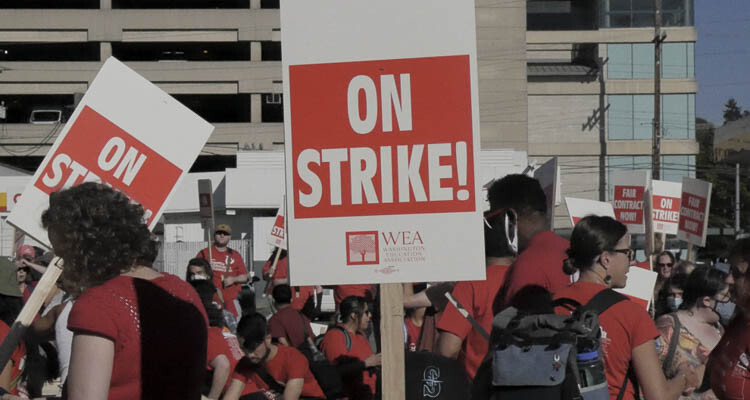
House Bill 1893 would remove the prohibition against receiving unemployment insurance benefits for workers taking part in a strike
Spencer Pauley
The Center Square Washington
The Washington House of Representatives has passed a bill that would allow workers in the state to receive unemployment insurance during strikes.
Currently, a worker is disqualified from receiving benefits if he or she is unemployed because of a labor action. House Bill 1893 would remove the prohibition against receiving unemployment insurance benefits for workers taking part in a strike.
The House approved a notable amendment to the bill to shift costs onto employers involved in labor disputes covered by HB 1893, instead of spreading the expense across the unemployment insurance system. This is a change from the underlying bill which would have had those benefits socialized across the unemployment insurance system.
Rep. Chris Corry, R-Yakima, noted that there is a 5.4% cap on the employment experience factor, so if there is a large strike with a lot of benefits paid out, the employer gets capped at the 5.4% mark.
“[This] inherently means that all the employers in the state are going to pick up the rest of the tab on the impact,” Corry said late Monday night during House floor debate.
According to the bill’s fiscal note, Washington could potentially see an increase this year in unemployment insurance claims from 812 to 3,000. That translates into an increase of $9.8 million to $14.1 million in annual payout of benefits that currently sit around $120 million a year.
The note also found that the state denied an average of 2,313 claims per year due to a labor dispute.
According to Cornell University’s Labor Action Tracker, thousands of workers went on strike in one of 26 labor actions in Washington in 2023.
During the floor debate, Rep. Suzanne Schmidt, R-Spokane Valley, argued that strikes are supposed to be what employees do as a last resort, because negotiations have stalled and this bill incentivizes employees to take advantage of the unemployment benefits.
“By paying employees unemployment during this time, it makes it an easier choice,” Schmidt said. “I fear that this is going to be something that becomes more usual and more often.”
Schmidt added that when workers go on strike, it slows down other industry sectors.
The House passed the bill by a 53-44 vote. The bill now goes to the Senate for consideration.
This report was first published by The Center Square Washington.
Also read:
- Opinion: California’s $20 fast food minimum wage creates less jobs and lower income
 Study data show California fast food workers now face fewer shifts, higher menu prices, and widespread automation after the $20 wage hike.
 - Gov. Ferguson signs law to undo WA estate tax increase enacted last year
 Washington rolls back its estate tax hike, restoring previous rates and prompting uncertainty around $340 million in expected revenue for education.
 - Vancouver house fire displaces residents
 Crews from Vancouver Fire Department stopped a living room blaze from spreading, but five residents were forced out due to lingering smoke.
 - VIDEO: Vote-by-mail rules in WA at risk in SCOTUS election law case
 More than 127,000 Washington ballots postmarked by Election Day but received after could be disqualified under a possible Supreme Court ruling, prompting debate from both parties.
 - Rounding out debate, Gov. Ferguson signs bill addressing retailers’ penny problem
 A new Washington law lets merchants round cash purchases to the nearest 5 cents, aiming to manage change as shortages of pennies affect both businesses and customers.
 - Opinion: State is rightly emphasizing experience and skills, not degrees
 Elizabeth New explains how a new state policy removes unnecessary advanced degree requirements, supporting skills-based employment and broadening opportunities for capable workers.
 - Opinion: The wealth migration is real – which states are benefiting?
 IRS data shows Idaho, Montana, and Wyoming attracted significant wealth from new residents, while Washington state saw a loss of $500 million as its new capital gains tax took effect.
 wpDiscuz
