



WAGOP Election Integrity Chairman Bill Bruch outlines the latest developments of the lawsuit
It was announced Wednesday (Jan. 29) that the WAGOP lawsuit filed in Clark County Superior Court disputing the current 2024 Legislative District 18 State Senator race, set to be heard on January 30, 2025, has been “postponed.”

Apparently, Clark County and the Secretary of State did not like the evidence that was recently submitted.
On Monday, the WAGOP appears to have submitted 312 sworn written affidavits by residents of LD 18 that say about 300 voters that cast a ballot from their respective addresses did NOT reside at their address.
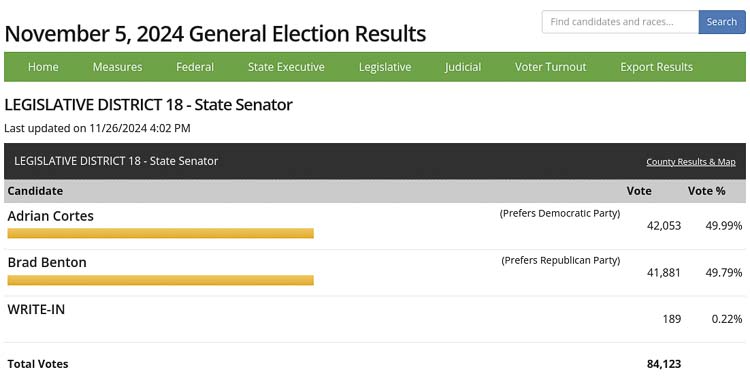
In the race, Republican candidate Brad Benton is down by only 172 votes with 84,123 total votes cast. Benton has 41,881 (49.79%) votes and his Democrat challenger Adrian Cortes has 42,053 (49.99%) votes.
The WAGOP and their attorney Ard Law Group say hundreds of votes counted in the race were from voters who did not reside in the district, violating RCW 29A.08.060.
More specifically, it appears that the National Change of Address (NCOA) database maintained by the US Postal Service reflects that hundreds of ballots mailed, returned, and tallied in the race were voted and returned by people who had previously filed change of address notices. According to the WAGOP, that list is now about 600 voters that were ineligible to vote in the election, but somehow their ballots were cast and counted.
The vote margin between the candidates of 172 votes (.20%) required a mandatory recount (per RCW 29A.64.021). As a reminder, that ludicrous “Recount” was completed Dec 9, where elections officials just looked at the “UNDER VOTES” OF VOTERS.
More specifically… Election officials only “recounted” ballot images for the race of the voters who did not vote in that race.
Of note, the WAGOP states these types of “recounts” are not actual recounts and additionally do nothing to verify if the paper ballots themselves are counterfeit.
If the vote margin is less than 150 votes, the recount must be a hand recount of the paper ballots (see RCW 29A.64.021), but mysteriously there was a huge discrepancy in the Ballot Cure acceptance rate between the Brad Benton campaign versus the rest of the cures turned in around Clark County.
When a voter forgets to sign the envelope containing their ballot or when the signature on the envelope does not match what is on record, “ballot curing” is necessary. It is the process of informing a voter to fix/cure their signature so their vote is counted per WAC 434-261-053.
According to the WAGOP: “The Benton campaign ran a robust ballot rehab effort for 2 1/2 weeks preceding certification and garnered over 400 cures. There was a natural cure rate that cut into the number of affidavits that could be effectively turned in. The campaign turned in everything we had, and of the over 400 affidavits submitted, we knew only 329 had not been cured and were within the boundaries of LD 18.
Clark County elections staff informed WAGOP that about 2,400 cures were submitted around the county, counting the ones the Benton campaign submitted. Subtracting out the new 329 cures the Benton campaign submitted leaves a little less than 2,100 cures submitted for the rest of the county. Only 20 of those roughly 2,100 cures were rejected; the rest were accepted and counted (about a 1% rejection rate).
The Benton cure rate is starkly different, with 59 of the 329 affidavits actually being rejected according to the final match back report from the SoS. This means the rejection rate for the Benton affidavits was about 18% or nearly 1,800% higher than the rest of the county’s cure forms. If 22 of those 59 affidavits were counted, it very likely would have triggered a manual recount. Additionally, all of the 329 Benton cure forms had valid witness signatures, which a simple reading of WAC 434.261.051-053 is sufficient to count them in virtually all circumstances.”
Why was the rejection rate for the Benton affidavits so abnormally high compared to the rest of the cures submitted across the county, especially considering they had witnesses verifying their legitimacy? It is also our understanding that many of the 2,100 cures Clark County elections accepted did NOT actually have witness signatures but were counted anyway.
WAGOP officials ask could it be that Clark County elections simply did not want to do a manual hand recount of all the paper ballots per 29A.64.021?
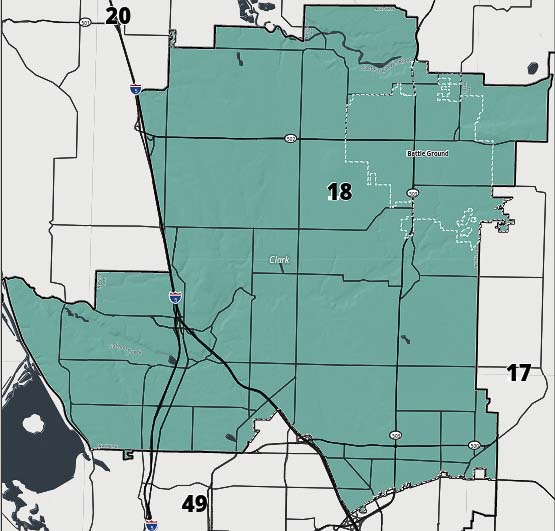
Washington’s 18th Legislative District is located within Clark County, bordering the 20th district in the North, and the 49th and 17th districts in the Southwest and East and includes parts of Vancouver, Battleground, Salmon Creek, Felida, a small part of Ridgefield, and other rural parts of Clark County.
We are tracking the case and will report on any important updates as they arise!
Bill Bruch is the WA State GOP Election Integrity Chairman, WSRP Executive Board Member, 5-Term Skagit County GOP Chairman, Citizen Journalist, Blogger, Business Owner, “2021 Citizen Activist of the Year” award by the Olympic Conference, 2020 WA State House Representative Candidate, Former Council Member, and WA State 2016 and 2024 RNC National Convention Delegate.

Also read:
- VIDEO: Rejected – WA SOS will not process referendum to repeal income tax law
 State officials stopped Let’s Go Washington’s referendum to overturn the new tax, citing constitutional limits. Legal and political battles, including a Supreme Court challenge, are expected next.
 - Southwest Washington lawmakers to hold a series of town hall meetings throughout the 17th Legislative District
 Sen. Paul Harris, Rep. Kevin Waters, and Rep. David Stuebe will answer questions and discuss the state’s expanded operating budget and newly passed income tax at five April town halls.
 - Project 42: It is an income tax, not a millionaire’s tax
 Project 42 co-founder Dann Mead Smith urged Clark County residents to organize against the new income tax law, emphasizing it can be expanded to reach more than just millionaires.
 - VIDEO: WA income tax signed into law with legal challenge right behind
 A 9.9% income tax affecting high earners in Washington faces swift legal opposition and a proposed citizen initiative seeking repeal.
 - Income tax signed in Washington with a legal challenge close behind
 A new law will tax households earning over $1 million, with funds aimed at expanding credits for lower-income residents. Lawsuits and challenges are already underway.
 wpDiscuz
