



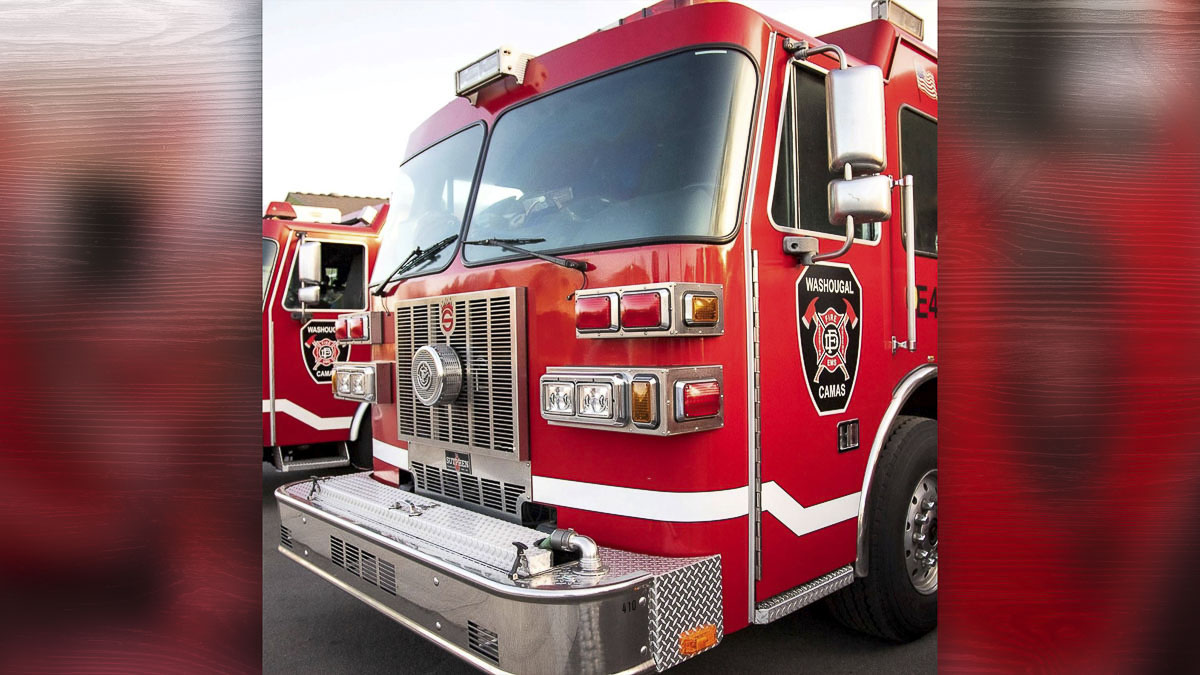
Proposed Regional Fire Authority rejected by Camas and Washougal voters; school levies in Battle Ground and Hockinson also rejected by voters
It appears Clark County voters have rejected all three tax propositions on the April 22 special election ballot, including a proposed Regional Fire Protection Authority in Camas and Washougal and school levy proposals in Battle Ground and Hockinson.
Proposition 1, a proposed Regional Fire Authority for the cities of Camas and Washougal was failing 51.96 percent (4,067 votes) to 48.04 percent (3,760 votes) in the initial results provided Tuesday night by the Clark County Elections Department.
The City Councils of Camas and Washougal adopted a joint resolution approving the Regional Fire Authority Protection Service Plan. The proposition would approve the plan and create an RFA to be known as the Camas-Washougal Fire Authority, effective Sept. 1, 2025, to provide fire protection and emergency medical services in the city of Camas and the city of Washougal. The RFA would be funded by property tax ($1.05 per $1,000 of assessed value).
In the Battle Ground School District, Proposition No. 9 is currently failing with 51.62 percent (10,282 votes) against and 48.38 percent (9,636 votes) for.
The Educational Programs and Operations Replacement Levy was proposed by the Board of Directors of the Battle Ground School District. The proposition was designed to continue funding student educational programs and operations. The proposition would authorize the district to levy the excess taxes, replacing an expiring levy, on all taxable property within the district for expenses not funded by the state (including student safety, instructional/support staff, small classes, curriculum, nursing, mental health support, special education, busing, sports, and arts. The four-year levy would have had a levy rate of $1.95 per 1,000 of assessed property and would have collected $38,300,000, $40,400,000, $42,600,000, and $44,975,000 in the four years.
In the Hockinson School District, Proposition 10 was failing by the largest margin of the three propositions before voters Tuesday. Just 44.02 percent (1,049 votes) of the voters were in favor of the levy and 55.98 percent) were against the capital levy proposal, which was designed for safety, security and infrastructure improvements. This proposition would have authorized the district to levy taxes, upon all taxable property within the district, to fund secure entries, automatic door locks and emergency communication systems; improve traffic flow and campus security at Hockinson Heights Elementary and upgrade facilities districtwide.
The six-year levy would have had a levy rate beginning at $0.66 per $1,000 of assessed property and increasing to $0.69 per $1,000. The levy amount each year would have been $1,875,000, $1,950,000, $2,050,000, $2,175,000, $2,285,000 and $2,400,000.
For updated election results this week, visit https://clark.wa.gov/elections/results.

Also read:
- 49th Legislative District Democrats share their reasons for backing state income tax at Town Hall
 Three Democrat legislators defended the new income tax affecting only those earning over $1 million annually.
 - Letter: Freeze the scope and build the bridge
 Vancouver resident calls for project discipline after 22 years of planning and nearly half a billion in costs.
 - Opinion: Public workers’ First Amendment rights are getting attention – in Idaho, not Washington
 Idaho moves to stop public schools from collecting union dues through government payroll while Washington continues favoring unions over worker choice.
 - Opinion: Lawsuit filed against the unconstitutional income tax in Washington state
 Former Attorney General Rob McKenna and Supreme Court Justice Phil Talmadge challenge the 9.9% income tax in Klickitat Superior Court.
 - Letter: ‘Oregon and Washington aren’t refusing to clean their rolls — they’re contesting federal jurisdiction and timing’
 Camas resident challenges Lars Larson’s fraud claims, explaining legal disputes over federal jurisdiction.
 wpDiscuz
