



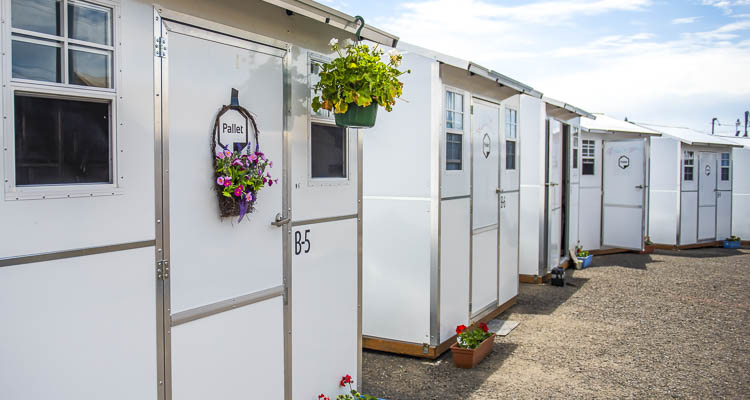
Hope Village, located at 4915 E. Fourth Plain Blvd., opened in April 2022 as Vancouver’s second temporary shelter community
VANCOUVER – On Friday, April 26, the city of Vancouver, non-profit operator Live Love Outreach and the many previously unsheltered individuals who have called Hope Village Safe Stay Community their temporary home, celebrated the community’s second anniversary.
“This program has pulled a lot of people off the streets and given them a safer place to live and transition out of homelessness,” said Jamie Spinelli, homeless response manager. “It’s also provided relief for the community because we’ve reduced camping in the area by providing these folks with a safe place to live and opportunities for neighbors to plug in and support its success.”
Hope Village, 4915 E. Fourth Plain Blvd., opened in April 2022 as Vancouver’s second temporary shelter community serving nearby unsheltered residents. From 2022 to 2023 Hope Village has served 86 unsheltered community members and graduated 36 into stable housing.
This Safe Stay is one of four temporary communities funded by the city of Vancouver to provide safe shelter and supportive services to unsheltered neighbors on their path to stable housing. In Nov. 2023, the city declared a state of emergency related to the growing complexity and magnitude of issues related to homelessness in Vancouver. Safe Stay programs are one of several tools the city uses to address the homelessness crisis in Vancouver. Learn more about the city’s emergency response efforts.
About Vancouver’s Safe Stay Program
In 2021, City Council approved a plan to create temporary, supportive Safe Stay Communities for people experiencing homelessness in Vancouver.
Safe Stays are temporary communities offering residents greater access to services, increased stability and safe living conditions to transition out of homelessness. Each Safe Stay has 20 two-person structures that offer shelter for up to 40 residents. A nonprofit operator provides 24/7 onsite management and services. All Safe Stays have fencing, provide sanitation and hygiene services, and offer health services. Camping is not permitted within 1,000 feet of a Safe Stay community.
Information provided by the city of Vancouver.
Also read:
- VIDEO: WA diesel hits record $6.53, crushing truckers and school budgets
 With diesel nearing $6.53 per gallon in Washington, trucking businesses and school districts now confront sharply higher fuel expenses affecting budgets and workers.
 - WA’s status solidifies as one of the most expensive places in US
 A new study shows Washington outpaces most states on cost of living, with metrics revealing a sharp rise in daily expenses and major metro areas ranking among the nation’s most expensive.
 - Opinion: Someone explain the Democrat Party to me please
 Lars Larson criticizes Democrat politicians for shutdown threats, Homeland Security funding refusals, and positions on election laws, housing, and gun rights.
 - CCSO to conduct search related to 1971 disappearance of Jamie Grissim
 Clark County Sheriff’s Office is coordinating a targeted search in Dole Valley, aiming to recover the remains of Jamie Rochelle Grissim, missing since 1971.
 - Business Profile: Columbia River volleyball coach teaches The Elite Competitor
 Bre Smedley co-founded The Elite Competitor to help young athletes handle the mental demands of sports by offering support, resources, and ongoing training for players, parents, and coaches.
 - POLL: Do you agree with requiring board members to follow council direction?
 Disagreement among county councilors centers on whether C-TRAN board members should reflect the council’s collective wishes or act independently, highlighting ongoing concerns about public accountability.
 - High-value WA home listings increase by 65% after income tax passage
 After lawmakers approved an income tax targeting millionaires, listings for homes priced at $2 million or more jumped 65 percent compared to last year, with experts urging caution about interpreting the spike.
 wpDiscuz
