



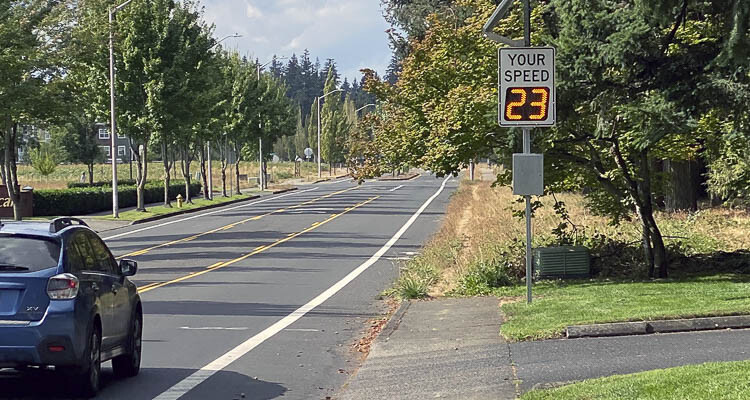
This competitive program allows residents to advocate for traffic calming along neighborhood streets in Vancouver
VANCOUVER – As part of the 2023 Neighborhood Traffic Calming Program, the city of Vancouver recently announced that two neighborhood traffic calming projects will be funded to help address traffic concerns and speeding within several residential communities. This competitive program allows residents to advocate for traffic calming along neighborhood streets in Vancouver.
Eight neighborhood project proposals were advanced as part of the program for 2023, and two of those projects were awarded funding as part of the City of Vancouver’s Neighborhood Traffic Calming Program. Developed with the support of the community-led Neighborhood Traffic Safety Alliance, the City’s Neighborhood Traffic Calming Program helps residents improve neighborhood livability and calm traffic by championing project proposals. Projects awarded funding as part of the 2023 program are:
– NE 72nd Avenue, from NE 63rd Street to NE 78th Street
Location: Green Meadows Neighborhood
– NE 39th Street, from NE 137th Avenue to NE 162nd Avenue
Location: Parkside, Parkway East and Burnt Bridge Creek Neighborhoods
Traffic calming elements will be determined and designed during the winter and spring, with project implementation anticipated for late summer or fall of 2024. Funding for the Neighborhood Traffic Calming Program is available through a combination of Real Estate Excise Tax (REET), Transportation Benefit District fees and multiple other revenue sources, providing an approximate budget of $300,000 for this year’s program. Project costs are coordinated through several different strategies and partnerships within City departments to maximize cost efficiencies.
Neighborhood traffic calming projects for 2024
The City of Vancouver and Neighborhood Traffic Safety Alliance invite community members to propose project locations and support projects through a competitive selection process for funding and implementation. City staff continue to explore program requirements, guidelines and funding efficiencies as we look at options to best support this neighborhood program and continue its success into the future.
More program details can be found on the city’s website: www.cityofvancouver.us/TrafficCalmingProgram. Look for updates on the 2024 program to be posted toward the first of the year.
Information provided by city of Vancouver.
Also read:
- Fiscal fallout: $375 million bond debt indirectly funding operating budget
 Shifting $375 million from a loan fund impacts local infrastructure as Washington state covers operating costs with bond debt, prompting concern among officials and advocacy groups.
 - Lawsuit aims to block new eligibility requirements for WA sheriffs
 Four sheriffs are suing over a state law that sets new eligibility rules, arguing it undermines voter authority by allowing removal for certification issues.
 - Opinion: The growing gap between public voice and political power
 Todd Myers describes how large-scale protest and sign-ins often fail to sway state leaders, and argues authentic influence is most likely found through local action.
 - City of Battle Ground seeks applicants for Salary Commission vacancy
 Battle Ground seeks a resident to join its independent Salary Commission, which reviews compensation and health benefits for local elected officials through 2027.
 - Opinion: Who is winning the race for affordable power?
 Hydroelectric power keeps Washington competitive, but new laws and carbon pricing are driving up electricity costs for residents each year.
 - Vancouver Fire Department assists with Columbia River Marina fire response
 Vancouver Fire Department joined Clark-Cowlitz and Scappoose crews to help fight a vessel and dock fire at Goble Marina, assisting in river operations where one boat sank and another was partially submerged.
 - White House govt. Funding request for 2027 cuts $73 billion
 President Trump’s budget seeks to boost defense funding while cutting $73 billion from agencies like the EPA, NASA, and Agriculture, prompting sharp criticism from Democratic leaders.
