



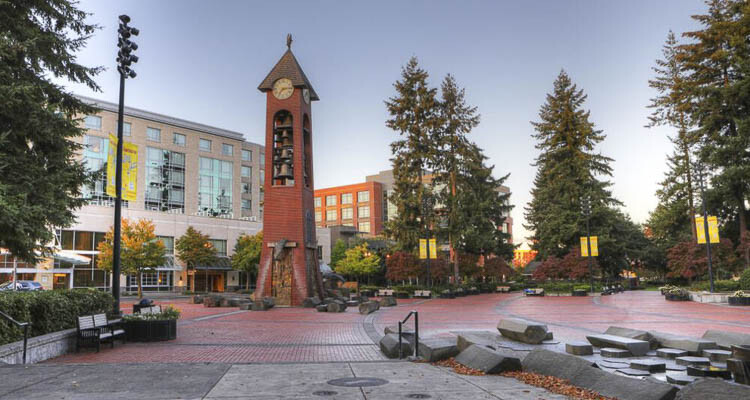
In 2022, the city adopted its climate action framework with the goal of transitioning to community-wide carbon neutrality by 2040
Spencer Pauley
The Center Square Washington
The city of Vancouver was able to secure $1.9 million in federal, state and regional funding for climate resiliency efforts.
Most recently, the city was awarded a $575,000 formula grant from the state Department of Commerce Climate Program. The grant funds must be used to reduce greenhouse gas emissions from buildings and the transportation sector community-wide, and to enhance local planning for climate resilience.
The Commerce Climate Planning grant is part of Washington state’s implementation of House Bill 1181.
According to the city, the latest funding will be distributed to four projects that are directly tied to advancing community-wide climate goals. One project is a citywide electric vehicle charging strategy, a citywide commercial building decarbonization strategy, a low carbon transportation acceleration strategy, and asset vulnerability mapping.
Throughout 2023, Vancouver was able to secure climate-related funding from the U.S. Department of Agriculture’s Forest Service Urban & Community Forestry, Washington state Department of Transportation’s sustainable aviation grants, Washington state Department of Commerce’s Solar Plus Storage for Resilient Communities and the Southwest Regional Transportation Council Transportation Alternative Program.
The city will use the collective $1.9 million for carbon sequestration, renewable energy, community resilience, green jobs and active transportation projects.
“As we head into 2024, this funding will help the city launch critical initiatives that bring the community along in achieving our 2040 climate goals,” Rebecca Small, Vancouver’s climate lead, said in a statement. “Everyone has a role to play in building a more sustainable future, and these city-led projects will support households and property owners in the transition to becoming carbon-free.”
In 2022, the city adopted its climate action framework with the goal of transitioning to community-wide carbon neutrality by 2040.
Vancouver intends to apply for additional state and federal grants for climate activities in 2024 and 2025.
This report was first published by The Center Square Washington.
Also read:
- Vancouver Police arrest barricaded man
 Terry Meyers, 58, faces multiple assault charges after pointing firearm at neighbor and barricading himself.
 - 49th Legislative District Democrats share their reasons for backing state income tax at Town Hall
 Three Democrat legislators defended the new income tax affecting only those earning over $1 million annually.
 - Letter: Freeze the scope and build the bridge
 Vancouver resident calls for project discipline after 22 years of planning and nearly half a billion in costs.
 - Ekklesia Theatre presents ‘Every Brilliant Thing’
 Interactive theatre production donates 50% of ticket sales to local counseling services.
 - Opinion: Public workers’ First Amendment rights are getting attention – in Idaho, not Washington
 Idaho moves to stop public schools from collecting union dues through government payroll while Washington continues favoring unions over worker choice.
 - Opinion: Lawsuit filed against the unconstitutional income tax in Washington state
 Former Attorney General Rob McKenna and Supreme Court Justice Phil Talmadge challenge the 9.9% income tax in Klickitat Superior Court.
 - Vancouver Police investigate domestic violence homicide
 Vancouver Police Major Crimes Unit investigating after woman found dead with knife wounds on NE Oakbrook Circle.
