



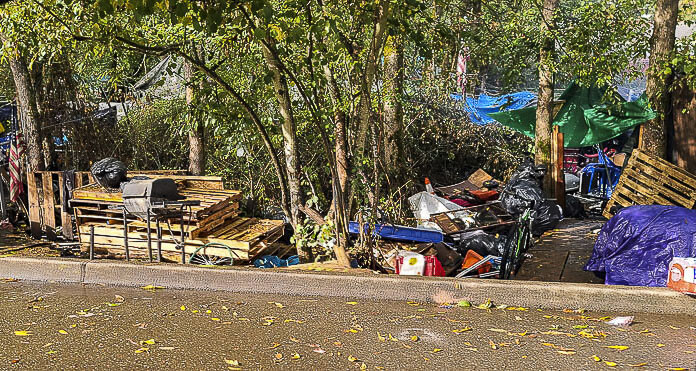
In order for the state of emergency to be over, the city manager has to present the Vancouver City Council with a resolution voting to rescind the declaration
Spencer Pauley
The Center Square Washington
Vancouver recently declared a state of emergency as a result of an increasing number of homeless people within city limits.
On Monday, the Vancouver City Council voted to ratify an emergency declaration related to homelessness. City Manager Eric Holmes made the emergency declaration the previous Friday.
The U.S. Department of Housing and Urban Services Office of Community Planning and Development found that between 2020 and 2022, Washington experienced the fourth largest increase in homelessness in the nation at 15.6%.
According to the city, it has surpassed the state averages, despite efforts to increase the available supply of affordable housing, among other initiatives to address homelessness.
At the time of the last Point-In-Time count conducted in January 2023, there were 1,300 homeless people in Clark County, with 672 being counted as unsheltered. The results also showed a 54% increase in chronic homelessness and a 78% increase in chronic unsheltered homelessness since 2022.
The Vancouver Homeless Assistance and Resources Team’s informal observations have produced a rough estimation of between 500 to 600 unsheltered homeless people within city limits.
Shortly after declaring the state of emergency, Holmes signed two initial emergency orders.
The first order allows increased authorization of a streamlined process for the city to accept donations, access financial reserves for budgeting needs, and buy goods and services needed to address homelessness.
For the duration of the emergency order, the city manager has the authority to increase the city budget to access its emergency reserve fund.
The second order allows Holmes to close up to 48 acres of public property to outdoor habitation, as a result of the city determining that homelessness continues to threaten the lives of residents.
“We are committed to doing everything we can to address homelessness in our city,” Holmes said in a statement. “While not all actions need the declaration, this mechanism will give us the agility we need to take action quickly as we continue to develop effective outreach-led, enforcement-backed solutions.”
In order for the state of emergency to be over, the city manager has to present the Vancouver City Council with a resolution voting to rescind the declaration.
This report was first published by The Center Square Washington.
Also read:
- Opinion: ‘When are we going to get the full and complete details of the Interstate Bridge Replacement Program’s I-5 Bridge replacement project?’
 IBR team buried key details about light rail ending at waterfront with massive elevator system required.
 - POLL: Do you support extending light rail beyond the waterfront to connect with C-TRAN at Library Square?
 Readers can weigh in on Anne McEnerny-Ogle’s proposal to extend light rail beyond the waterfront to Library Square for improved C-TRAN connections.
 - Opinion: Passing a cyclist – Law, myth and a little patience
 Most drivers can’t legally pass cyclists in-lane due to vehicle width versus road measurements.
 - County seeks public comment on plans tied to CDBG and HOME funding
 Clark County proposes $2.4 million in federal funding for dental care, affordable housing, and sidewalk improvements.
 - Opinion: The path to real tax reform requires a spending limit
 Washington Policy Center director argues constitutional spending caps would force real budget tradeoffs instead of endless tax increases.
 - Court battle set to begin over WA’s new income tax
 Former AG Rob McKenna leads constitutional challenge against 9.9% tax on earnings above $1 million starting Thursday.
 - Vancouver mayor counters IBR’s proposal for the only light rail stop to be at the waterfront
 Vancouver’s mayor wants light rail extended beyond the waterfront to connect with C-TRAN buses at Library Square.
 wpDiscuz
