



The weather is changing, and it there is less daylight hours, with brings more challenges to driving in the region
Paul Valencia
ClarkCountyToday.com
The clocks changed. The weather changed.
Driving habits should change, too.
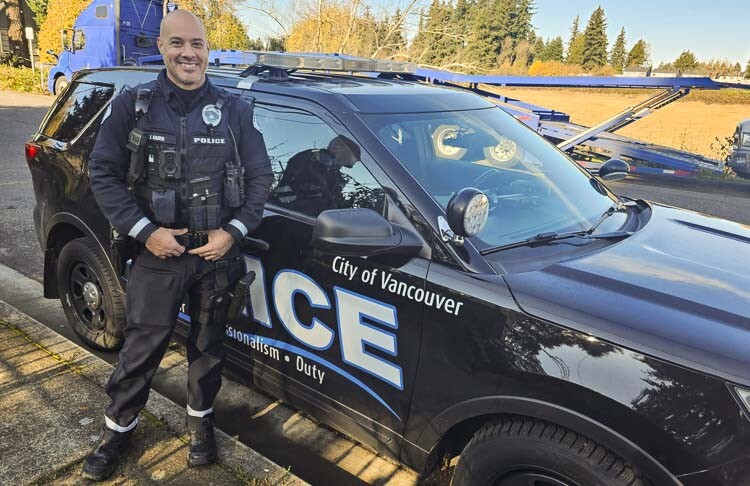
“The sun is going down quicker. We’re getting more hours of darkness. The rain has kicked in, too. We’re seeing more rainy days,” noted Jeff Anaya of the Vancouver Police Department. “Darkness is showing up at 4:30 in the afternoon. By the time you’re driving home, it’s almost pitch black. And we’re still seeing a lot of excessive speed.”

The word is out: Slow down. Keep your distance. Stay focused.
November’s emphasis for Target Zero is speed, low visibility, and risk factors. Target Zero is a statewide campaign with the goal to have zero deaths on state highways and roads by 2030. Law enforcement officials throughout Clark County take part in the campaign, hoping to educate drivers while also enforcing the law.
Anaya said that fatalities on the roadways are down just a bit from last year, but last year was one of the worst in recent history. It is frustrating for law enforcement and other first responders to see so many drivers traveling 15, 20, or even more miles per hour over the speed limit.
Those dangerous habits are worse now after the big changes: Daylight Savings Time to Daylight Standard Time comes about the time the rain returns and foggy conditions roll in to the region.
To law enforcement officials, it is a simple equation. Just about everything associated with operating a vehicle becomes more of a challenge in the fall and winter months.
“With more speed, you have a decrease in reaction time,” Anaya said. “When you crash, you’re going to do more damage because you’re carrying more energy, more momentum behind you. With the low visibility, with darkness coming so early, you’ll have slower reaction time. You’re going to see things later.
“And then we’ve got our wet roadways. Your stopping distance is going to increase because you’re going to slide farther,” Anaya added. “The roadway is going to be slicker. You’re not going to stop as well as you would on a dry surface.”
Among the risk factors that law enforcement officers are on the look out for is following too close. That is illegal at any time of the year, but is more dangerous in the fall and winter months — for the reasons already stated.
Anaya has seen the horrific effects of crashes.
“The on-scene stuff, it hits hard because it’s real,” Anaya said. “You’re seeing that person’s life is no longer here.”
Even more difficult for Anaya, though, is notifying a family member that a person has died. He has been on the receiving end of that notification, as well.
“I know what they’re going through,” Anaya said. “For me, that’s the hardest part.”
Target Zero, Anaya, and first responders are hoping drivers follow their advice: Slow down, keep your distance, and stay focused during challenging driving situations.
Also read:
- Fiscal fallout: $375 million bond debt indirectly funding operating budget
 Shifting $375 million from a loan fund impacts local infrastructure as Washington state covers operating costs with bond debt, prompting concern among officials and advocacy groups.
 - Lawsuit aims to block new eligibility requirements for WA sheriffs
 Four sheriffs are suing over a state law that sets new eligibility rules, arguing it undermines voter authority by allowing removal for certification issues.
 - Opinion: The growing gap between public voice and political power
 Todd Myers describes how large-scale protest and sign-ins often fail to sway state leaders, and argues authentic influence is most likely found through local action.
 - City of Battle Ground seeks applicants for Salary Commission vacancy
 Battle Ground seeks a resident to join its independent Salary Commission, which reviews compensation and health benefits for local elected officials through 2027.
 - Opinion: Who is winning the race for affordable power?
 Hydroelectric power keeps Washington competitive, but new laws and carbon pricing are driving up electricity costs for residents each year.
 - Vancouver Fire Department assists with Columbia River Marina fire response
 Vancouver Fire Department joined Clark-Cowlitz and Scappoose crews to help fight a vessel and dock fire at Goble Marina, assisting in river operations where one boat sank and another was partially submerged.
 - White House govt. Funding request for 2027 cuts $73 billion
 President Trump’s budget seeks to boost defense funding while cutting $73 billion from agencies like the EPA, NASA, and Agriculture, prompting sharp criticism from Democratic leaders.
