



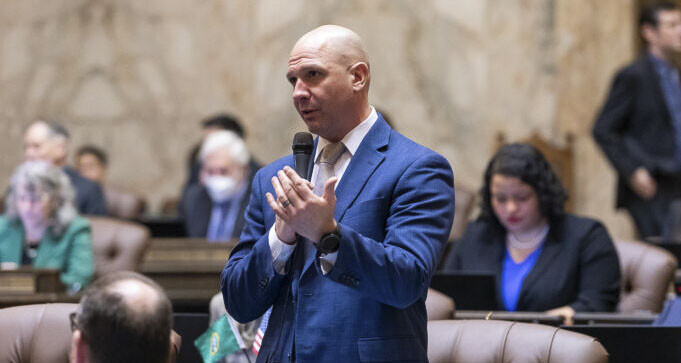
Lawmaker states that while the bill establishes drug possession as a gross misdemeanor, it creates opportunities for violators to ‘game the system’ without punishment or undergoing treatment
Rep. Peter Abbarno released the following statement after Senate Bill 5536 – a flawed effort to address the state’s drug possession laws – failed to pass the House on the final day of the 2023 legislative session:
“Senate Bill 5536 takes the very policies that have failed to address substance abuse on the local level and expands those failed policies statewide. It will lead to more substance abuse, more homelessness, more preventable tragedies, and less local control. If the majority party were serious about addressing this crisis, they would work with us, on a bipartisan basis, and pass legislation that effectively helps people recover from addiction. Sadly, this bill will do the opposite.”
While the bill establishes drug possession as a gross misdemeanor, it creates opportunities for violators to “game the system” without punishment or undergoing treatment. The measure would also prevent local governments from restricting the distribution of dangerous drug paraphernalia; house recovering addicts with active drug users; establish “safe” injection sites open to all ages, including children; and eliminate the public notice requirement for siting opioid treatment facilities.
For these reasons, House Republicans were unanimous in their opposition to the bill and were joined by 14 House Democrats. A tentative, bipartisan agreement was struck the day prior, but House Democrats offered only a partisan conference report to vote on as the House approached the final hours of session.
“Drug abuse, addiction, and the rise in crime are serious issues in communities across Washington state,” added Abbarno, R-Centralia. “The proposal brought forth by House Democrats did not represent my values, the values of my community, or the values of the state of Washington. We are committed to working on a real solution that protects our communities and serves the most marginalized and those struggling with addition. That might require a special session and we will have to wait.”
Background: In Feb. 2021, the state Supreme Court ruled in State v. Blake, that Washington’s felony drug-possession statute was unconstitutional because it criminalized possession even when a person did not knowingly have drugs.
Two months later, the Legislature passed Senate Bill 5476, a temporary measure reducing the penalty for possessing illegal drugs like fentanyl, heroin, and methamphetamine from a felony to a misdemeanor, which is set to expire on July 1, 2023. Unless the Legislature acts in time, there will be no statewide criminal penalty for possession of these drugs. Local governments could, however, adopt their own criminal penalties.
Information provided by Washington State House Republicans,
houserepublicans.wa.gov
Also read:
- POLL: Do you agree with requiring board members to follow council direction?
 Disagreement among county councilors centers on whether C-TRAN board members should reflect the council’s collective wishes or act independently, highlighting ongoing concerns about public accountability.
 - 18th District lawmakers to host town hall meeting on Saturday, March 28, in Battle Ground
 Stephanie McClintock and John Ley will meet with Battle Ground constituents to answer questions, review the new income tax, and discuss the effects of the $80 billion budget.
 - Opinion: In plain sight – yielding to pedestrians
 Drivers often fail to see pedestrians due to inattentional blindness, which highlights the need for more focused awareness at intersections and stronger safety practices.
 - NBA vote clears way for expansion to Seattle
 The NBA Board of Governors has voted to explore adding teams in Seattle and Las Vegas, moving Seattle closer than ever to hosting pro basketball again.
 - Opinion: The legislature has committed $2.4 billion to recurring pension increases since 2018
 Six legislative COLAs have raised public employer costs by $2.38 billion since 2018, driving up unfunded pension liabilities and increasing burdens on county and city budgets.
 - Opinion: ‘Just because they got away with it doesn’t mean they weren’t wrong’
 A Skamania County deputy’s report found violations of county rules and the Open Public Meetings Act, but no prosecutor acted on the findings.
 - More drama at Clark County Council in regard to its representatives on the C-TRAN Board
 Councilors debated whether C-TRAN board representatives must follow group mandates, with Michelle Belkot refusing to commit to new voting rules and Glen Yung opposing her nomination.
