



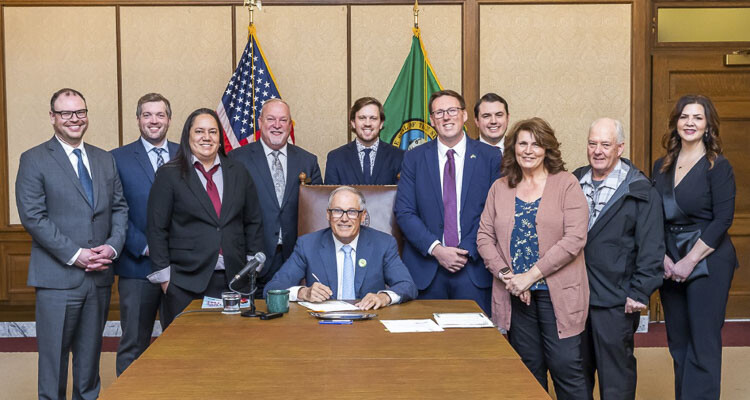
House Bill 1730, which is the freshman lawmaker’s first piece of legislation, will improve the state’s workforce by opening up certain job positions to a larger group of applicants
The governor signed into law a bill from Rep. Kevin Waters on Thursday that will give many of Washington’s smaller businesses a boost in their hiring efforts.
House Bill 1730, which is the freshman lawmaker’s first piece of legislation, will improve the state’s workforce by opening up certain job positions to a larger group of applicants. The legislation allows young adults between the ages of 18 to 21 to be employed in establishments traditionally classified as off-limits to persons under the age of 21, under specific and limited circumstances
“I’m grateful to see this bill become law. I have no doubt it will help our state’s workforce,” said Waters, R-Stevenson. “Many small businesses, especially restaurants and bars, are still having a hard time finding and holding onto good employees. This legislation is also going to open more opportunities for individuals under 21 looking for work. This is a positive step forward for employers and job seekers, and the entire state.”
Because HB 1730 contains an emergency clause it takes effect immediately.
Under the law, it is now legal for anyone at least 18-years-old to perform services unrelated to the sale or service of alcohol to enter and remain on premises, but only to carry out the duties of their employment as a dishwasher, cook, chef, sanitation specialist, or other kitchen staff and only under the following conditions:
- The individual may not perform any services or work in the bar, lounge, or dining area of the licensed premises.
- The individual may not serve food, drinks, or otherwise interact with the patrons of the licensee.
- The individual may never be in possession of or consume alcohol at any time.
- The licensee must ensure that a supervisor, who is at least 21 years of age, is always present where an individual employed under this section is working.
- This section shall not be construed as permitting the sale or distribution of any alcoholic beverages to any person under the age of 21 years.
“It’s great to see this simple bill become law and I’m excited to see the positive effects it will have in easing our workforce shortage,” added Waters.
The 2023 legislative session is scheduled to end on Sunday, April 23.
Information provided by Washington State House Republicans, houserepublicans.wa.gov
Also read:
- Opinion: Small things grow great by concord
 Washington’s initiative process gives citizens direct power to challenge lawmakers. Failed restrictions and new measures on girls’ sports, parental rights, and citizenship prove the influence of grassroots action.
 - Opinion: California’s $20 fast food minimum wage creates less jobs and lower income
 Study data show California fast food workers now face fewer shifts, higher menu prices, and widespread automation after the $20 wage hike.
 - Gov. Ferguson signs law to undo WA estate tax increase enacted last year
 Washington rolls back its estate tax hike, restoring previous rates and prompting uncertainty around $340 million in expected revenue for education.
 - Vancouver house fire displaces residents
 Crews from Vancouver Fire Department stopped a living room blaze from spreading, but five residents were forced out due to lingering smoke.
 - VIDEO: Vote-by-mail rules in WA at risk in SCOTUS election law case
 More than 127,000 Washington ballots postmarked by Election Day but received after could be disqualified under a possible Supreme Court ruling, prompting debate from both parties.
 - Rounding out debate, Gov. Ferguson signs bill addressing retailers’ penny problem
 A new Washington law lets merchants round cash purchases to the nearest 5 cents, aiming to manage change as shortages of pennies affect both businesses and customers.
 - Opinion: State is rightly emphasizing experience and skills, not degrees
 Elizabeth New explains how a new state policy removes unnecessary advanced degree requirements, supporting skills-based employment and broadening opportunities for capable workers.
