



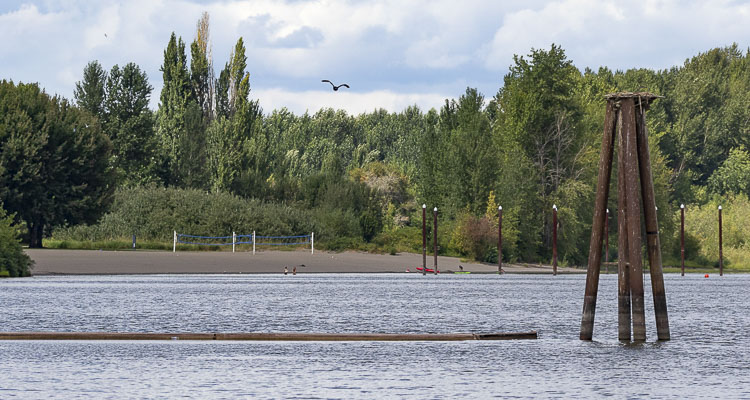
AquaTechnex, a lake and aquatic plant management firm, will again apply an aquatic algaecide to the water at the Vancouver Lake swim beach
VANCOUVER – Clark County’s second treatment of harmful algae at Vancouver Lake Regional Park is scheduled for Friday (Aug. 2).
AquaTechnex, a lake and aquatic plant management firm, will again apply an aquatic algaecide to the water at the Vancouver Lake swim beach. Boats will be used to apply the algaecide, which is designed to target and kill cells in harmful algae.
The first treatment occurred on July 25. The second treatment will begin at about 10 am Friday and is expected to take about two hours, during which the swim beach will be closed to the public.
Clark County Public Health issued a warning advisory for Vancouver Lake on July 25 due to the presence of algae at the swim beach and uncertainty of how treatment could impact toxin levels in the water. The warning advisory remains in place while Public Health continues to evaluate conditions at the swim beach.
While a warning advisory is in place, Public Health advises against swimming or wading in the lake and recommends avoiding areas of scum when using motorized boats, paddle boarding, kayaking or canoeing. Fish should be cleaned well, and organs should be discarded.
When applied in water, the algaecide targets the algae cells and then breaks down after treatment into water and oxygen. The algaecide does not pose a risk to people and pets, or cause harm to other plants, birds, fish and wildlife when applied according to the directions on the label. As a reminder, dogs and other domestic animals – except for service animals – are not allowed on the beach or surrounding grassy area of Vancouver Lake Regional Park between April 1 and Oct. 31.
Clark County Public Works’ Clean Water Division is working closely with Clark County Parks and Lands Division, Clark County Public Health and Herrera Environmental Consultants – with input from community stakeholders through the Vancouver Lake Technical Advisory Group – to develop and implement a beach management plan for Vancouver Lake, which includes the algaecide treatment. Additional algae treatments are expected to occur this summer.
For more information about the beach management plan for Vancouver Lake, visit the Vancouver Lake Management Plan Project webpage. Additional information about harmful algal blooms and current advisories are available on the Public Health website.
Information provided by Clark Co. WA Communications.
Also read:
- State Representatives McClintock and Ley answer questions at town hall in Battle Ground
 Residents voiced rising concerns about property taxes, school funding debates, the impact of new income tax legislation, and major costs tied to the Interstate Bridge plan.
 - As Washington gets an income tax, the fight to overturn it begins
 Opponents are organizing lawsuits and potential ballot measures to challenge the new 9.9% income tax on Washington households earning over $1 million.
 - Battle Ground Police arrest suspect in fatal 2025 crash
 Laboratory results from a blood sample collected in 2025 provided probable cause for police to arrest Michael T. Smith, more than a year after the Battle Ground crash.
 - Vancouver Police seeking missing person
 Vancouver Police are searching for 62-year-old Carrie Ann Winters, who was last known to be near Frenchman’s Bar in west Vancouver. She has distinctive tattoos.
 - VIDEO: WA diesel hits record $6.53, crushing truckers and school budgets
 With diesel nearing $6.53 per gallon in Washington, trucking businesses and school districts now confront sharply higher fuel expenses affecting budgets and workers.
 - WA’s status solidifies as one of the most expensive places in US
 A new study shows Washington outpaces most states on cost of living, with metrics revealing a sharp rise in daily expenses and major metro areas ranking among the nation’s most expensive.
 - Opinion: Someone explain the Democrat Party to me please
 Lars Larson criticizes Democrat politicians for shutdown threats, Homeland Security funding refusals, and positions on election laws, housing, and gun rights.
