



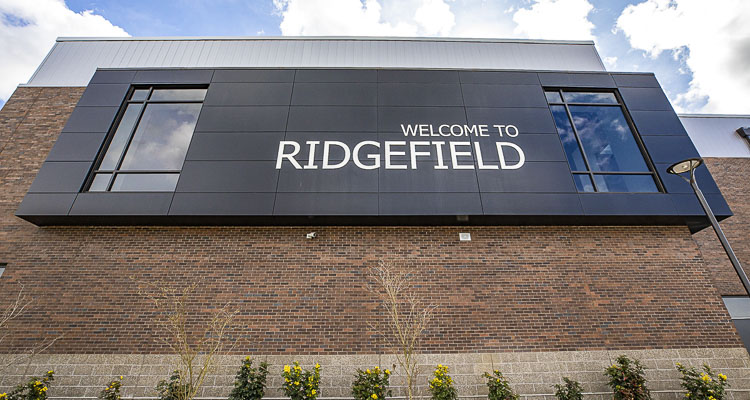
District makes updated offer to the teacher’s union during Wednesday negotiations; one more session scheduled Thursday prior to deadline
Ridgefield Education Association (REA) has voted to authorize a strike beginning Friday (Sept. 9). Its contract expired Aug. 31, which was also its first student day of the 2022-2023 school year.
The Ridgefield School District and REA each announced that one more negotiating session will take place Thursday before the teachers’ deadline Friday.
“After 6+ hours, we did not reach a TA tonight,’’ read a post on the REA Facebook page late Wednesday. “But agreed to one last bargaining session tomorrow at 4:30 p.m. before a potential strike Friday. In solidarity, the REA bargaining team.’’
The Ridgefield School District and the REA have been negotiating for several months, exchanging many proposals in an attempt to resolve a successor collective bargaining agreement. The district and REA met in a bargaining session on Wednesday (Sept. 7).
The next bargaining session is scheduled for Thursday (Sept. 8) at 4:30 p.m. The district is hopeful to reach a resolution. Should an agreement not be reached, the district will keep the community informed of the status of negotiations.
“We want our community to be aware of the current status of bargaining. You can review the district’s proposals and a summary on our Bargaining Updates page at www.ridgefieldsd.org/page/bargaining-update,’’ stated a release from the district late Wednesday night. “Please note that the most recent district proposal posted online includes portions of the REA’s most recent proposal within the document.’’
The district’s offer includes a minimum 8.5 percent wage increase in overall compensation to all employees for the current 2022-23 school year; a minimum 4.5 percent wage increase for the next school year (2023-24); and a minimum 3 percent wage increase for the following school year (2024-25). Additionally, eligible employees will receive an annual 2.5 percent step increase until reaching the top of the salary scale.
Additionally, the district has a 20-year salary scale with each year of service equating to one step. Each step is valued at 2.5 percent more than the previous step. For school year 2023-2024, the district will adjust to a 19-year scale by removing the first step, resulting in all employees on the salary scale moving up by one step, for an additional 2.5 percent increase (unless already maximized on the salary scale).
Similarly, for school year 2024-2025, the district will adjust to an 18-year scale by again removing the first step, resulting in all employees on the salary scale moving up by one step, for an additional 2.5 percent increase (unless already maximized on the salary scale).
The district’s proposal represents an approximate 3-year compensation package of at least 16 percent with eligible employees seeing up to 28.5 percent increases. Funding for these proposals includes additional state revenue of 5.5 percent (the value of the State of Washington’s Implicit Price Deflator Index, or IPD) this year and projected increases of 2.0 percent and 2.1 percent in the following years.
Information provided by Ridgefield School District.
Also read:
- Former WA Supreme Court justice joins legal effort against income tax
 Phil Talmadge and Rob McKenna have joined forces with the Citizens Action Defense Fund to oppose Washington’s new tax on high-income earners, raising legal and constitutional questions.
 - Makeover in store for Congress with flood of lawmakers headed for the exits
 A wave of exits from Congress—over 65 lawmakers—will usher in unfamiliar faces and decrease veteran expertise, shifting the political landscape in Washington.
 - Opinion: Sheriffs fight back
 Four county sheriffs are suing to block a new law giving a governor-appointed board power to decertify and remove sheriffs, bypassing voter oversight in Washington.
 - Obituary for Lucille ‘Erma’ Christenson Madore – April 22,1924-March 13, 2026
 Known for her love of music and family, Lucille ‘Erma’ Christenson Madore lived through nearly 102 years and leaves a large, grateful legacy in Vancouver.
 - Fiscal fallout: $375 million bond debt indirectly funding operating budget
 Shifting $375 million from a loan fund impacts local infrastructure as Washington state covers operating costs with bond debt, prompting concern among officials and advocacy groups.
 - Lawsuit aims to block new eligibility requirements for WA sheriffs
 Four sheriffs are suing over a state law that sets new eligibility rules, arguing it undermines voter authority by allowing removal for certification issues.
 - Opinion: The growing gap between public voice and political power
 Todd Myers describes how large-scale protest and sign-ins often fail to sway state leaders, and argues authentic influence is most likely found through local action.
 wpDiscuz
