



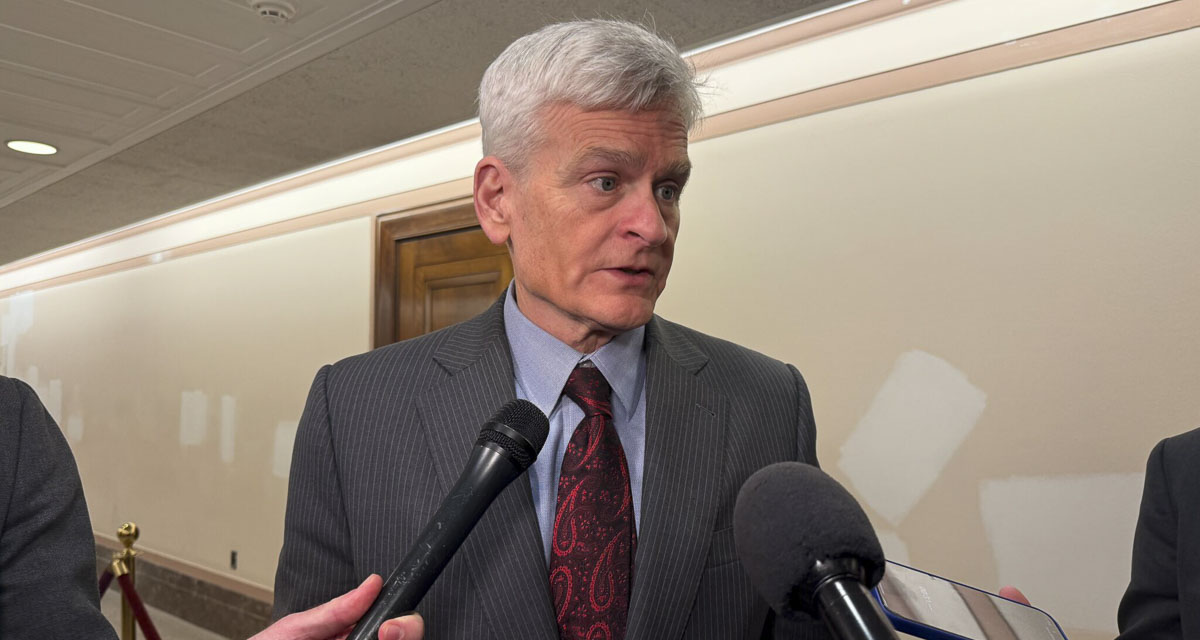
President Donald Trump’s administration and congressional Republicans have made school choice a central point of their education agenda
Shauneen Miranda
Washington State Standard
 See Grok’s analysis of this story
WASHINGTON — The fierce debate surrounding school choice initiatives took center stage Wednesday during a hearing in a U.S. Senate panel.
President Donald Trump’s administration and congressional Republicans have made school choice a central point of their education agenda, including a sweeping national school voucher program baked into the GOP’s mega tax and spending cut bill Trump signed into law in July.
The hearing came in the middle of National School Choice Week, which the U.S. Department of Education dubbed a “time to highlight the many different types of education across the United States and to empower families to choose the best learning option for their child’s success.”
The umbrella term “school choice” centers on alternative programs to one’s assigned public school. Opponents argue these efforts drain critical funds and resources from school districts, though advocates say the initiatives are necessary for parents dissatisfied with their local public schools.
Sen. Bill Cassidy, chair of the Senate Committee on Health, Education, Labor and Pensions, which held the hearing, described school choice as “the avenue for expressing the innovation that we need to meet a student’s need.”
“Traditional schools work for many students — what we’re asking, though, is to give the parent the choice if it does not,” the Louisiana Republican added.
Many models for school choice
Proponents in Ohio and Florida touted the work of their respective organizations and the broader school choice efforts in their states.
Cris Gulacy-Worrel serves as vice president of Oakmont Education, an operator of dropout recovery charter schools serving more than 5,500 students in Ohio, Iowa and Michigan.
Gulacy-Worrel said last year, Oakmont Education “graduated 1,309 students, and we’ve placed over 4,500 young people directly into the workforce over the last three years alone.”
“For far too long, we’ve been told school choice is about (Education Savings Accounts) or public charter schools — it’s not,” she said. “What we’re really talking about is educational plurality, a system with room for many models and many pathways to success.”
John Kirtley is chairman of Step Up For Students, a nonprofit scholarship funding organization that distributes scholarships for children in Florida.
Kirtley said his state “has been moving towards a new definition of public education: Raise taxpayer dollars to educate children, but then empower families to direct those dollars to different providers and even different delivery methods that best suit their individual children’s learning needs.”
More than half of all K-12 students in the Sunshine State participate in a school choice program rather than attending their local public school.
Bernie Sanders sees two-tier system created
Meanwhile, Sen. Bernie Sanders, the panel’s ranking member, said that while there are a “number of things we can and should be doing to strengthen and improve education” in the country, “we should not be creating a two-tier education system in America — private schools for the wealthy and well-connected and severely under-funded and under-resourced public schools for low-income, disabled and working-class kids.”
The Vermont independent said that “unfortunately, that is precisely what the Trump administration and my Republican colleagues in Congress are doing,” pointing to the national school voucher program that’s now law.
Sanders’ staff released a committee report Wednesday analyzing the state laws of 21 states with school voucher programs that scholarship granting organizations administer, in an effort to understand the forthcoming federal school voucher program’s potential effects.
Among the findings, the report concluded that “nearly half of analyzed private schools (48%) explicitly state that they choose not to provide some or all students with disabilities with the services, protections, and rights provided to those students in public schools under federal law.”
Arizona voucher program
Marisol Garcia, president of the Arizona Education Association, testified about the negative repercussions of private school vouchers in the Grand Canyon state.
In 2022, Arizona became the first state in the country to enact a universal school voucher program.
Garcia described her state’s voucher program as a “bloated mess costing three times more than it was projected” and said vouchers “often only offer the illusion of choice.”
“Every child deserves a great public school in Arizona,” she added. “Our experiences show that vouchers are not the way to achieve that goal.”
National school voucher program
The permanent national school voucher program, starting in 2027, allocates up to $1,700 in federal tax credits for individuals who donate to organizations that provide private and religious school scholarships.
The program reflects a sweeping bill that Cassidy and GOP Reps. Adrian Smith of Nebraska and Burgess Owens of Utah had reintroduced in their respective chambers in 2025.
Cassidy defended the program during the hearing, saying: “We’re not trying to supplant funding for public education — we’re trying to supplement funding for education.”
As of Tuesday, nearly half of all states have opted in to the initiative, per the Education Department.
This report was first published by the Washington State Standard.

This independent analysis was created with Grok, an AI model from xAI. It is not written or edited by ClarkCountyToday.com and is provided to help readers evaluate the article’s sourcing and context.
Quick summary
A U.S. Senate HELP Committee hearing on Jan. 29, 2026 featured testimony praising school choice and voucher-style programs in states such as Ohio and Florida. Democrats, led by Sen. Bernie Sanders, argued these programs create a two-tier system by drawing resources away from public schools and by sending public support to private schools without comparable accountability requirements.
What Grok notices
- Contrasts supporters’ claims—more options for families and success stories in choice states—with Democratic concerns about equity, funding diversion, and gaps in services for students with disabilities.
- Connects the hearing to a new national voucher-style tax credit program described as providing up to $1,700 starting in 2027, and notes the pace of state participation referenced in the article.
- Includes specific quotations from witnesses and senators, giving readers a clearer sense of how each side frames “choice,” “accountability,” and “public system” impacts.
- Cites a committee report that, according to the article, found nearly half of analyzed private schools may not provide full federal disability protections, highlighting a key point of contention about compliance and oversight.
- Points readers toward deeper documentation—committee materials and state-level outcome data—to evaluate the claims about academic results, fiscal effects, and equity impacts.
Questions worth asking
- How might the federal tax-credit structure of the national program affect public school funding flows in participating states, and what assumptions drive those projections?
- If private schools vary in disability-related protections and services, how could that affect equity for students with special needs seeking to use vouchers or tax-credit support?
- Across diverse student populations, what evidence exists that choice initiatives improve outcomes overall (academics, graduation, long-term earnings), and what outcomes show mixed or negative effects?
- What lessons from universal-voucher states (such as Arizona, as referenced) are most relevant for anticipating participation rates, costs, and oversight challenges under a federal program?
- What accountability standards—testing, financial audits, admissions transparency, disability compliance, or performance reporting—would be comparable to public-school expectations while still preserving private-school autonomy?
Research this topic more
- U.S. Senate HELP Committee – hearing transcripts, videos, and reports
- U.S. Department of Education – program information and policy updates
- NCSL – state voucher and school choice policy trackers
- EdChoice – research and reports on school choice programs
- U.S. GAO – federal evaluations and reports related to education programs

Also read:
- POLL: What do you believe is the biggest reason school districts are facing budget shortfalls?
 Districts across Washington warn of budget gaps as debate grows over rising costs versus inadequate state funding.
 - Lt. Governor shares his ideas on fixing housing shortage to members of BIA of Clark County
 Lt. Gov. Denny Heck told Clark County builders the state needs one million additional homes in 20 years.
 - Opinion: The high cost of hiding – Why IBR’s delayed revenue study is a $15 billion warning sign
 IBR delays critical toll revenue analysis until June 2027, hiding financial details until after project approval.
 - Opinion: The high cost of hiding – Why IBR’s delayed revenue study is a $15 billion warning sign
 IBR delays critical toll revenue analysis until June 2027, hiding financial details until after project approval.
 - Opinion: Washington fails the test for affordability
 Mountain States Policy Center analysis reveals Washington ranks 5th most expensive state as residents migrate to Idaho and Texas.
