



Walsh said Republicans are aware of inefficiencies in state agencies that should be addressed immediately, especially given that most Democrats are suggesting huge tax increases are unavoidable to balance the budget
Carleen Johnson
The Center Square Washington
Rep. Jim Walsh, D-Aberdeen, has introduced House Bill 2076 that would create the Washington Department of Government Efficiency, or WA DOGE, to identify outdated rules, eliminate waste and crack down on agencies operating beyond their legal authority.
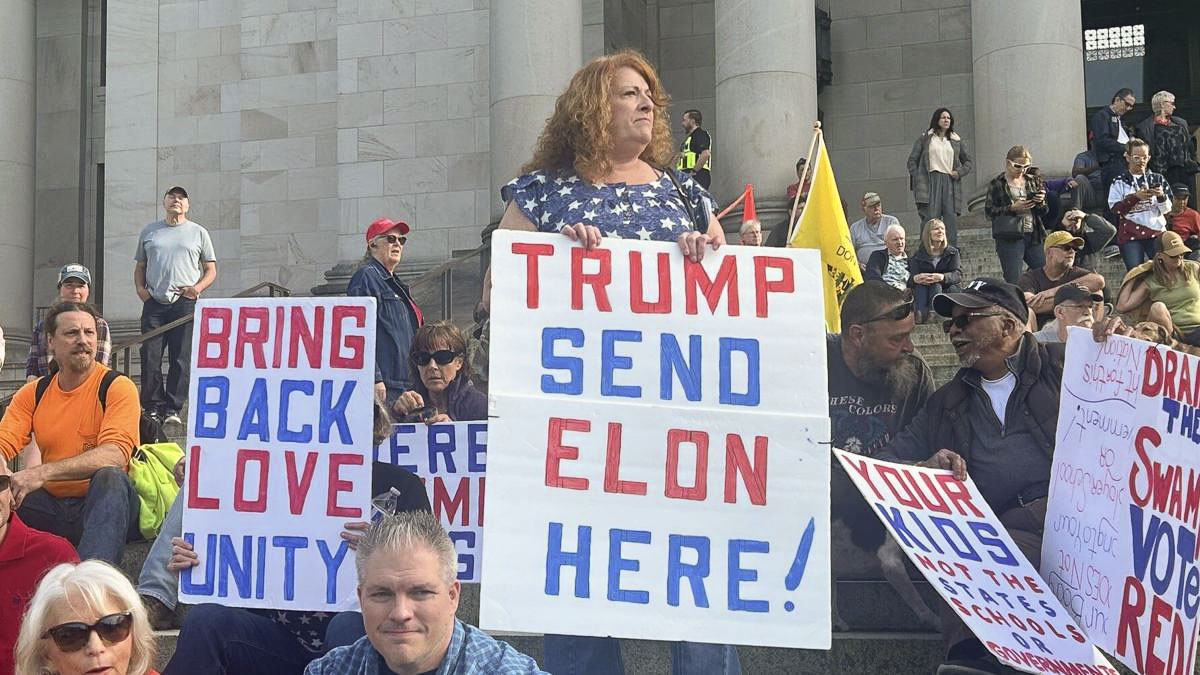
The proposed department is inspired by President Donald Trump’s federal Department of Government Efficiency helmed by Elon Musk.
On Saturday, HB 2076 was referred to the House State Government & Tribal Relations Committee.
Walsh, who also serves as the chair of the Washington State Republican Party, is not holding his breath that his bill will advance this session as majority party Democrats focus on revenue-generating proposals to fill a projected $16 billion operating budget shortfall over the next four years.
“The WA DOGE bill creates a temporary agency within state government, and the purpose of the agency is to do a really thorough audit of agencies,” he said. “Think in terms of Department of Ecology, L&I, Department of Commerce, Department of Health.”
The Center Square emailed the office of Rep. Sharlett Mena, D-Tacoma, who chairs the House Government & Tribal Relations Committee, to inquire if the bill would receive a public hearing, but it did not receive a response.
During a Tuesday interview, Walsh said Republicans are aware of inefficiencies in state agencies that should be addressed immediately, especially given that most Democrats are suggesting huge tax increases are unavoidable to balance the budget.
“Volunteer agencies, some using the DOGE name, have already been digging in,” said Walsh, who noted early findings show plenty of room for improvement. “Things that look like crony capitalism, grant grifting, these sorts of things.”
For example, what started out as a spontaneous on-air comment by KVI conservative radio talk show host Ari Hoffman has turned into “Washington State DOGE,” where everyday citizens can act as watchdogs.
Walsh said WA DOGE, as crafted in HB 2076, would operate much differently than Trump’s DOGE.
“At the federal level, DOGE is an advisory agency to the president. The WA DOGE agency is a legislative creature, and it operates under the wing of the Joint Legislative Audit and Review Committee, and the proposal gives the state agency a little more real teeth than the federal one,” he noted. “Federal DOGE just researches and then reports, and it’s up to the President to take action. WA DOGE gives the state more power.”
Walsh explained that HB 2076, as drafted, withholds some agency funding pending the outcome of WA DOGE investigations.
“It withholds 6% of each of the state agencies budgets for the upcoming two-year cycle in reserve, in kind of an escrow account, pending the completion of the WA DOGE review of that agency’s operations,” he said. “If it passes, then the 6% gets released back to the agency. If it doesn’t cooperate and participate, and it doesn’t pass the review, then the 6% stays withheld and could be reapportioned.”
In a news release, Walsh noted that Gov. Bob Ferguson recommended 6% cuts across state agencies to help balance the budget shortly before he was sworn in as governor. Some $750,000 would be appropriated to cover the small staff and overhead costs at the temporary WA DOGE agency.
Walsh said he offered the bill late in the session and knows it faces a steeper than an uphill battle. But given it impacts the budget, the late session filing is allowed.
“I filed it late in session. It is necessary to implement the budget because of the 6% withholding part. It’s a budget bill, but I fully expect that if it gets a hearing, it will probably be in the next session. It’s like pre-pre-filing for the next session,” he said.
Walsh noted the legislation could also be an initiative to the people.
“The bill is public now that it’s been filed, and anybody could take it now and run it as an initiative,” he said.
The 105-day session ends April 27.
This report was first published by The Center Square Washington.

Also read:
- Opinion: The legislature has committed $2.4 billion to recurring pension increases since 2018
 Six legislative COLAs have raised public employer costs by $2.38 billion since 2018, driving up unfunded pension liabilities and increasing burdens on county and city budgets.
 - Opinion: ‘Just because they got away with it doesn’t mean they weren’t wrong’
 A Skamania County deputy’s report found violations of county rules and the Open Public Meetings Act, but no prosecutor acted on the findings.
 - More drama at Clark County Council in regard to its representatives on the C-TRAN Board
 Councilors debated whether C-TRAN board representatives must follow group mandates, with Michelle Belkot refusing to commit to new voting rules and Glen Yung opposing her nomination.
 - Opinion: Small things grow great by concord
 Washington’s initiative process gives citizens direct power to challenge lawmakers. Failed restrictions and new measures on girls’ sports, parental rights, and citizenship prove the influence of grassroots action.
 - Opinion: California’s $20 fast food minimum wage creates less jobs and lower income
 Study data show California fast food workers now face fewer shifts, higher menu prices, and widespread automation after the $20 wage hike.
 wpDiscuz
