



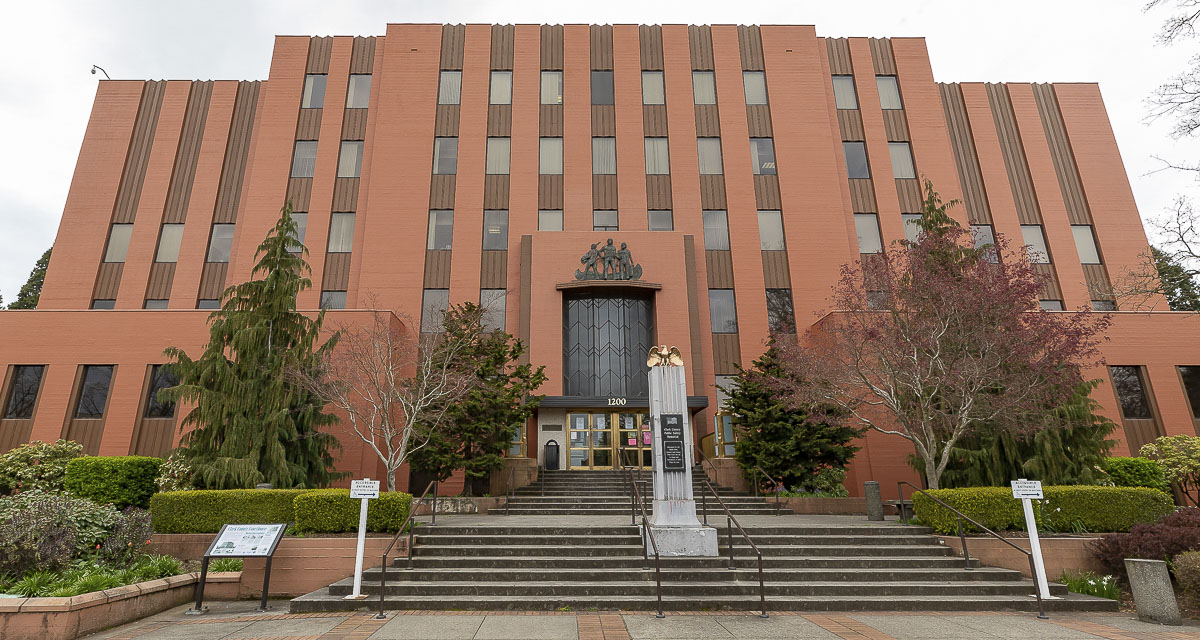
Arguments were made Friday in Clark County Superior Court regarding potential violation of the Open Public Meetings Act, and after a flaw in the case was revealed, the judge asked Rob Anderson to withdraw his complaint
Paul Valencia
Clark County Today
Reform Clark County’s Rob Anderson withdrew his complaint against members of the Clark County Council on Friday after he learned he made unintentional flaws in regard to documents he filed with the court.

“Obviously I’m disappointed with what happened today, but it’s not a terrible surprise being a pro se, non lawyer,” Anderson said. “It is challenging to move these more complicated cases — and it is a complicated case — forward. There were some mistakes made. As a result, it turned out to be better to withdraw.”
Anderson filed a civil complaint against Clark County council members Sue Marshall, Glen Yung, Wil Fuentes, and Matt Little back in April, accusing them of violating the Open Public Meetings Act. This was soon after the council voted to remove colleague Michelle Belkot from the C-TRAN Board of Directors and replace her with Fuentes.
Anderson said the council made these actions without giving notice to the public, so the public was denied the opportunity to give public comment.
Anderson first filed his complaint in Skamania County. It was moved to Clark County. Then the case was delayed once, and again when a judge recused himself.
Clark County Superior Court Judge Camara Banfield heard arguments Friday morning.
Anderson said that the Clark County Council failed to list on its agenda actions regarding a vote on light rail operations and maintenance costs in a February meeting. Then, in early March, failed to put on the agenda that they would be discussing the removal of Belkot from the C-TRAN board and the Fuentes appointment to that board.
“This omission, combined with restricting public comment to agenda items only, denied me and the public input on these actions,” Anderson said.
Later in the hearing, Banfield heard from the defense that some of the cases that Anderson filed for his argument might not not exist. Banfield wondered if AI was used in Anderson’s prep.
“You did great with your arguments,” Banfield told Anderson. “It’s bad that this had to happen.”
She then suggested that Anderson withdraw his case.
Anderson, while disappointed, appreciated the judge’s words.
“I finally got my day in court,” said Anderson, the founder of Reform Clark County, an organization with the mission to serve as a catalyst for restoring constitutional republic principles in Clark County.
He also said that while his fight is over, the battle for Belkot continues. Belkot has her own case — a federal case — that is still to be heard. Belkot’s case, Anderson said, will also tackle the subject of whether the council violated the Open Public Meetings Act. Belkot is represented by an attorney.

Also read:
- VIDEO: WA diesel hits record $6.53, crushing truckers and school budgets
 With diesel nearing $6.53 per gallon in Washington, trucking businesses and school districts now confront sharply higher fuel expenses affecting budgets and workers.
 - WA’s status solidifies as one of the most expensive places in US
 A new study shows Washington outpaces most states on cost of living, with metrics revealing a sharp rise in daily expenses and major metro areas ranking among the nation’s most expensive.
 - Opinion: Someone explain the Democrat Party to me please
 Lars Larson criticizes Democrat politicians for shutdown threats, Homeland Security funding refusals, and positions on election laws, housing, and gun rights.
 - POLL: Do you agree with requiring board members to follow council direction?
 Disagreement among county councilors centers on whether C-TRAN board members should reflect the council’s collective wishes or act independently, highlighting ongoing concerns about public accountability.
 - High-value WA home listings increase by 65% after income tax passage
 After lawmakers approved an income tax targeting millionaires, listings for homes priced at $2 million or more jumped 65 percent compared to last year, with experts urging caution about interpreting the spike.
