



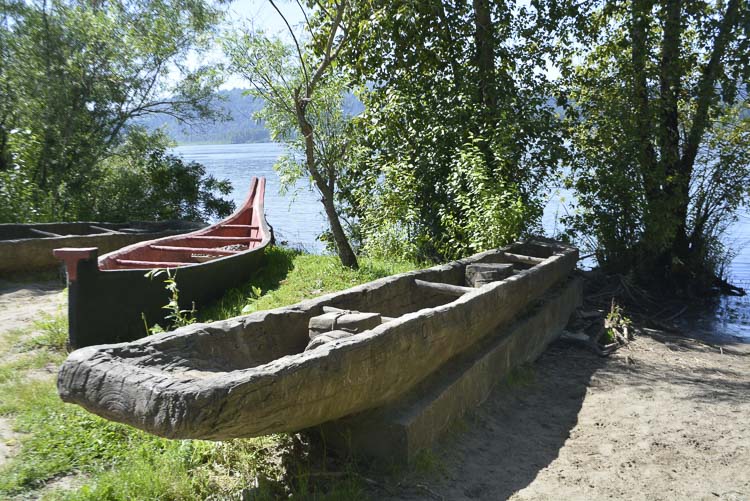
This year’s Parkersville Day event will be held on Saturday, June 1 at Parker’s Landing Historical Park near the Port of Camas-Washougal
The third annual Parkersville Day will again shine a spotlight on early Washougal history. This year’s event, on Saturday June 1 at Parker’s Landing Historical Park near the Port of Camas-Washougal, will celebrate the rich history of Parkersville and early water transportation along the Columbia River.
The Chinook people visited and lived and hunted in the Parkersville area before settlers arrived from the east. These friendly, peaceful, industrious indigenous people built and used dugout canoes as their primary method of transportation, and for hunting and fishing expeditions.
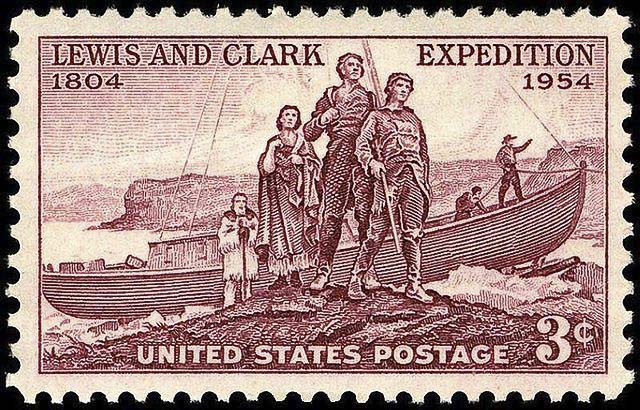
The Lewis and Clark Corps of Discovery camped for six days in 1806 near Washougal during their return journey along the Columbia River. Eighty percent of the Corp’s round trip exploration was by water putting to use an impressive 25 vessels of distinct types and uses.
Two large, flat-bottomed rowboats, called Pirogues, were important crafts used by the group. They are typically rowed and use sails and rudders. Pirogues were large, open, boats made from planks and frames, or narrow canoes made from tree trunks.
The Corps of Discovery traveled by river almost 600 days of their journey and raised a sail about one-tenth of the time. Rowing required crew training and experience. A bowman barked, “Stroke” to the rowers as he took in visual cues for pace, length, and depth of strokes. As crew members viewed new scenery and shook off gnats and mosquitos, they learned how to row as a team and keep their minds focused on moving the craft forward in a synchronized pattern.
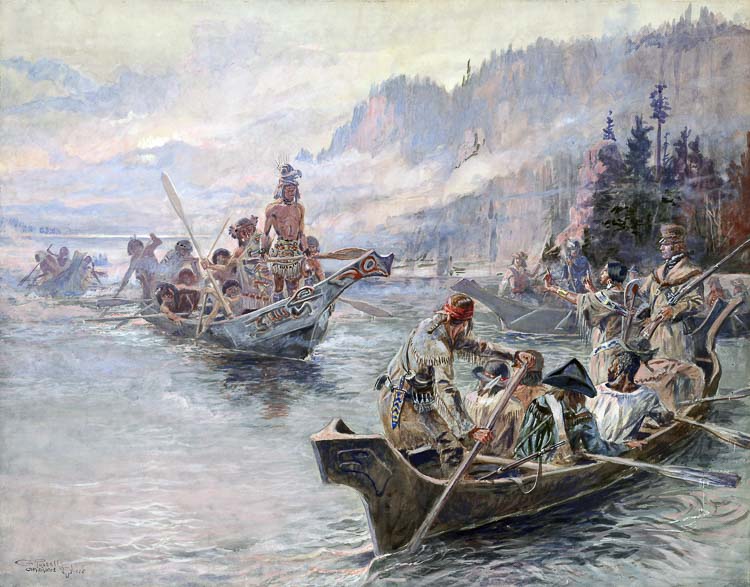
Meriwether Lewis listed a keeled boat in his pre-expedition shopping list that was later noted as “the boat” 190 times and as “the barge” 32 times in journals. Lewis and Clark finished their journey in 1806. In 1811, Canadian mapmaker, David Thompson paddled down the Columbia River and visited the Washougal area. His cedar plank bateau boat’s shallow draft navigated well in rivers and its flat bottom provided stability for heavy cargo.
The smallest batteau required only one crew member while larger ones, up to 58 feet long, required five men. The largest batteau could carry up to ten tons of cargo and mount a small sail although the flat bottom was not optimal for sailing.
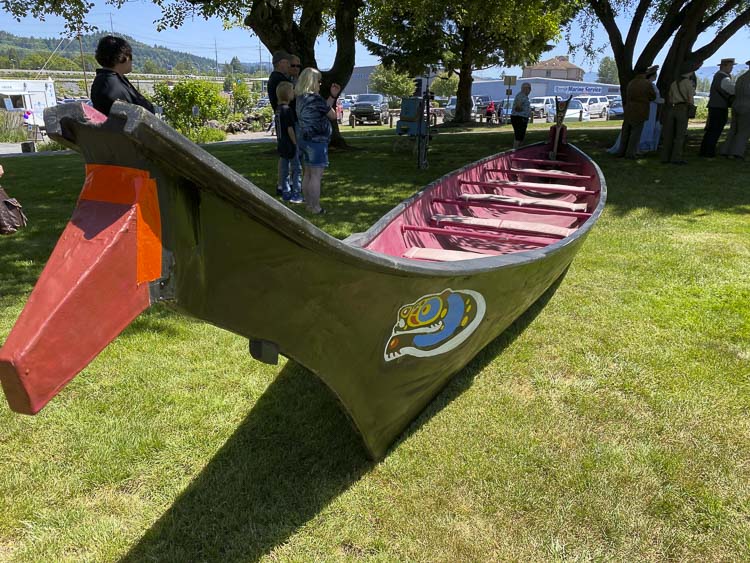
A Scow was a small barge or ferry type with some rigged for sailing. In the 19th century, scows carried cargo with the advantage of easy navigation in shallow waters or small harbors due to their large flat bottoms and square ends. Some Scows were made from willows and covered with skins.
When the Oregon Trail opened up travel from the east to settle the west, wagons needed to cross the rugged Snake River before reaching the Columbia River. Travelers could follow the Barlow Road around Mount Hood to Oregon City or transport wagons down the river by placing them on rafts. Heavy rope or chains held the floating boats together.
The third annual Parkersville Day, a free family-friendly event that educates the public on interesting and notable local history through engaging activities, displays, games, art, music, and storytelling. The event takes place on Saturday, June 1 from noon to 3 p.m.
For more information about the Parker’s Landing Historical Park and local history events email ParkersLandingHistoricalPark@gmail.com or follow local history stories and events at https://www.facebook.com/ParkersLandingHistoricalPark.
Also read:
- White House govt. Funding request for 2027 cuts $73 billion
 President Trump’s budget seeks to boost defense funding while cutting $73 billion from agencies like the EPA, NASA, and Agriculture, prompting sharp criticism from Democratic leaders.
 - Heywood asks WA Supreme Court to allow referendum effort on income tax
 Brian Heywood is petitioning the state Supreme Court after the Secretary of State rejected a referendum to repeal Washington’s new 9.9% tax on income over $1 million.
 - Opinion: Half the road, full stop – Understanding pedestrian right-of-way
 Doug Dahl explains how Washington’s law requires drivers to stop when a pedestrian is within one lane of their half of the road, not just when directly in front.
 - Clark County seeks volunteer for Law and Justice Council
 Applicants with experience in mental health services are encouraged to help guide Clark County’s coordination of local criminal justice and corrections planning.
 - VIDEO: Families at center of WA transgender sports debate face-to-face with OSPI
 Two Washington high school students and their parents met with Superintendent Chris Reykdal to discuss concerns about sports policies after one student faced an investigation for harassment.
 - As Washington lawmakers punt on school cellphone ban, some want more action
 At Robert Eagle Staff Middle School, all-day phone removal led to fewer conflicts and more student engagement, but some parents and lawmakers argue a ban should not be imposed statewide.
 - Opinion: The state’s RFK-proofing bill comes with a cost
 Mandates like HB 2242 can lead to higher premiums as insurance companies absorb costs for new preventive services, affecting affordability statewide.
 wpDiscuz
