



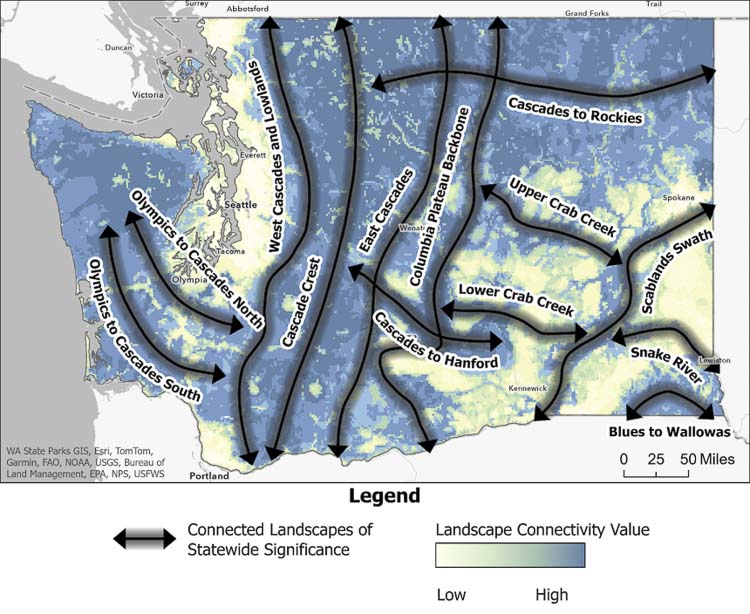
The new plan offers a statewide roadmap for identifying the best places to protect and restore wildlife movement, whether through safer road crossings, land conservation, or better-informed local planning
OLYMPIA — The Washington Department of Fish and Wildlife (WDFW), in partnership with the Washington State Department of Transportation (WSDOT), has released a landmark strategy to reduce wildlife-vehicle collisions, reconnect habitats fragmented by development, and help the state’s wildlife adapt to climate change.
The Washington Habitat Connectivity Action Plan (WAHCAP) offers a statewide roadmap for identifying the best places to protect and restore wildlife movement, whether through safer road crossings, land conservation, or better-informed local planning.
“Wildlife don’t stop at county lines or property fences,” said Julia Michalak, WDFW’s priority habitats and species section manager. “This plan gives Washington a common map and shared tools so that people across the state – local planners, landowners, tribal governments, state and federal agencies – can work together to reconnect the land.”
Every year in Washington, thousands of animals are hit by vehicles, causing injuries to people and costly damage to property, and killing wildlife—including threatened or endangered species. At the same time, climate change is shifting where species live and migrate. Reconnecting landscapes is one of the most effective strategies for helping wildlife survive those changes.
A statewide blueprint for wildlife movement
As the human presence on Washington’s landscape grows, roads and development make it harder for wildlife like deer, elk, cougar, and black bears to find food, migrate, and adapt to climate change. This new plan addresses these challenges through a variety of innovative resources, including:
- High-priority road segments: The plan identifies 38 sections of state highways where actions like building wildlife crossings, installing fencing, or retrofitting culverts could offer the most significant benefits statewide—dramatically reducing collisions and restoring movement corridors for wildlife. The plan also breaks the entire state highway system into mile-long increments, ranking them by their potential to improve connectivity and prevent wildlife-vehicle collisions.
- Statewide wildlife pathways: The plan outlines 13 large “connected landscapes of statewide significance” that are essential for connecting major ecological core areas across the state. Protecting these broad zones is key to keeping habitats connected over the long term.
- Regional planning tools: The plan includes publicly available interactive maps that combine 10 key types of ecological data—such as climate resilience, habitat quality, and species movement needs—to help local governments, tribes, and landowners identify where and how to act.
Developed in collaboration with local and tribal governments, conservation groups, and technical experts, the plan includes regional strategies tailored to the specific needs of different parts of the state.
What’s next
WAHCAP is already informing efforts to secure federal infrastructure and climate funding for wildlife crossings and conservation. Local governments are encouraged to use WAHCAP data in land-use planning, zoning, and open space protection.
“The data in WAHCAP will help WSDOT plan safer roads that work better for people and wildlife,” said Glen Kalisz, habitat connectivity biologist at WSDOT. “This kind of statewide coordination allows us to identify where to focus our investments, design more effective crossings, and support healthy ecosystems across Washington.”
The full plan is available at the WDFW website. Interactive maps and other planning resources are available at ArcGIS online.
About WDFW
The Washington Department of Fish and Wildlife is dedicated to preserving, protecting, and perpetuating the state’s fish, wildlife, and ecosystems while providing sustainable recreational and commercial opportunities.
About WSDOT
The Washington State Department of Transportation is focused on providing safe, sustainable, reliable and cost-effective transportation options to improve livable communities and economic vitality for people and businesses.
Also read:
- Public Health investigating confirmed measles case in Clark County
 Clark County Public Health is investigating a confirmed measles case after a contagious individual was present at Ridgefield High School on Jan. 14, 15 and 16.
 - VIDEO: Bill dubbed the ‘initiative killer’ clears WA Senate committee
 A bill critics label the “initiative killer” cleared a Washington Senate committee on a party-line vote after all Republican amendments were rejected.
 - Opinion: IBR’s evasive, misleading and dishonest excuses for higher cost
 Joe Cortright argues the Interstate Bridge Replacement Program has withheld detailed cost estimates while offering contradictory explanations for rising costs tied to the I-5 Bridge project.
 - Journey Theater seeks performers, crew for this summer’s Into the Woods
 Journey Theater is seeking performers ages 8 and older, along with crew and production committee members, for its summer production of Into the Woods.
 - CCSO honors heroism and outstanding service at annual awards ceremony
 The Clark County Sheriff’s Office recognized deputies, civilian employees, and community members for heroism and exceptional service during its annual awards ceremony at Clark College.
 - Rep. Stephanie McClintock’s bill to modernize beer warehousing laws receives a public hearing
 House Bill 2207, sponsored by Rep. Stephanie McClintock, received a public hearing as lawmakers considered updates to Washington’s beer warehousing laws.
 - Michelle Belkot announces bid for re-election to Clark County Council, District 2
 Clark County Councilor Michelle Belkot announced she is seeking re-election in District 2 in the November 2026 General Election.
 wpDiscuz
