


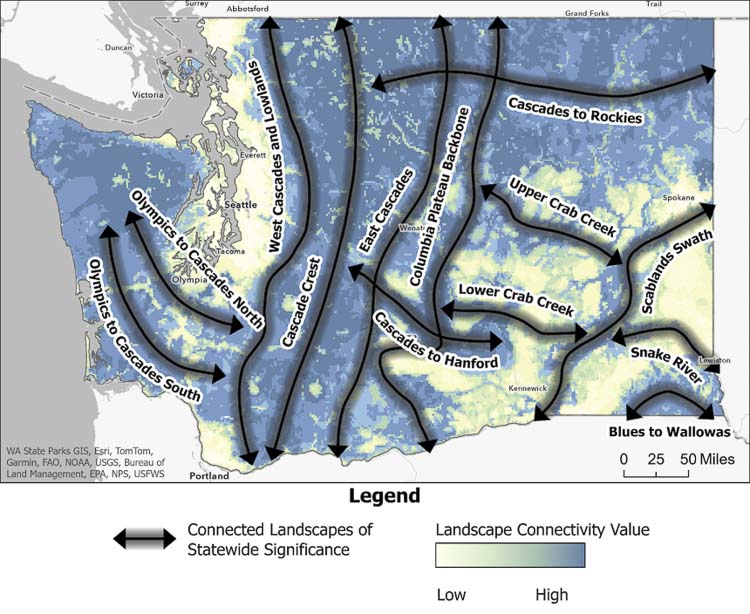
The new plan offers a statewide roadmap for identifying the best places to protect and restore wildlife movement, whether through safer road crossings, land conservation, or better-informed local planning
OLYMPIA — The Washington Department of Fish and Wildlife (WDFW), in partnership with the Washington State Department of Transportation (WSDOT), has released a landmark strategy to reduce wildlife-vehicle collisions, reconnect habitats fragmented by development, and help the state’s wildlife adapt to climate change.
The Washington Habitat Connectivity Action Plan (WAHCAP) offers a statewide roadmap for identifying the best places to protect and restore wildlife movement, whether through safer road crossings, land conservation, or better-informed local planning.
“Wildlife don’t stop at county lines or property fences,” said Julia Michalak, WDFW’s priority habitats and species section manager. “This plan gives Washington a common map and shared tools so that people across the state – local planners, landowners, tribal governments, state and federal agencies – can work together to reconnect the land.”
Every year in Washington, thousands of animals are hit by vehicles, causing injuries to people and costly damage to property, and killing wildlife—including threatened or endangered species. At the same time, climate change is shifting where species live and migrate. Reconnecting landscapes is one of the most effective strategies for helping wildlife survive those changes.
A statewide blueprint for wildlife movement
As the human presence on Washington’s landscape grows, roads and development make it harder for wildlife like deer, elk, cougar, and black bears to find food, migrate, and adapt to climate change. This new plan addresses these challenges through a variety of innovative resources, including:
- High-priority road segments: The plan identifies 38 sections of state highways where actions like building wildlife crossings, installing fencing, or retrofitting culverts could offer the most significant benefits statewide—dramatically reducing collisions and restoring movement corridors for wildlife. The plan also breaks the entire state highway system into mile-long increments, ranking them by their potential to improve connectivity and prevent wildlife-vehicle collisions.
- Statewide wildlife pathways: The plan outlines 13 large “connected landscapes of statewide significance” that are essential for connecting major ecological core areas across the state. Protecting these broad zones is key to keeping habitats connected over the long term.
- Regional planning tools: The plan includes publicly available interactive maps that combine 10 key types of ecological data—such as climate resilience, habitat quality, and species movement needs—to help local governments, tribes, and landowners identify where and how to act.
Developed in collaboration with local and tribal governments, conservation groups, and technical experts, the plan includes regional strategies tailored to the specific needs of different parts of the state.
What’s next
WAHCAP is already informing efforts to secure federal infrastructure and climate funding for wildlife crossings and conservation. Local governments are encouraged to use WAHCAP data in land-use planning, zoning, and open space protection.
“The data in WAHCAP will help WSDOT plan safer roads that work better for people and wildlife,” said Glen Kalisz, habitat connectivity biologist at WSDOT. “This kind of statewide coordination allows us to identify where to focus our investments, design more effective crossings, and support healthy ecosystems across Washington.”
The full plan is available at the WDFW website. Interactive maps and other planning resources are available at ArcGIS online.
About WDFW
The Washington Department of Fish and Wildlife is dedicated to preserving, protecting, and perpetuating the state’s fish, wildlife, and ecosystems while providing sustainable recreational and commercial opportunities.
About WSDOT
The Washington State Department of Transportation is focused on providing safe, sustainable, reliable and cost-effective transportation options to improve livable communities and economic vitality for people and businesses.
Also read:
- Opinion: Were Republican voters just sleeping during the August primary election?
 CCRP Chairman Matt Bumala says 60% of primary no-shows in the 17th and 18th districts were Republicans.
 - High school football: New coach prepares for long-term success at Prairie High School
 James Young-Lewis, a Clark County native who graduated from Evergreen in 2009, became Prairie’s head coach in May after working as an assistant coach across various programs since 2015, joining Prairie’s staff in 2024.
 - Cost to battle 20 wildfires in WA has topped $200M
 Twenty wildfires have cost Washington $207M in one month, more than two-thirds of what DNR spent all last fiscal year.
 - Opinion: WA Cares’ launch showcased care WA Cares did not provide
 Gov. Ferguson showcased a caregiving arrangement at the WA Cares launch that the program had not paid for a single day of.
 - Former State Rep. Liz Pike provides update on husband Neil Cahoon
 Neil Cahoon, a Camas resident, has undergone multiple surgeries including five on Aug. 15 after the Aug. 10 crash near La Center’s Daybreak Airport.
 - Opinion: Portland’s War on Cars Part 4 – A smarter automobile strategy to end gridlock
 O’Toole argues fuel wasted in Portland-area congestion has sextupled since 1982, generating 250,000 tons of extra greenhouse gases annually.
 - $1,000 first prize for Camas Plein Air Art Event honoring Marquita Call on Sept. 26
 Plein air artists compete Sept. 26 in Camas for $1,000 first prize honoring gallery founder Marquita Call.
 wpDiscuz