



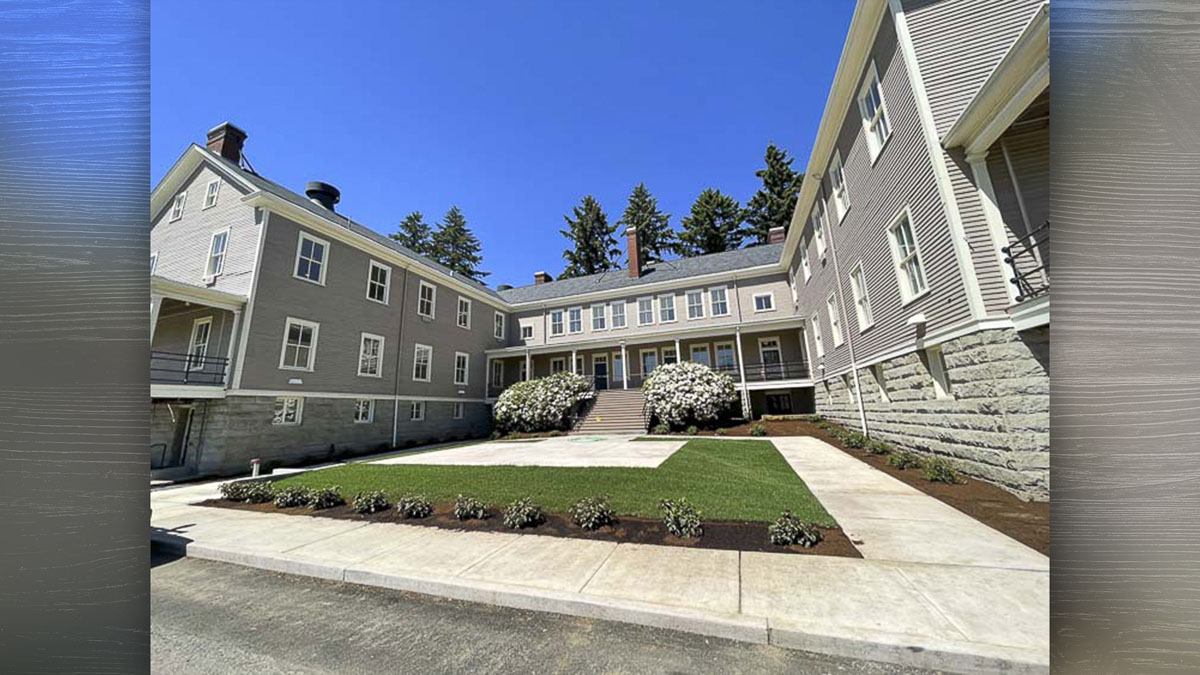
The project retained the building’s historic character while providing necessary upgrades and repairs to provide for continued public use and enjoyment of the structure and surrounding area
VANCOUVER. — A total of 175 years after the establishment of Vancouver Barracks, the National Park Service (NPS) is ensuring a new chapter of public service for the first U.S. Army post in the Pacific Northwest. The NPS has completed one of the most significant projects in this effort, rehabilitation of Building 993, one of the historic double infantry barracks lining the Parade Ground.
The project retained the building’s historic character while providing necessary upgrades and repairs to provide for continued public use and enjoyment of the structure and surrounding area. Two federal agencies — the Bureau of Indian Affairs and the U.S. Fish and Wildlife Service — are now using the building as an office.
“We are grateful for the Great American Outdoors Act funding that the park received to do this work on the Vancouver Barracks,” said Fort Vancouver National Historic Site Superintendent Tracy Fortmann. “The rehab project, which adapted and modernized this iconic 33,000 square-foot structure, focused on safety, accessibility and energy efficiency for continued use in the future.”
The building’s historic features have been preserved, including its covered porches, pressed tin ceilings, plaster walls, columns, wood floors, and historic windows and doors. The addition of an elevator inside and an upgraded parking area and pedestrian pathways improved accessibility. In addition, the approximately $16.5 million project reduced more than $15 million in deferred maintenance associated with Building 993 and related facilities.
Pacific Tech Construction, a Southwest Washington company, started the work in the fall of 2021. The project included seismic stabilization of the building and modernization of the water, sewer, electrical, telecommunications, and fire suppression systems.
This project is part of the park’s master plan to preserve the integrity of its historic structures while upgrading the park’s buildings for expanded use and public enjoyment.
“We are excited about our new satellite office at historic Fort Vancouver,” said Hugh Morrison, Pacific Regional Director for the U.S. Fish and Wildlife Service. “Having this location to pair with our regional office building in Portland will provide benefits to our staff, partners and the public. Being co-located with the Bureau of Indian Affairs, and in close proximity to National Park Service and Forest Service offices, will give us increased opportunities for face-to-face collaboration on important issues.”
The Bureau of Indian Affairs entered its 200th year of existence in 2024, and the agency’s continued presence at Fort Vancouver National Historic Site reaffirms the historical and indigenous connections that have existed in the area since time immemorial.
Sean Johnson, advisor to the director of the Bureau of Indian Affairs, said the Northwest Regional Office satellite office will “increase visibility, strengthen collaboration, and improve organizational effectiveness for BIA, and we are proud to join the National Park Service and to work alongside federal agencies to enhance and fulfill our mission in the 21st century.”
Two other BIA offices, the Office of Justice Services and the Office of Self-governance, have been onsite since 2019.
Building 993 was built in 1907 during a period of intense construction. Vancouver Barracks was considered the Pacific Northwest’s central military base in the early 20th century, and increasing numbers of troops arriving at the post required new living facilities. The double infantry barracks during this period were wood-frame, two-story buildings with basements on stone foundations, which could accommodate a total of 180 men.
The Great American Outdoors Act’s Legacy Restoration Fund is part of a concerted effort to address extensive maintenance and repair needs in national parks. Supported by revenue from energy development, it provides up to $1.3 billion per year for five years to make significant enhancements in national parks and other public lands to ensure their preservation and provide opportunities for recreation, education, and enjoyment for current and future visitors.
For more information, go to www.nps.gov.
Also read:
- POLL: Do you agree with requiring board members to follow council direction?
 Disagreement among county councilors centers on whether C-TRAN board members should reflect the council’s collective wishes or act independently, highlighting ongoing concerns about public accountability.
 - 18th District lawmakers to host town hall meeting on Saturday, March 28, in Battle Ground
 Stephanie McClintock and John Ley will meet with Battle Ground constituents to answer questions, review the new income tax, and discuss the effects of the $80 billion budget.
 - Opinion: In plain sight – yielding to pedestrians
 Drivers often fail to see pedestrians due to inattentional blindness, which highlights the need for more focused awareness at intersections and stronger safety practices.
 - NBA vote clears way for expansion to Seattle
 The NBA Board of Governors has voted to explore adding teams in Seattle and Las Vegas, moving Seattle closer than ever to hosting pro basketball again.
 - Opinion: The legislature has committed $2.4 billion to recurring pension increases since 2018
 Six legislative COLAs have raised public employer costs by $2.38 billion since 2018, driving up unfunded pension liabilities and increasing burdens on county and city budgets.
 - Opinion: ‘Just because they got away with it doesn’t mean they weren’t wrong’
 A Skamania County deputy’s report found violations of county rules and the Open Public Meetings Act, but no prosecutor acted on the findings.
 - More drama at Clark County Council in regard to its representatives on the C-TRAN Board
 Councilors debated whether C-TRAN board representatives must follow group mandates, with Michelle Belkot refusing to commit to new voting rules and Glen Yung opposing her nomination.
